
Cincinnati Radial Arm Drill Press: What It Is and What to Check
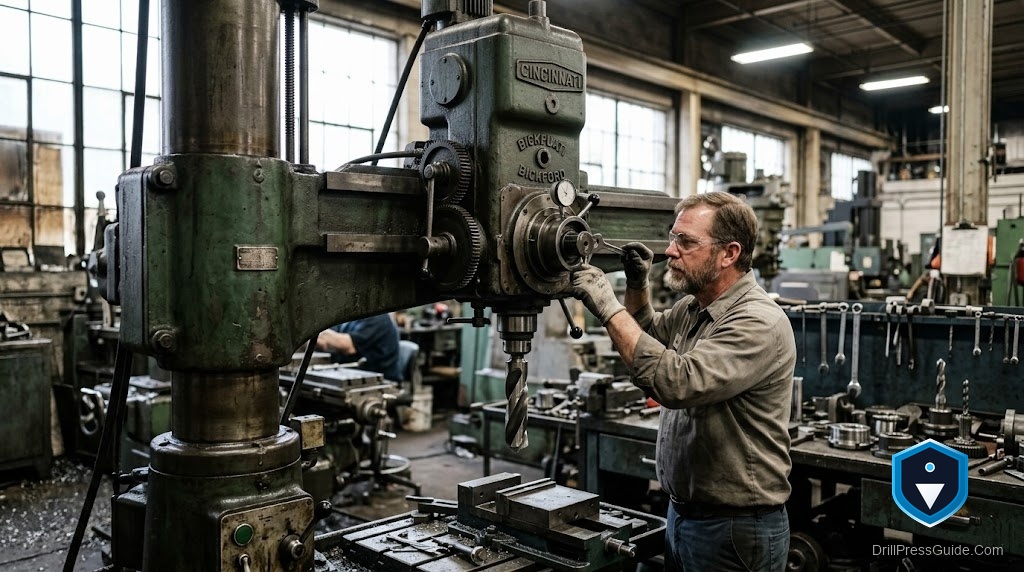
The name Cincinnati carries weight in machine tool circles. For much of the last century, machines wearing that name were fixtures in shops that drilled heavy steel for a living, and a Cincinnati radial arm drill press was the machine you reached for when the workpiece was too big and too heavy to move under an ordinary spindle. Many are still running. If one has crossed your path, to buy, to operate, or to restore, the payoff comes from knowing how a radial arm drill works and what to inspect on a machine that has likely seen decades of use.
A Cincinnati radial arm drill press is a large industrial drilling machine whose drill head slides along a horizontal arm that swings around and raises on a vertical column, letting the spindle reach anywhere over a big, stationary workpiece. Cincinnati was a major American machine tool maker, and these heavy radial drills were built for serious metalworking and fabrication.
Short answer: a radial arm drill brings the spindle to the work instead of the work to the spindle, which is what makes it right for large, heavy parts. On a Cincinnati specifically, inspect the spindle and bearings, the arm elevation and clamping, the head traverse and lock, and the general wear, because the machine’s value rests entirely on being mechanically sound.
The idea behind the radial arm
An ordinary drill press asks you to move the workpiece to line each hole up under a fixed spindle. That is impossible with a heavy casting or a large steel weldment. The radial arm design flips the problem: the head slides in and out along the arm, and the arm swings around the column and raises and lowers, so the operator moves the spindle to each hole while the heavy part stays put. That single capability is why radial drills like the Cincinnati exist and why they dominate work on large, heavy pieces that cannot be shuffled around between holes.
The systems that determine its health
A radial drill is a set of moving and clamping systems, and each one is worth checking. The arm has to raise and lower on the column smoothly, then clamp dead solid, because any give in that clamp lets the arm shift under drilling load and spoils the hole. The head must traverse the arm and lock firm. The spindle and bearings must run true, since runout signals costly wear. The column must let the arm swing and hold. On a machine that could be fifty years old or more, it is the state of these clamps, ways, and bearings, not the famous name, that decides whether you have a workhorse or a rebuild.
Inspecting a Cincinnati before committing
Check the spindle first: fit a test bar or a straight bit, rotate it, and watch for runout, since worn spindle bearings are the most expensive fault on any old drilling machine. Run the arm up and down its full travel, feeling for smoothness, then clamp it and try hard to move it; it must not shift. Traverse the head along the arm and lock it the same way. Swing the arm on the column and confirm it holds position. Look over the ways and column for deep scoring or heavy rust that would stop solid clamping. Verify the motor and any powered elevation and feed work. A Cincinnati that spins true and clamps rock solid is worth restoring; one loose and worn through the ways is a big project.
Operating and maintaining it safely
A radial drill is powerful, so respect it. Clamp the workpiece to the table or base every time, because a large bit can catch and spin heavy stock. Confirm the arm and head are locked before each hole, since an unclamped arm can move under load and is a real hazard. Match speed and feed to the bit and material, dropping into the low-speed range for big bits in steel, and keep the spindle and cutter guarded with the area clear. Lubricate the ways, column, and elevation mechanism as the machine specifies, because smooth, oiled ways are what keep an old radial drill both accurate and safe. Consistent attention to clamps and lubrication keeps these machines useful for generations.
Conclusion
A Cincinnati radial arm drill press is a heavy industrial machine built to move the spindle to large, stationary work, which is exactly what makes it valuable for parts too big to shift. The Cincinnati name is a good sign, but the machine in front of you is judged on its spindle and bearings, its arm elevation and clamps, its head traverse and lock, and the wear on its ways. Check the spindle for runout first, prove every clamp holds solid, and inspect the ways and motor before you commit. In use, clamp the work, lock the arm, and keep it lubricated, and a sound Cincinnati radial drill will bore accurate holes in heavy steel for many years yet.
Frequently asked questions
What is a Cincinnati radial arm drill press? A large industrial drilling machine whose head slides along a horizontal arm that swings and raises on a column, so the spindle can reach anywhere over a big, stationary workpiece.
Why choose a radial arm drill over a standard one? Because it brings the spindle to the work, which is essential for large, heavy parts you cannot practically move under a fixed spindle between holes.
Was Cincinnati a respected machine tool maker? Yes, Cincinnati was a major American machine tool builder. Even so, judge any specific radial drill by its mechanical condition, since these machines are usually decades old.
What should I inspect on a used one? Spindle runout first, then smooth arm elevation with a solid clamp, head traverse and lock, arm swing that holds position, and ways and column free of heavy wear.
Are these machines safe to run? Yes, with respect. Clamp the workpiece, lock the arm and head before drilling, match speed and feed to the job, and keep the spindle guarded. Their power demands care.
What maintenance keeps one accurate? Lubricating the ways, column, and elevation mechanism as specified, and keeping clamps and bearings sound. Smooth, well-oiled ways are the key to lasting accuracy.
References
- Vintage Machinery, Cincinnati machine tool histories and manuals, vintagemachinery.org
- OSHA, Machine Guarding eTool: Drill Presses, osha.gov


