
Carlton Radial Arm Drill Press: What It Is and What to Check
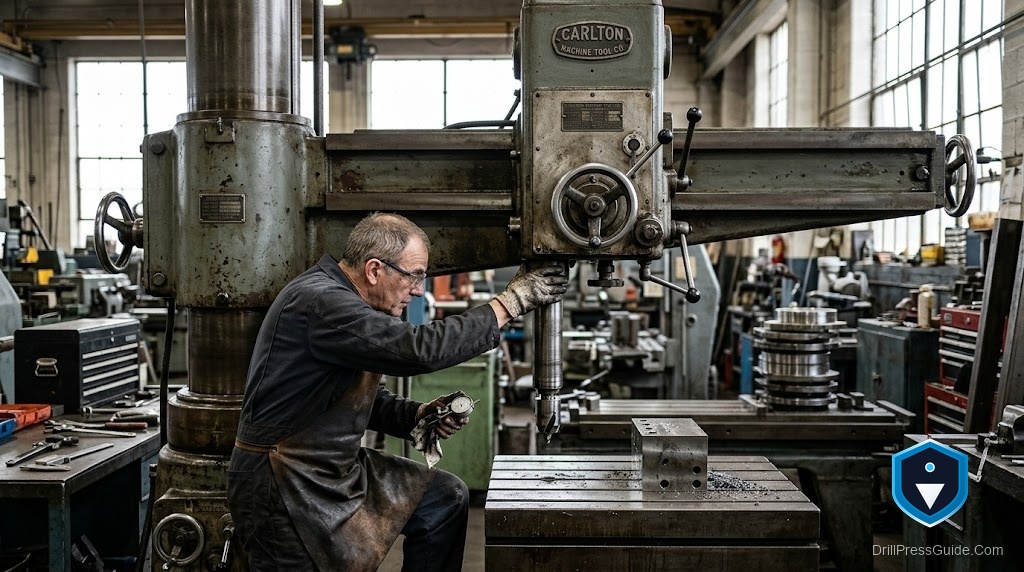
Walk through an old machine shop or a fabrication yard and you may find a Carlton radial arm drill press still earning its keep after decades. These are big, serious machines, the kind built when a drill press was expected to bore large holes in heavy steel all day. Carlton earned a strong name among them. Whether you are eyeing one to buy, tasked with running one, or restoring a survivor, the smart move is understanding what makes a radial arm drill different and what to inspect on a machine that may be very old.
A Carlton radial arm drill press is a large industrial drilling machine with a drill head that moves along a horizontal arm, which itself swings around and raises on a vertical column, so the spindle can be positioned over a large, heavy workpiece without moving the work. Carlton is a well-known maker of these heavy radial drills used in metalworking and fabrication.
Short answer: a radial arm drill exists to bring the spindle to the work rather than the work to the spindle, which is invaluable for large, heavy parts. On a Carlton specifically, check the arm elevation and clamping, the spindle and bearings, the head traverse, and the overall wear, because these are industrial machines whose value lies in being mechanically sound.
Why a radial arm design exists
On an ordinary drill press you slide the workpiece around to line up each hole under the fixed spindle. That is fine for small parts and impossible for a heavy casting or a large steel plate. A radial arm drill solves this by moving the spindle instead: the head slides in and out along the arm, the arm swings around the column and raises or lowers, so the operator positions the bit anywhere over a big, stationary workpiece. That is the entire reason these machines exist, and why they dominate work with large, heavy parts that you cannot practically move between holes.
The parts that define its condition
Several systems make a radial arm drill work, and each is a thing to check. The arm must raise and lower smoothly on the column and then clamp rock solid, because a weak clamp lets the arm shift under drilling load. The head must traverse along the arm and lock firmly in position. The spindle and its bearings must run true, since runout there ruins accuracy and points to expensive wear. The column must let the arm swing and then hold its position. On a machine that may be many decades old, the condition of these clamps, ways, and bearings, not the brand casting, is what determines whether it is a workhorse or a project.
Inspecting a Carlton before you commit
Start with the spindle: chuck or fit a test bar, turn it, and look for runout; worn spindle bearings are the costliest issue on any old drill. Raise and lower the arm through its travel, feeling for smoothness, then clamp it and try to move it, it should not budge. Traverse the head along the arm and lock it the same way. Swing the arm on the column and check that it holds. Inspect the ways and the column for scoring and heavy rust that would prevent solid clamping. Confirm the motor and any power elevation and feed systems work. A Carlton that clamps solidly and spins true is worth having; one with worn ways and loose clamps is a major rebuild.
Running and maintaining one safely
These are powerful machines, so treat them with respect. Always clamp the workpiece to the table or base, because a large bit can grab and spin heavy stock dangerously. Confirm the arm and head are locked before drilling each hole, since an unclamped arm can move under load. Match speed and feed to the bit size and material, using the machine’s back gear or speed range for large bits in steel, and keep the spindle and cutter guarded and the area clear. Lubricate the ways, column, and elevation mechanism as specified, since smooth, well-oiled ways are what keep an old radial drill accurate and safe. Regular attention to clamps and lubrication is what keeps these machines working for generations.
Conclusion
A Carlton radial arm drill press is a heavy industrial machine built around one idea: move the spindle to the work, so large and heavy parts can be drilled without shifting them. Carlton’s reputation is good, but on any specific machine the condition of the arm elevation and clamps, the head traverse, the spindle and bearings, and the ways is what matters, especially given these machines’ age. Inspect the spindle for runout first, confirm every clamp holds solid, and check the ways and motor before committing. Clamp the work, lock the arm, and keep it lubricated in use, and a sound Carlton radial drill will bore big holes accurately for decades more.
Frequently asked questions
What is a radial arm drill press? A drilling machine whose head moves along a horizontal arm that swings and raises on a column, so the spindle can be positioned over a large, stationary workpiece rather than moving the work.
Why use a radial arm drill instead of a regular one? Because it brings the spindle to the work, which is essential for large, heavy parts you cannot practically slide around under a fixed spindle between holes.
Is Carlton a good brand of radial drill? Carlton is a well-known maker of heavy industrial radial drills. That said, judge any specific machine by its mechanical condition, since these tools are often decades old.
What should I check when buying a used one? Spindle runout first, then that the arm raises smoothly and clamps solid, the head traverses and locks, the arm swings and holds, and the ways and column are free of heavy wear.
Are radial arm drills dangerous? They are powerful, so clamp the workpiece, lock the arm and head before drilling, match speed and feed to the job, and keep the spindle guarded. Respected properly, they are safe.
What maintenance do they need? Lubrication of the ways, column, and elevation mechanism as specified, plus keeping clamps and bearings in good order. Smooth, oiled ways are what keep an old radial drill accurate.
References
- Vintage Machinery, radial drill manufacturer histories and manuals, vintagemachinery.org
- OSHA, Machine Guarding eTool: Drill Presses, osha.gov


