
Craftsman Portable Drill Press Motor Replacement: What to Check Before You Buy
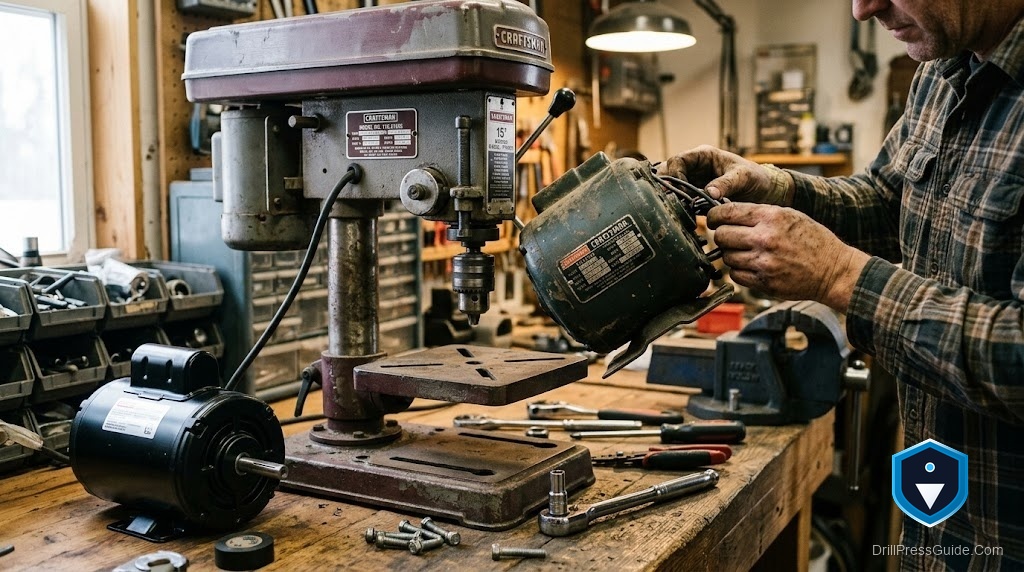
There is a particular disappointment in flipping the switch on a Craftsman press and hearing nothing, or hearing a strained hum that never turns into a spin. Before you commit to a Craftsman portable drill press motor replacement, it helps to know that these Sears-era machines came from several manufacturers, so the motor you need is defined by the numbers on your machine, not by the Craftsman name on the front.
The motor is the single-phase induction motor that spins the belt and pulleys to drive the spindle. A replacement has to match on power, speed, voltage, shaft size, and the way it bolts to the frame. On a compact Craftsman press those specs sit in a modest range, which makes the swap approachable once you have read the plate.
Short answer: find the model number (often starting with 113 or 137) and read the motor nameplate, then match roughly 1/2 HP, 1725 RPM, single-phase 120V, and the shaft diameter and mount you measured. A general-purpose 1/2 HP, 1725 RPM motor with a 5/8 inch shaft covers most of these machines, as long as your pulley bore matches the shaft.
Confirm the failure is the motor
Do not buy a motor for a problem the motor does not have:
- A hum with no spin usually means the start capacitor, not the windings. Spin the pulley by hand as you switch on; if it runs, replace the capacitor.
- Dead silence points to the switch, cord, or a tripped overload.
- A burning smell with a motor that will not turn, or windings that read open, is a genuine motor failure.
On Craftsman presses the capacitor is a frequent culprit and far less involved than a motor, so it is worth ruling out first.
Read the plate, then match five specs
- Horsepower, usually around 1/2 HP on a compact press.
- Speed, 1725 RPM. A 3450 RPM motor overspins every belt step.
- Voltage, almost always 120V single phase.
- Shaft diameter, so your existing pulley slides on. Many replacements use 5/8 inch; some older Craftsman motors used 1/2 inch.
- Mounting, the bolt pattern or band that secures the motor to the frame.
The motor and belt to use
For a Craftsman press that measures to standard specs, a 1/2 HP, 1725 RPM single-phase motor with a 5/8 inch shaft runs at the right speed and power on 120V. Since you will have the belt off anyway, a matching Craftsman drill press drive belt is worth fitting so a fresh motor is not driving a glazed belt.
The honest drawback of the motor: its 5/8 inch shaft means a pulley bored for 1/2 inch will not slide on, so confirm your pulley bore or plan to replace it. Who should skip it: anyone whose only fault is a bad capacitor, which is far simpler to replace than the whole motor.
Wiring and rotation
When the new motor is mounted, confirm it turns the correct direction for your pulley setup; most single-phase motors reverse by swapping two leads in the junction box, with the diagram on the nameplate. Keep the wiring tidy and clear of the belt path.
Match the machine, not the badge
A Craftsman portable drill press motor replacement is straightforward once you accept that the machine’s numbers, not the brand, define the part. Rule out the capacitor, read the nameplate, match power, speed, voltage, shaft, and mount, and refresh the belt while you are there.
Three takeaways:
- Test for a bad capacitor before buying a motor; it is the common culprit.
- Match 1725 RPM and the shaft diameter as carefully as horsepower.
- Confirm your Craftsman model number, since several makers built these presses.
FAQ
Why does my Craftsman drill press hum but not spin? Usually a failed start capacitor. Spin the pulley by hand as you switch on; if the motor then runs, replace the capacitor rather than the motor.
What size motor does a Craftsman portable drill press use? Compact models are typically around 1/2 HP, 1725 RPM, 120V single phase. Confirm on your motor nameplate before buying.
Will a 5/8 inch shaft motor fit my pulley? Only if the pulley bore is 5/8 inch. If your old shaft was 1/2 inch, you will also need a pulley bored to match the new shaft.
Where is my Craftsman model number? On the label or motor plate, often starting with 113 or 137. It identifies the maker and the correct parts.
Can I reverse the motor direction? Most single-phase motors reverse by swapping two leads in the junction box. Check the nameplate diagram.
Should I replace the belt with the motor? Yes, if the belt is glazed or cracked. A new motor driving a worn belt will still slip.
Is it worth replacing the motor on an old Craftsman press? Yes if the spindle and quill are tight. If the whole machine is worn, put the money toward a newer press.
References
- Sears PartsDirect, Craftsman drill press parts and model lookup: https://www.searspartsdirect.com
- Grizzly Industrial, 1/2 HP single-phase 1725 RPM replacement motor specifications: https://www.grizzly.com/products/grizzly-motor-1-2-hp-single-phase-1725-rpm-odp-110v-220v-for-g4008-09/h5373


