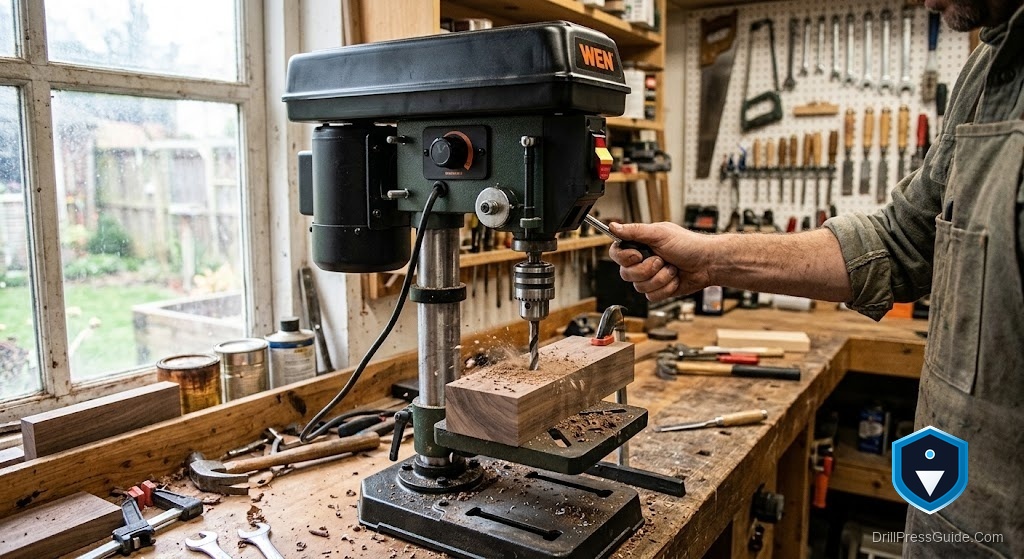
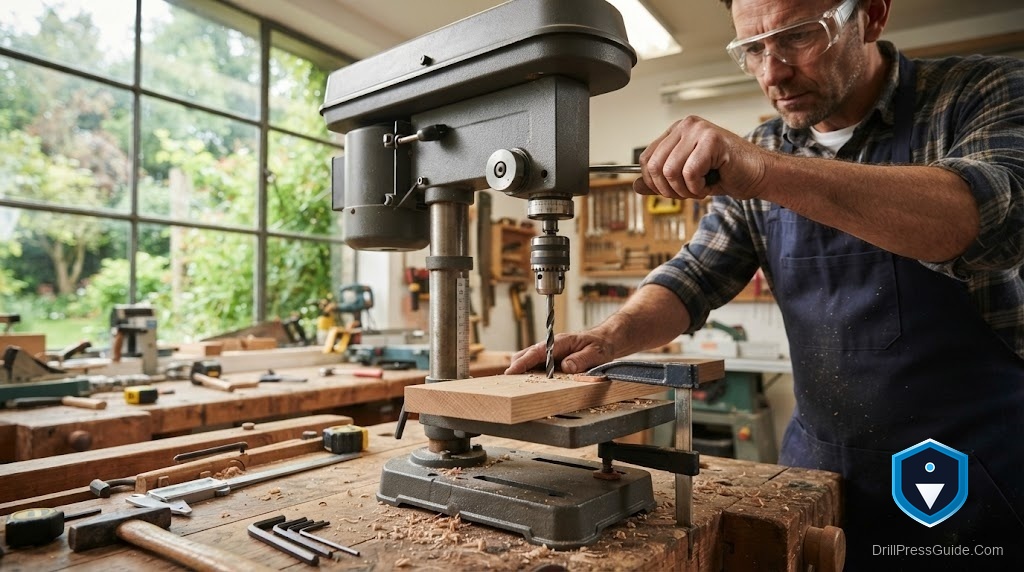
Planning a DIY Drill Press Stand for Hand Drill: What the Drawings Need to Show
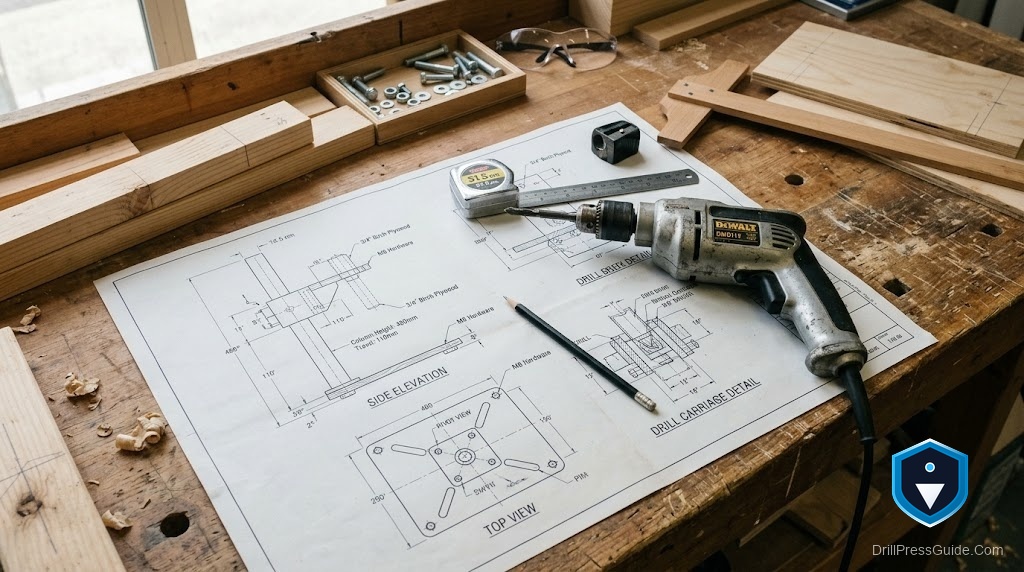
A drill press stand for a hand drill turns your cordless or corded drill into something that plunges straight down, giving much of a drill press’s best trick, square holes, without buying a machine. It is a popular build, but the difference between a stand that drills accurately and one that wanders comes down to details the drawings must show. A hand-drill stand is fundamentally about rigidity and true vertical travel, so before you build, it helps to know exactly what a good plan needs to include.
A DIY drill press stand for a hand drill is a shop-built stand that clamps a handheld drill and feeds it straight down into the work, replicating a drill press’s perpendicular plunge. Useful drawings need to show how the drill is held securely, how it travels straight down without play, how the table is flat and square to the drill axis, and how the work is clamped.
Short answer: the drawings need to show a secure drill holder, a straight play-free vertical slide with a return spring and feed handle, a flat table square to the drill axis, and a way to clamp the workpiece, all on a rigid structure. Because it is built around a handheld drill, the drawings should also make its honest limits clear: light woodworking and hobby work, not heavy or metal drilling.
Show how the drill is held securely
The drawings must first show how the specific hand drill is clamped, because the whole stand is built around gripping it solidly. A good plan shows a holder that clamps a solid, cylindrical part of the drill body, often the collar behind the chuck, firmly enough that the drill cannot rotate, slip, or tilt, without covering the vents or gripping anything that flexes. The plan should show the holder sized to a typical drill and how it fastens to the slide. Drawings that clearly show a secure drill mount let you build a stand that holds the drill steady; vague ones leave the most failure-prone part, the grip on the drill, to guesswork.
Show straight, play-free vertical travel
The defining feature is how the drill travels straight down, so the drawings must show the vertical slide clearly. A good plan shows a play-free guide, linear rails, a close-fitting sliding column, or a similar mechanism, that lets the drill move only up and down, exactly perpendicular to the table, with no side play. It should show a return spring so the drill lifts when released and a feed handle or lever for controlled downward travel. Critically, the drawings should make clear how side play is eliminated, since any looseness lets the bit wander and defeats the purpose. Drawings that show a true, play-free vertical slide are what make the stand drill straight rather than merely straight-ish.
Show a flat table square to the drill axis
The drawings need to show a flat table below the drill, set square to the drill’s axis so holes come out perpendicular to the work. A good plan shows how the table is made flat, how it attaches, and, importantly, how it can be checked and adjusted or shimmed square to the axis, since a table that is not square drills angled holes no matter how good the slide is. The plan should also show a way to clamp the workpiece, a fence and clamps or hold-downs, because a handheld drill can grab and spin the work. Drawings that show a flat, adjustable, square table with work clamping cover both accuracy and safety.
Show rigidity and state the limits
Finally, the drawings need to convey rigidity and honesty about limits. A good plan shows a heavy, stable base and a stiff structure that will not flex under feed pressure, because a hand-drill stand is only as accurate as it is rigid, and flex becomes angled holes. The drawings, or the accompanying notes, should also make clear what the tool is for: light woodworking, hobby work, and small bits, not heavy or metal drilling that needs a real machine’s rigidity and low runout. Drawings that show a genuinely rigid structure and set honest expectations produce a stand that is useful and safe within its role, rather than one that disappoints when pushed too far.
Conclusion
Planning a DIY drill press stand for a hand drill is about making sure the drawings show what actually determines success: a secure drill holder, a straight play-free vertical slide with a return spring and feed handle, a flat table that can be set square to the drill axis, a way to clamp the work, and a genuinely rigid structure, along with honest limits. A stand that holds the drill loosely, wanders on a sloppy slide, or flexes under feed produces holes no better than freehand. Insist on drawings that show secure holding, true vertical travel, a square table, and rigidity, and you can build a hand-drill stand that gives far straighter, steadier holes than drilling by hand.
Frequently asked questions
What should a hand-drill stand plan show? A secure drill holder, a straight play-free vertical slide with a return spring and feed handle, a flat table that can be set square to the drill axis, a way to clamp the work, and a rigid structure.
How should the drill be held? By a holder that clamps a solid, cylindrical part of the drill body firmly, so it cannot rotate, slip, or tilt, without covering the vents or gripping anything that flexes.
Why does the vertical slide matter so much? Because it determines whether the drill travels exactly straight down. A play-free guide, linear rails or a close-fitting column, keeps the bit from wandering; any side play defeats the purpose.
How is the table kept square? The plan should show a flat table that can be checked and adjusted or shimmed square to the drill’s axis, since a table that is not square drills angled holes no matter how good the slide.
Do I need to clamp the work? Yes. A handheld drill can grab and spin the workpiece, so the plan should show a fence and clamps or hold-downs. This is both an accuracy and a safety necessity.
What are the limits of a hand-drill stand? Light woodworking, hobby work, and small bits. It will not match a real drill press for rigidity, runout, or heavy and metal drilling, and the drawings should set that expectation.
References
- OSHA, portable power tool and machine guarding guidance, osha.gov
- Forest Products Laboratory, wood machining references, fpl.fs.usda.gov