Choosing and Using a Drill Press Portable Attachable
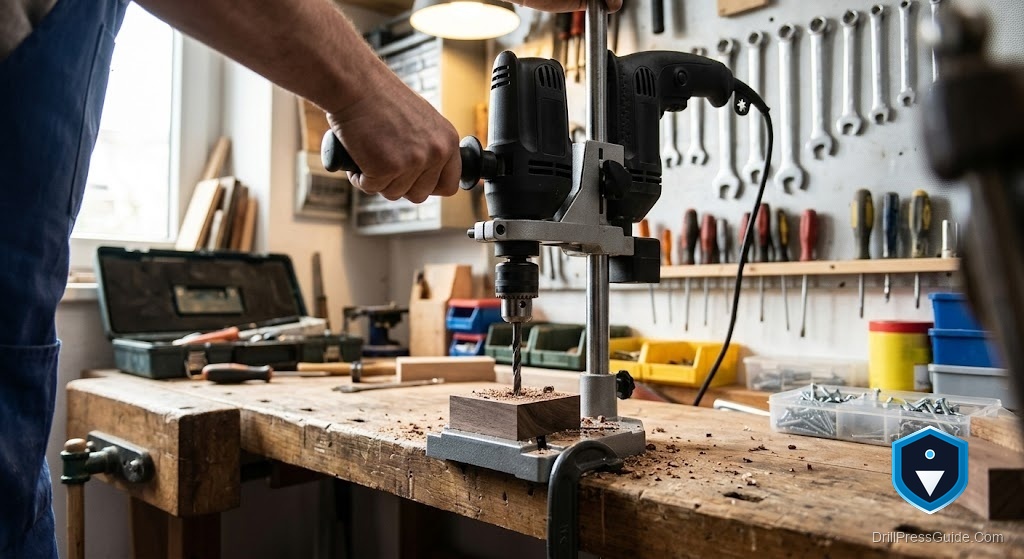
The phrase sounds a little clunky, but the idea behind a “drill press portable attachable” is simple and genuinely useful: a device you attach your own drill to that gives you portable drill-press function. It is the answer for anyone who wants straight, controlled holes but does not want, or does not have room for, a stationary machine bolted to a bench. If you have wondered whether one of these attachable stands can really replace a drill press for your work, the honest answer depends entirely on what your work is.
A portable attachable drill press is a stand or guide that attaches to a handheld drill and controls its plunge so the bit enters straight, or at a set angle, with repeatable depth. It supplies the guidance, the lever feed, and the depth stop, while the drill you attach supplies the power. It is portable because it is small and carryable, and attachable because it works with a drill you already own.
Short answer: an attachable portable press is the right tool for guided accuracy without a fixed machine, best for wood, light metal, angled holes, and drilling where you cannot bring the work to a bench. Pick one that fits your drill securely, is built of metal rather than mostly plastic, and offers the angle range and depth control you need. For heavy, repeated metal drilling, a real drill press still wins.
What “attachable” really means for accuracy
Everything about these tools comes down to how securely the drill attaches. Some accept the drill into their own chuck, some clamp a standard collar, and some grip the drill body. Whichever the method, the connection has to be rock solid, because any play where the drill meets the stand becomes a crooked or oversized hole. So when you evaluate one of these, the attachment mechanism is the first thing to judge, ahead of angle features or looks. A guide that holds the drill with no wobble will out-drill a fancier one that lets the drill shift.
Where it fits, and where it does not
An attachable portable press fits beautifully into a few situations: a small shop with no room for a stationary machine, a job site where holes need drilling in place, angled holes a fixed press struggles with, and light, varied drilling in wood, plastic, and thin metal. It does not fit heavy production or thick-steel drilling, where the lighter frame flexes and the handheld drill lacks the sustained torque of a dedicated motor. Knowing this split saves disappointment: buy it to extend a drill’s precision and reach, not to replace an industrial machine.
Options and the tradeoffs between them
The Milescraft 1318 DrillMate is the widely used general-purpose choice, attaching your drill via its own 3/8-inch chuck, adjusting between straight and angled holes, and self-centering on round and flat stock. Its trade is a part-plastic build best kept to light and occasional work.
Step up for heavier or more frequent use and the Milescraft 1348 DrillMate PRO is all metal, takes a 1/2-inch chuck for bigger bits, and offers infinite angles from 0 to 60 degrees with a dual-spring feed that holds accuracy better. If you would rather clamp your existing drill than rechuck a bit, the CertBuy portable drill press stand uses a light aluminum-alloy frame and multi-angle adjustment to hold a handheld drill directly. The honest tradeoff runs from lightest and simplest, the DrillMate, to sturdiest and highest-capacity, the PRO, with the clamp-style CertBuy sitting in between for people who want to keep using their drill without removing the chuck.
Setting it up for clean results
Attach the drill fully and confirm zero play before you do anything else. Set your angle and check it against the workpiece, using the centering grooves or pins to align the bit on your mark. Dial in the depth stop for repeatable holes. Steady or clamp the base so it cannot shift, match speed and torque to the material, and feed the lever down slowly, letting the spring control the return. Patience on the plunge and a solid attachment are the whole game; get those right and the holes come out looking machined.
Conclusion
A drill press portable attachable is a smart way to get guided, repeatable holes from a drill you already own, without surrendering bench space to a stationary machine. Its accuracy lives or dies on how securely the drill attaches, so judge that first, then favor metal build, useful angles, and a real depth stop. The Milescraft DrillMate suits light general work, the DrillMate PRO handles heavier drilling and bigger bits, and the CertBuy stand fits those who prefer to clamp their drill directly. Use it for wood, light metal, and angled or on-site holes, respect its limits on heavy steel, and it becomes one of the most useful small tools in the shop.
Frequently asked questions
What is a portable attachable drill press? A stand or guide that attaches to a handheld drill and controls its plunge for straight or angled holes with a depth stop. The drill supplies power; the device supplies guidance and repeatability.
How does the drill attach to it? Depending on the model, the drill seats in the device’s own chuck, clamps by a standard collar, or is gripped by the body. A rock-solid connection is essential for straight holes.
Can it fully replace a drill press? For wood, light metal, and portable or angled work, largely yes. For heavy, repeated drilling in thick steel, a stationary drill press remains better because it is more rigid and powerful.
Which model takes larger bits? The Milescraft DrillMate PRO with its 1/2-inch chuck handles larger bits than the standard DrillMate’s 3/8-inch chuck, and it is all metal for heavier use.
Do these drill angled holes? Yes. Most adjust for angled drilling, and the DrillMate PRO offers infinite angles from 0 to 60 degrees, which is a key advantage over a fixed machine.
Why is my hole oversized or crooked? Usually there is play where the drill attaches, or the base shifted during the plunge. Confirm the drill is locked with no wobble and steady or clamp the base before drilling.
References
- Milescraft, DrillMate product documentation, milescraft.com
- OSHA, portable power tool safety guidance, osha.gov