
Portable Drill Press for Cordless Drill: A Practical Guide for the Workshop
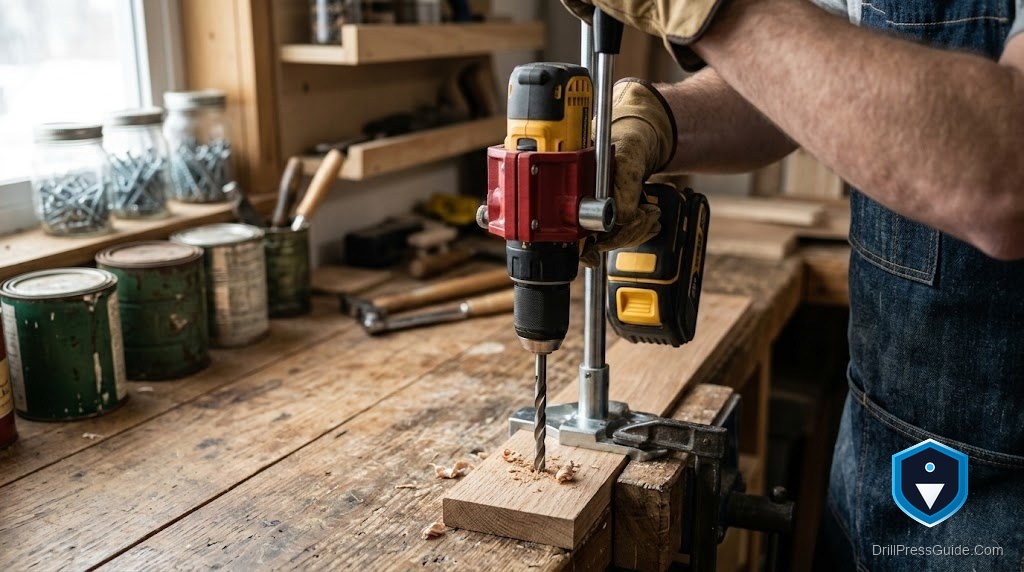
Cordless drills have gotten so good that many people no longer own a corded one, let alone a stationary drill press. So the question comes up a lot: can you get drill-press accuracy out of the cordless drill you already have, without buying a whole machine? The answer is yes, with a portable drill press stand, and it is one of the smartest small buys for a shop tight on space or a job that moves around. The trick is knowing what these stands do well and where they quietly fall short.
A portable drill press for a cordless drill is a stand or guide that clamps your cordless drill and feeds it straight down into the work with a lever and a depth stop, turning the handheld tool into a small, guided drilling machine. Your drill’s own motor and battery do the drilling; the stand supplies the alignment, the controlled plunge, and the repeatability.
Short answer: a portable stand is the right call when you want straight, repeatable holes from a cordless drill without the footprint or fixed location of a bench press. Choose one that actually fits your drill’s collar or handle, has a solid metal build, and offers the angles and depth control you need. It will not match a full drill press for heavy metal work, and that is the honest tradeoff.
Why pair a stand with a cordless drill
The appeal is obvious once you use one. You keep the tool you already own and charge, you gain straightness and a depth stop, and you get a machine you can pick up and carry to the work instead of carrying the work to the machine. For woodworking, light metal, plastic, and on-site tasks, that combination covers a surprising amount of ground. The catch is that a cordless drill plus a stand is lighter and less rigid than a dedicated press, so for repeated drilling in thick steel it will bog and flex where a real machine would not. Match the tool to the job and it shines; overload it and its limits show.
Fit and build are what make or break it
The single biggest mistake is buying a stand that does not properly fit the drill. Many stands clamp a standard 43mm collar found on some drills, while others grip the body or handle. Before buying, check how the stand secures a drill and whether yours matches, because a drill that is not held solidly will drill crooked no matter how good the stand is. After fit, look at build: an aluminum-alloy or steel frame holds alignment far better than a flimsy one, and a smooth rack-and-pinion or spring-guided plunge beats a sloppy slide. A depth stop and centering grooves round out the features that actually matter day to day.
Options worth considering
The CertBuy portable drill press for hand drills is an aluminum-alloy stand that is light and genuinely portable, adjusts for multiple angles, and is built to hold a handheld drill for straight or angled holes. It is a good match for a shop that wants something to carry to the job, with the honest limit that a light stand needs a firm, clamped base to stay accurate.
If you want a more guide-style tool with a proper chuck rather than a clamp, the SpeTool S04001 portable drill guide uses liner ball-bearing guide poles and a 1/2-inch chuck, adjusts from 0 to 60 degrees, and is aimed at straight, precise holes. And for the widest fit and lightest footprint, the Milescraft 1318 DrillMate accepts your drill into its own 3/8-inch chuck and centers easily on round and flat stock. The tradeoff among them is capacity versus portability: the chuck-style guides take bigger bits and hold angles well, while the clamp-style stands are quickest to drop your existing drill into.
Getting accurate holes
Clamp or hold the base firmly, because a moving base is the top cause of a bad hole. Seat the drill fully and lock it with no play. Center the bit on your mark using the V-grooves or centering pins, set the depth stop for repeat holes, and match the drill’s speed and torque to the material, slower for metal, faster for wood. Feed the lever down slowly and evenly and let the return spring bring it back. Treat a cordless stand as a precision aid that rewards patience, and it will give you holes a freehand drill never could.
Conclusion
A portable drill press for a cordless drill turns a tool you already own into a small, guided machine you can carry anywhere, and for wood, light metal, and on-site work that is a genuinely useful upgrade. Fit and build decide everything: make sure the stand truly holds your drill, choose metal over flimsy, and get a depth stop and centering grooves. The CertBuy stand suits carry-anywhere use, the SpeTool guide adds a real chuck and bigger bit capacity, and the Milescraft DrillMate offers the widest, lightest fit. Respect its limits on heavy steel, feed it slowly, and it delivers drill-press straightness without the drill press.
Frequently asked questions
Can I turn my cordless drill into a drill press? Yes. A portable drill press stand or guide holds your cordless drill and feeds it straight down with a depth stop, giving you guided, repeatable holes. Your drill supplies the power.
Will a portable stand fit any cordless drill? Not automatically. Some stands clamp a 43mm collar, others grip the body or use their own chuck. Check how the stand secures a drill and confirm yours matches before buying.
Is it as good as a real drill press? For wood, light metal, and portability, it is close. For heavy, repeated drilling in thick steel it will flex and bog, because it is lighter and less rigid than a stationary machine.
Does the cordless battery last long enough? For typical hole counts, yes. Match the drill’s torque and speed to the material and keep a charged spare battery for bigger jobs.
What features matter most? A solid metal frame, a fit that truly holds your drill, a smooth guided plunge, a depth stop, and centering grooves or pins for lining up on the mark.
Why do my holes come out crooked? Usually the base moved, the drill was not seated tightly, or the plunge was rushed. Clamp the base, lock the drill firmly, and feed slowly and evenly.
References
- OSHA, portable power tool safety guidance, osha.gov
- Milescraft, portable drill guide documentation, milescraft.com


