Portable Drill Press for Metal: Match the Bit, Speed, and Support to the Job
A bench or floor drill press assumes the work comes to the machine. A lot of metal work does not cooperate: a beam already bolted in place, a large plate too heavy to lift onto a table, a hole in a structure you cannot move. That is the gap a portable drill press fills. The most capable version for metal is the magnetic drill, which clamps itself to the steel and brings the machine to the work.
Quick answer: for portable metal drilling, a magnetic drill press grips ferrous steel with an electromagnet and drills large, accurate holes on-site. Match it with the right cutter, a slow steady speed, and cutting fluid, and it handles holes a hand drill cannot.
How a magnetic drill changes the job
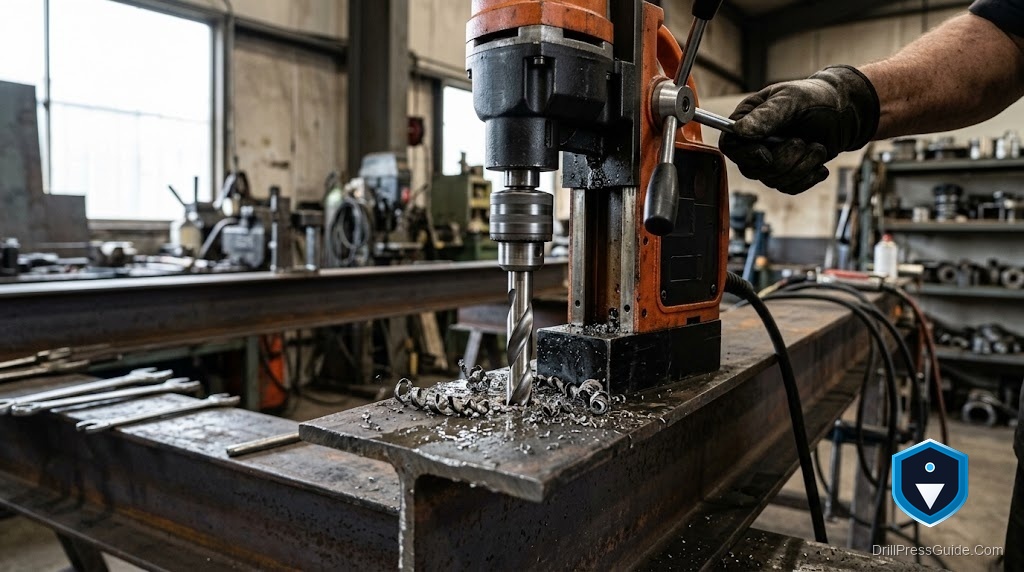
A magnetic drill uses a powerful electromagnet in its base to lock onto steel, then feeds a cutter down through the work like a small drill press. Because it is clamped to the workpiece itself, it stays rigid and square even on a vertical beam or an overhead flange. That rigidity is what lets a portable machine drill clean, large holes in structural steel where a handheld drill would wander and grab. A machine like this portable magnetic drill press clamps to the steel and drives an annular cutter through plate and beam on-site.
Annular cutters, not twist bits
Magnetic drills usually run annular cutters rather than twist bits. An annular cutter cuts only the ring of material around the hole and leaves a solid slug, so it removes far less metal and cuts large holes faster and with less force than a twist bit that has to chew the entire diameter. This is why a portable machine can make big holes that would stall a hand drill. Twist bits work too with an adapter, but annular cutters are what make the magnetic drill efficient.
Speed and fluid still apply
Portable does not mean the metal rules change. Larger cutters need slow speeds, and steel needs cutting fluid to carry heat and flush chips. Many magnetic drills have a built-in coolant feed for exactly this reason. Run the cutter at the low speed its diameter calls for, keep fluid flowing, and feed steadily. The physics of cutting steel is the same on a beam as on a bench; only the mounting has changed.
Support and safety on-site
The magnet is the support, and it has to be trusted. Clean the steel surface so the magnet seats fully, because paint, rust, or a gap weakens its grip. Use the safety strap most machines include, especially when drilling vertically or overhead, so the machine cannot fall if power drops. Never rely on the magnet on thin or non-flat steel where it cannot get full contact. On-site, the magnet’s grip is your workholding and your safety line at once.
The verdict
A portable magnetic drill brings real drill-press capability to work that cannot move:
- Use a magnetic drill for large, accurate holes in structural steel on-site.
- Run annular cutters for efficient large holes, at slow speeds with cutting fluid.
- Seat the magnet on clean, flat steel and use the safety strap for vertical or overhead work.
Who does not need one? Anyone whose metal fits on a bench press. The magnetic drill earns its keep the moment the work is too big, too heavy, or already fixed in place.
Frequently asked questions
What makes a magnetic drill hold on? A powerful electromagnet in the base grips ferrous steel. Clean, flat, thick enough steel gives full grip; paint, rust, or thin material weakens it.
Why annular cutters instead of twist bits? Annular cutters remove only a ring of metal and leave a slug, so they cut large holes faster and with less force than a twist bit chewing the whole diameter.
Can a magnetic drill work on a vertical surface? Yes, that is a main reason to own one. Use the safety strap and make sure the magnet seats fully on clean steel before drilling.
Does it need cutting fluid? Yes. Steel still needs fluid to cool the cutter and clear chips. Many magnetic drills have a built-in coolant feed for this.
Will it hold on aluminum or stainless? The magnet only grips ferrous steel. Non-magnetic metals need mechanical clamping instead, which limits the portable magnetic approach.
How thick must the steel be? Thick enough for the magnet to develop full holding force, generally around a quarter inch or more. Thin steel needs a backing plate or another method.
References
- CCOHS, Metalworking Machines - Drill Presses: https://www.ccohs.ca/oshanswers/safety_haz/metalworking/drillpresses.html
- Dynabrade HSS Drill Speed Recommendation Chart: https://www.dynabrade.com/pdf/lit/D1201_Singles/D12.01_pg134.pdf
- Delta 17-900 Instruction Manual: https://powertool.manualsonline.com/manuals/mfg/delta/17900.html