Is the 1/3 HP Craftsman Drill Press Right for Your Shop?
The 1/3 HP Craftsman drill press is one of the most debated tools on the used market. People defend it because they grew up using one, and people dismiss it because the horsepower sounds low. Both groups are partly right. The 1/3 HP machines, specifically the Emerson-built 113-prefix models like the 113.213850, are genuinely well-made tools that do exactly what a woodworking shop needs, as long as you understand what a 1/3 HP motor actually means for day-to-day drilling. Here is the honest answer about whether one is right for your shop.
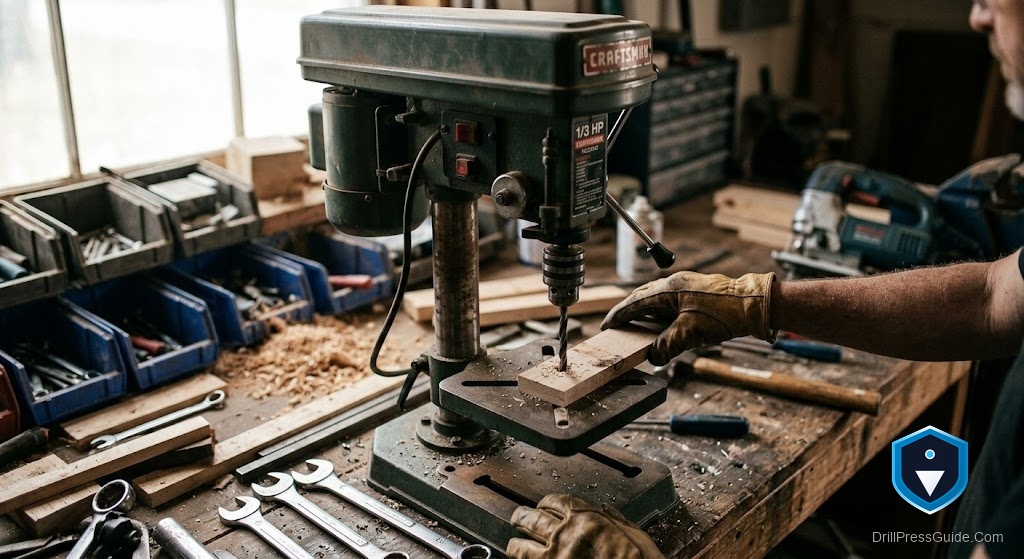
The 1/3 HP Craftsman drill press refers primarily to the Emerson Electric-built 113-prefix machines sold by Sears under the Craftsman name, including the 113.213850 and related benchtop and floor models, featuring a 1/3-HP split-phase induction motor at 115V, belt-driven stepped speeds, cast-iron construction throughout, a 1/2-inch keyed chuck, and a torsion spring quill return, with parts supported through Sears PartsDirect by model and type number.
Short answer: yes, the 1/3 HP Craftsman is right for your shop if you drill wood, plastic, and occasional thin metal with bits up to 1 inch and you do not need variable speed. It is not right if you regularly drill large bits in hardwood or metal, need variable speed, or want a warranty. Here is how the machine works and how to decide.
What 1/3 HP means in practice
Horsepower on a drill press governs torque and the ability to maintain speed under load. A 1/3-HP induction motor:
- Handles bits up to about 1 inch in softwood and 5/8 inch in hardwood without bogging.
- Maintains speed on small-to-medium bits in wood and plastic with no issue.
- Bogs on large bits in dense material (large Forstner bits in maple, for example, at higher speeds).
- Is not a metalworking motor. Small bits in aluminum and thin steel are fine; anything more is working against the motor’s rating.
For a woodworking shop drilling shelving pin holes, mortise center holes, dowel holes, and general furniture joinery, 1/3 HP is enough motor. For a production shop or regular heavy drilling, it is not.
The 113.213850 and related models
The 113.213850 is one of the most common 1/3 HP Craftsman benchtop presses. What it has:
- 1/3-HP split-phase induction motor at 115V, single-phase.
- Belt-driven speeds: typically 5 positions via a stepped pulley.
- Full cast-iron construction: head, column, table, and base.
- 1/2-inch keyed chuck on a standard taper.
- Torsion spring quill return.
- Rack-and-pinion table height adjustment (floor models).
- Spindle assembly with taper pin for chuck retention.
Other 113-prefix models (113.213100, 113.21340, 113.213850T, and others) share this basic architecture with minor variations in table size, motor mount, or speed count.
The components worth knowing
- V-belt: the most common wear item. Replace with a correctly sized belt from Sears PartsDirect by model number.
- Torsion spring and spring cap: the quill return mechanism. A dropped quill means a worn or broken spring. Springs are available by model number.
- Ball bearings (spindle): long-lived in cast-iron construction; replace if runout develops and reseating the chuck does not fix it.
- Chuck: a standard Jacobs-pattern taper chuck. Replacement 1/2-inch chucks on JT33 taper are widely available.
- Center pulley, motor pulley, spindle pulley: the three-pulley speed system. These rarely fail but are available by model if needed.
- Locking switch: some models have a key lock; replacements are available by voltage and amperage rating.
- Retaining ring: secures the spindle assembly; tiny and easy to lose during service.
- Bed lock and table bracket: the table tilt and lock mechanism.
Setting it up
- Replace the belt if it is original.
- Reseat or replace the chuck if there is runout.
- Check the torsion spring; if the quill droops, replace it.
- Square the table two directions with a rod and square.
- Lubricate the quill sleeve, table rack, and sliding surfaces with light machine oil.
- Set the depth stop for repeatable holes.
Who should skip it
- You need variable speed. The 113-prefix Craftsman is belt-change only.
- You need a warranty. These machines are long out of production.
- You regularly drill large bits in hardwood or metal. The 1/3 HP motor is not the right choice.
- You want modern features (laser, LED, digital readout). This is a 1950s-era machine.
In those cases, the variable-speed WEN 4212T 10-inch is the better choice for a modern benchtop press with a two-year warranty.
How it compares
Against a current WEN 4208T 8-inch 5-speed, the 113 Craftsman trades the WEN’s LED work light, laser, and two-year warranty for cast-iron mass, a 1/2-inch chuck, and simple repairability. Against a newer 137-prefix Craftsman 15-inch, it trades 12 speeds and a work light for older Emerson build quality. Against a Delta Milwaukee DP220, the comparison is very close in class and repairability; choose by condition and price.
Our 1950s Craftsman drill press guide covers the full setup and service flow for these machines.
The verdict
The 1/3 HP Craftsman drill press is right for your shop if you do general woodworking and light metal drilling, value cast-iron construction and simple repairability over modern features, and are comfortable sourcing parts through Sears PartsDirect by model number. The 113.213850 and related 113-prefix machines are genuinely good tools built to last. Their 1/3-HP motor is not a limitation for most woodworking; it is simply the right size for the job. If you need variable speed, a warranty, or more power, step to a modern press. If you need a well-built, repairable, cast-iron woodworking drill press and can find a clean one, the 1/3 HP Craftsman earns its place in the shop.
Frequently asked questions
What is a 1/3 HP Craftsman drill press? Primarily the Emerson-built 113-prefix machines sold under the Craftsman name, including the 113.213850 and related models, with a 1/3-HP induction motor, belt-driven stepped speeds, and full cast-iron construction.
Is 1/3 HP enough for a drill press? For woodworking with bits up to 1 inch in softwood and occasional metal drilling, yes. For large bits in hardwood, heavy metalwork, or production drilling, a 1/2 HP or larger motor is better suited.
What model is the 1/3 HP Craftsman drill press? Common models include 113.213850, 113.213100, 113.21340, and other 113-prefix machines. All share the Emerson-built architecture with a 1/3-HP motor and belt drive.
How do I find parts for a 1/3 HP Craftsman drill press? Use the full model number and type number from the ID plate at Sears PartsDirect (searspartsdirect.com). VintageMachinery.org provides additional documentation. Generic V-belts, Jacobs-taper replacement chucks, and torsion springs cover most consumable needs.
What speeds does the 1/3 HP Craftsman drill press have? Typically 5 belt-driven stepped speeds. The exact RPM range depends on the specific model; check the speed chart in the manual available on VintageMachinery.org.
Can the 1/3 HP Craftsman drill press drill metal? For thin metal with small bits at the slowest speed, yes. Center punch carefully and use cutting fluid on steel. It is not a metalworking machine; the 1/3-HP motor is designed for woodworking.
What is the swing of the 1/3 HP Craftsman drill press? The spindle-centerline distance varies by model. Most 113-prefix benchtop Craftsman presses are in the 8-to-12-inch swing range; check the full model number for exact specifications.
References
- Sears PartsDirect, Craftsman 113-prefix drill press parts and manuals: https://www.searspartsdirect.com
- VintageMachinery.org, Craftsman and Emerson drill press documentation and photo index: https://vintagemachinery.org
- eReplacementParts, Craftsman drill press parts by model: https://www.ereplacementparts.com