
Craftsman Drill Press Slow Speed Attachment: What Are Your Options?
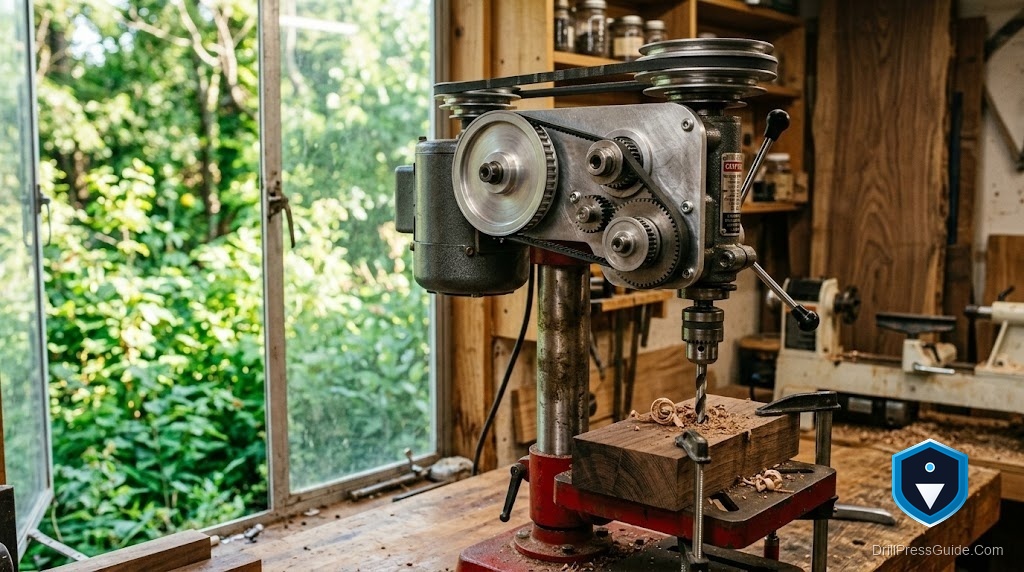
You put a big hole saw or a large twist bit in an old Craftsman drill press, pull the trigger, and the bit screams, smokes, and skates across the metal instead of cutting it. The press is running too fast, and no amount of pressure fixes that. What you want is a way to slow the spindle down, and if you have searched for a “Craftsman drill press slow speed attachment,” you have probably found more confusion than answers. Let me clear it up, because the honest picture is different from what the phrase suggests.
A slow speed attachment for a drill press is any add-on that lowers the spindle speed below what the machine’s standard pulleys allow, so large bits, hole saws, and metalwork can cut at a safe, effective rate. On most Craftsman presses that means changing the pulley ratio, adding a third pulley on a jackshaft, or driving the motor with an electronic speed control, rather than bolting on a single branded part.
Here is the direct answer many people do not want to hear: Craftsman did not sell a universal “slow speed attachment” that clicks onto every press. Slowing a Craftsman drill press is a setup you create, and there are three proven ways to do it. Two are cheap and mechanical, and one is electronic. All of them work.
Why you even want slower speeds
Speed is about the cutting edge, not the motor. A tiny bit has a small edge that can spin fast, but a large bit or a hole saw has a much bigger circumference, so at the same spindle speed its edge is racing far faster and generating heat. Too much heat dulls the bit, burns wood, and work-hardens metal so it stops cutting. Slower speeds keep the edge in its happy range, which is why steel and big holes call for the lowest speed you have, and often lower than a standard press offers.
Option one: change the pulley ratio
The simplest fix costs the least. Your press changes speed by moving the belt between steps on the motor pulley and the spindle pulley. To go slower than the lowest step, fit a smaller pulley on the motor or a larger one on the spindle, or both. This keeps the motor spinning at full speed, where it makes its best torque and cools itself, while the spindle turns slower. It is the method most machinists recommend precisely because you do not lose power. The tradeoff is a bit of shopping to match shaft sizes and belt length.
Option two: add a jackshaft
When a pulley swap alone will not get you low enough, a jackshaft does. This is a third pulley on its own shaft mounted between the motor and the spindle, adding a second reduction stage so the spindle can drop into the low hundreds of revolutions per minute. Woodworkers and metalworkers build these to run large Forstner bits and hole saws safely. It is more work to mount, but it multiplies your reduction and preserves torque, and once built it just works.
Option three: electronic speed control
The modern route is to fit a three-phase motor and drive it with a variable frequency drive, which lets you dial the speed up and down by changing the frequency. It is the most flexible answer and the priciest, and it makes the most sense on a press you plan to keep and use hard. One caution: simply putting a light-dimmer style control on a standard single-phase motor is not the right approach, because it robs torque and can overheat the motor. Do it with the proper motor and drive.
The verdict
There is no single Craftsman part to buy, and knowing that saves you a frustrating search. Slow your press with a pulley change if you want the cheapest fix, a jackshaft if you need to go really low while keeping torque, or a three-phase motor and variable frequency drive if you want to turn a dial and never think about belts again. Match the method to how often you run big bits and metal. Do that and your old Craftsman will bore large, clean holes it simply cannot manage at its factory speeds.
FAQ
Did Craftsman make a bolt-on slow speed attachment? Not a universal one for every press. Slowing the spindle is done by changing pulleys, adding a jackshaft, or using an electronic drive.
What is the cheapest way to slow my drill press? Swap to a smaller motor pulley or a larger spindle pulley. It keeps motor torque up and only costs the parts and a belt.
Will a jackshaft reduce power? No. Because the motor keeps running at full speed, a jackshaft preserves torque while dropping spindle speed, unlike electronic tricks on the wrong motor.
Can I use a dimmer or router speed control on my drill press motor? Not on a standard single-phase induction motor. It loses torque and can overheat. Use a three-phase motor with a variable frequency drive instead.
What speed do I need for metal or large holes? Generally the lowest you can manage. Bigger bits and harder metals need slower spindle speeds to control heat.
How low should a jackshaft or pulley setup go? Low hundreds of revolutions per minute covers large hole saws and metal drilling. Match the reduction to the biggest bit you plan to run.
References
- The Hobby-Machinist forum, “Slowing Drill Press RPMs” (pulley and reducer methods): https://www.hobby-machinist.com/threads/slowing-drill-press-rpms.102649/
- Practical Machinist forum, “Converting a Drill Press to Variable Speed” (motor and drive options): https://www.practicalmachinist.com/forum/threads/converting-a-drill-press-to-variable-speed.151266/


