The Duracraft Drill Press: What the Range Was and Where to Get Support Today
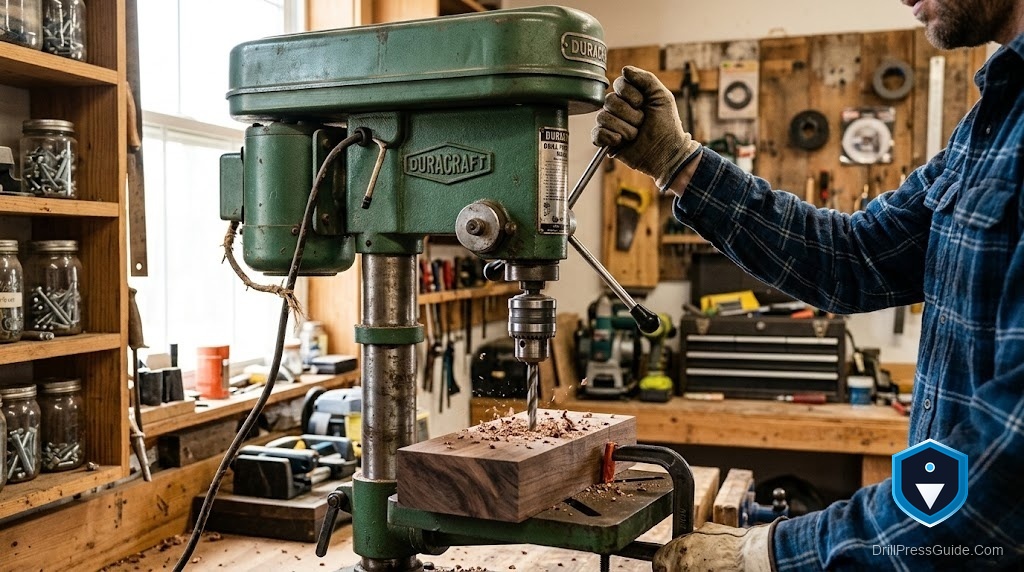
Duracraft is not a company you will find with an active website or a customer service number that picks up. It is a brand from the 1970s and early 1980s that sold Taiwanese-made drill presses through Kmart, Sears competitors, and discount retailers, and then faded from production. The machines they sold, floor presses and bench presses in various horsepowers, were mid-grade imports of the era: better than the cheapest Taiwanese imports but not in the Delta or Craftsman class. If you own one, inherited one, or are looking at one on the used market, here is what the range actually was, what the machines can do, and how parts work today.
A Duracraft drill press is a floor-standing or benchtop drilling machine imported from Taiwan and sold under the Duracraft brand in the 1970s through early 1980s, including the DP-514 floor press (115V, floor-standing), the DP-514-12S (12 speeds, 5/8-inch chuck, 1977), the DP1214 (3/4 HP, 1979), and the 1600 (3/4 HP benchtop), with no current manufacturer support, now found exclusively on the used market.
Short answer: Duracraft made floor and bench presses in the 1970s through early 1980s, in roughly 3/4-HP configurations, with 12 to 16 speeds and 5/8-inch chucks. These are no longer in production, support is through VintageMachinery.org and generic parts, and the good news is that the machines used standard components, so belts, chucks, and bearings are generic replacements. Here is the practical breakdown.
What Duracraft made
DP-514 (floor press, 1970s)
The standard floor press of the Duracraft range:
- Floor-standing configuration.
- 115V, single-phase motor.
- Belt-driven speeds.
- 5/8-inch chuck.
- Standard late-1970s mid-grade Taiwanese construction.
DP-514-12S (12-speed floor press, 1977)
The 12-speed variant of the floor press:
- 12 speeds.
- 5/8-inch chuck.
- Floor-standing, 115V.
- The most common Duracraft floor press on the used market.
DP1214 (1979)
- 3/4-HP motor.
- Full floor press configuration.
- Introduced in 1979, one of the later Duracraft models.
1600 (benchtop)
- 3/4-HP motor.
- Benchtop-mount configuration.
- For shops that needed a capable benchtop without the floor-standing footprint.
DP-1617 (1978)
- 16 speeds.
- 3/4-inch chuck (larger than the standard 5/8-inch).
- Introduced in 1978 as the high-speed-count variant.
The Duracraft context
Duracraft entered the market during the late 1970s when Taiwanese tool imports were standard for mid-grade retail tools. The brand sold through Kmart and similar mass-market retailers, a tier below Sears Craftsman and Delta but above the cheapest house brands.
The machines were serviceable. Their weakness was the Taiwanese casting quality of the era and the thin motor build on some models. Their strength was that they used standard components (standard V-belts, standard JT33 or similar chuck tapers, standard motor configurations) that are easy to replace with generics.
Important note: after the early 1980s, the “Duracraft” name appeared on unrelated Taiwanese imports of lower quality sold through various channels. These later products share a name and nothing else with the original Duracraft drill presses.
What these machines can do
A Duracraft floor press from the late 1970s:
- Drills wood, plastic, and light metal at appropriate speeds.
- 3/4 HP is enough for general shop work with bits up to 1 inch in wood and smaller in metal.
- 12 to 16 speeds cover a reasonable range for matched bit-and-material selection.
- 5/8-inch chuck takes standard shank sizes.
These are general-purpose drilling machines, not precision metalworking tools.
Parts and support today
Duracraft has no current manufacturer support. The path to parts:
- VintageMachinery.org: Search for Duracraft in their brand index and publications database for any surviving documentation.
- Generic replacements: Standard V-belts (match by length and width), replacement JT33 or similar chuck, matched bearings by size, and compatible switches by voltage and amperage cover essentially all common repairs.
- Machinist communities: Practical Machinist and similar forums have addressed Duracraft machines.
- Local machine shops: For any precision repair (spindle, quill sleeve, bearings), a local shop can measure and match generic parts.
The honest flaws
No manufacturer support. Duracraft is not coming back.
Condition-dependent. These machines are fifty years old; condition varies.
Original parts are unavailable. Generic substitutes cover most needs, but specific Duracraft castings do not exist in a parts warehouse.
Brand confusion. Post-1980s “Duracraft” products are unrelated; identify the machine by model number and era, not just the name.
Buying a used Duracraft
If you are buying a Duracraft press, inspect:
- Spindle runout: should be near zero with a bit in the chuck.
- Quill travel: smooth through the full stroke.
- Motor: clean start and run, no vibration or hum.
- Table: no cracks, tilt mechanism works, clamps solidly.
- Completeness: chuck, chuck key, and depth stop.
- Belt condition: expect to replace it.
A clean, running Duracraft floor press in good mechanical condition is a workable used-market machine. It is not a collectible, but it drills holes.
How it compares
Against a current WEN 4212T benchtop, a Duracraft trades variable speed, a digital readout, an LED, a laser, and a two-year warranty for floor-press capacity and a lower used-market price. Against a vintage Craftsman 113-prefix floor press from the same era, the Craftsman is generally the better-regarded machine with stronger parts documentation. Against a Delta Milwaukee DP220, the vintage Delta wins clearly on build quality, parts support, and collectibility. Choose a Duracraft if the price is very low and the condition is good; for any other situation, the Craftsman or Delta is the smarter used-market buy.
The verdict
The Duracraft drill press was a mid-grade Taiwanese floor and bench press sold through discount retailers in the late 1970s and early 1980s. The range covers floor-standing models (DP-514, DP-514-12S at 12 speeds, DP1214 at 3/4 HP) and a benchtop (1600), plus the 16-speed DP-1617 variant. No manufacturer support exists; parts are generics matched by size. These are workable used-market machines in good condition, but neither collectible nor a value leader versus the contemporary Craftsman and Delta machines they competed with. If you own one in good running condition, maintain it with generic wear items; if you are buying used, price it accordingly and inspect it carefully.
Frequently asked questions
What drill presses did Duracraft make? The DP-514 floor press (115V), the DP-514-12S (12 speeds, 5/8-inch chuck, 1977), the DP1214 (3/4 HP, 1979), the 1600 (3/4 HP benchtop), and the DP-1617 (16 speeds, 3/4-inch chuck, 1978), all Taiwanese imports sold through discount retail channels in the late 1970s and early 1980s.
Where can I get parts for a Duracraft drill press? No manufacturer support exists. Generic V-belts, chuck replacements by taper size, matched bearings, and voltage-matched switches cover most needs. VintageMachinery.org may have documentation. Machinist community forums help with specific part matching.
Are Duracraft drill presses any good? For the era, they were mid-grade imports: adequate for general shop work, not in the same class as Craftsman 113-prefix or Delta machines. In good condition they drill holes reliably; the weakness is Taiwanese casting quality of the late 1970s and thin motor construction on some models.
What does a Duracraft drill press sell for on the used market? Used prices reflect condition and local market. These are not collectible machines; expect pricing well below comparable vintage Craftsman or Delta presses. Condition is everything.
Is a Duracraft drill press the same as later Duracraft products? No. The original Duracraft drill presses are from the late 1970s to early 1980s. Later “Duracraft” labeled products sold under that name are unrelated Taiwanese imports of lower quality and share no lineage with the original machines.
How many speeds does the Duracraft drill press have? Depending on model: the DP-514-12S has 12 speeds, the DP-1617 has 16 speeds, and the base DP-514 varies. All are belt-driven stepped speeds.
What chuck does the Duracraft drill press use? Most floor models use a 5/8-inch chuck (the DP-514-12S and others). The DP-1617 uses a 3/4-inch chuck. Replacement chucks by taper size (typically JT33 or equivalent) are available generically.
References
- VintageMachinery.org, Duracraft brand index and publication search: https://vintagemachinery.org
- Practical Machinist, vintage drill press technical discussion: https://www.practicalmachinist.com
- Popular Woodworking, vintage drill press guidance: https://www.popularwoodworking.com