Owning a 1950s Craftsman Drill Press: Setup, Limits, and Parts Support
The 1950s Craftsman drill press is one of the most enduring shop tools in American woodworking, and it is still working in thousands of garages and small shops. These are Emerson Electric-built machines, heavy cast iron, simple belt-driven speed changes, and a design so well-sorted that they needed almost no improvement for decades. But they also have real limits that a modern buyer needs to understand, and getting parts for them is not the same as ordering from Amazon. If you own or are buying a 1950s Craftsman, here is the practical guide to setting it up, knowing its limits, and finding support.
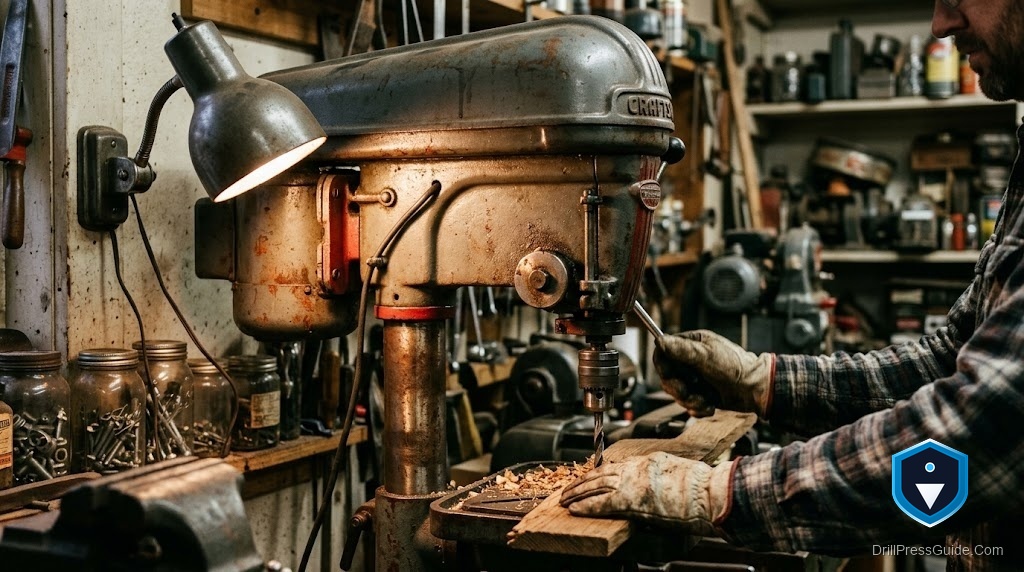
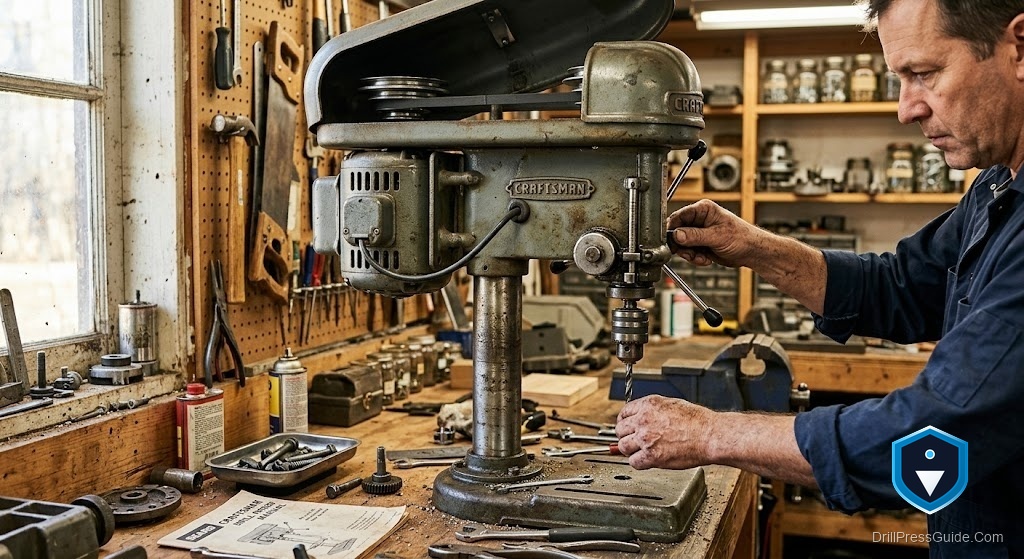
A 1950s Craftsman drill press is a floor-standing or benchtop drilling machine built by Emerson Electric for Sears under the Craftsman name in the 1950s, with a 113-prefix model number (commonly 113.213100, 113.213850, and related models), a 1/3-HP motor, belt-driven speeds, and full cast-iron construction, supported today through Sears PartsDirect by model number and VintageMachinery.org documentation.
Short answer: a 1950s Craftsman press is a 113-prefix Emerson-built machine with a 1/3-HP motor and simple belt-drive speeds. These are repairable, well-built tools that last decades with basic maintenance. Their limits are light power, fewer speeds than modern machines, and vintage-market parts availability. Setup requires a belt check, chuck inspection, and table squaring. Parts come from Sears PartsDirect and VintageMachinery.org. Here is the complete guide.
Identifying your 1950s Craftsman
Every 1950s Craftsman press has:
- A model number beginning with 113, identifying it as Emerson-built. Common examples include 113.213100, 113.213850, 113.21340, and similar.
- A type number on the same ID plate, which is as important as the model number for ordering parts.
- A serial number that can help date the machine; VintageMachinery.org helps decode these.
Do not assume all Craftsman drill presses are the same. Only the 113-prefix are the Emerson-built machines from this era. Later 137-prefix machines are Rexon-built from Taiwan and a different tool entirely.
What the machines actually are
The typical 1950s Craftsman 113-prefix press:
- 1/3-HP split-phase induction motor at 115V.
- 3 to 5 belt-driven speeds depending on exact model (earlier models had 3; some had 5 via a two-step pulley arrangement).
- Full cast-iron construction: head, column, table, and base.
- 1/2-inch keyed chuck.
- 4-inch or more of quill travel on floor models.
- Rack-and-pinion table height adjustment on floor models.
- Simple torsion spring quill return.
These are light-duty to general-purpose presses. They drill wood, plastic, and light metal with a small-to-medium bit accurately and quietly.
Setting one up
Step 1: Level and position. A floor press needs a level surface. A benchtop press needs a sturdy, level bench.
Step 2: Inspect and service the belt. Old belts are the most common failure. Match the belt length and width from the existing belt (or from the model number on Sears PartsDirect) and replace it. Correct tension: about 1/2-inch deflection at mid-span.
Step 3: Service the chuck. The stock Craftsman chuck is a Jacobs or equivalent. If there is runout, check first by pulling the chuck off the arbor and reseating it. If the chuck itself has runout, a replacement 1/2-inch Jacobs chuck on the correct taper is widely available.
Step 4: Inspect the quill spring. The torsion spring that returns the quill (and keeps it from dropping) degrades or breaks over decades. A drooping quill means a worn spring. Replacements are available by model number.
Step 5: Square the table. Use a rod in the chuck and a square, two directions. The table should be perpendicular to the spindle in both axes. Adjust by loosening the table-tilt clamp and leveling.
Step 6: Set the depth stop. Use the graduated collar and lock nut for repeatable depth control.
Step 7: Lubricate. Light machine oil on the quill sleeve, the rack-and-pinion table adjuster, and any sliding surfaces. Not grease; light oil.
The real limits
Light power. A 1/3-HP motor is a woodworking press. It bogs on large bits in hardwood and is not a metalworking machine.
Fewer speeds than modern machines. Three to five belt-driven speeds cover the basics, but the speed steps are wider than a modern 12-speed machine.
Vintage parts. Specific Craftsman castings and worm gears from the 1950s are not on a shelf at the hardware store. Common wear items are generics; specific parts require the model and type number plus some sourcing patience.
No laser, no LED, no digital readout. These are 1950s machines. You mark, punch, and drill.
Parts and support
For a 1950s Craftsman press:
- Sears PartsDirect (searspartsdirect.com) by full model number and type number: the first stop for documented parts.
- VintageMachinery.org: manuals, owner discussions, photo archives, and publication reprints for Craftsman and Emerson presses.
- Generic replacements: Correctly sized V-belts, replacement Jacobs-type 1/2-inch chucks (JT33 taper), and torsion springs cover most consumable needs.
- Specialty suppliers: eReplacementParts.com and similar carry some Craftsman parts by model number.
Common repairs
- Belt replacement: most common. Match by model on Sears PartsDirect or by measuring the existing belt.
- Chuck replacement or reseating: Jacobs taper; pull with a wedge tool, clean the taper surfaces, reseat firmly.
- Quill spring replacement: order by model number; instructions in the manual on VintageMachinery.org.
- Switch replacement: single-phase toggle or key switch by voltage and amperage match.
How it compares
Against a current variable-speed WEN 4212T 10-inch, a 1950s Craftsman trades the WEN’s variable-speed dial, digital readout, LED light, laser, and two-year warranty for cast-iron mass, simple repairability, and zero depreciation. Against a newer Craftsman 137-prefix 15-inch, it trades 12 belt-driven speeds and a work light for older Emerson build quality. Against a Delta Milwaukee DP220, the comparison is very close in era, class, and repairability; machine preference comes down to specific condition and price.
The verdict
A 1950s Craftsman drill press is an Emerson-built 113-prefix machine: 1/3-HP induction motor, belt-driven speeds, full cast-iron construction, and a design that has survived seventy-plus years in working shops. Its limits (light power, fewer speeds, vintage parts) are real but manageable for a shop that does general woodworking and occasional light metal. Set it up with a new belt, a serviced chuck, a fresh spring, and a squared table, and it drills straight holes accurately and quietly for decades more. Parts come from Sears PartsDirect by model and type number and from VintageMachinery.org documentation. This is not a machine for everyone, but for the right shop, it is irreplaceable.
Frequently asked questions
How do I identify a 1950s Craftsman drill press? By the model number on the ID plate: a 1950s Craftsman is a 113-prefix Emerson-built machine (like 113.213100 or 113.213850). Record both the model number and the type number for parts ordering.
What motor does a 1950s Craftsman drill press have? A 1/3-HP split-phase induction motor at 115V, belt-driven to the spindle. Simple, well-proven, and repairable if a winding fails.
How many speeds does a 1950s Craftsman drill press have? Depending on the exact model, typically 3 to 5 belt-driven speeds. Earlier models had 3; some models used a two-step arrangement for 5 speeds.
Where do I get parts for a 1950s Craftsman drill press? Sears PartsDirect by full model and type number is the primary source. VintageMachinery.org provides manuals and documentation. Generic V-belts, Jacobs-taper chucks, and torsion springs cover most consumable needs. eReplacementParts.com carries some Craftsman parts.
What is the most common repair on a 1950s Craftsman drill press? Belt replacement. The original belt degrades over decades. A new correctly sized V-belt is the first thing to address on any used purchase. The quill spring and chuck are the next common items.
Is a 1950s Craftsman drill press worth restoring? For a clean, complete machine in good structural condition, yes. The cast-iron construction is durable, parts are accessible for common items, and a restored Craftsman 113-prefix is a genuinely capable woodworking press. The time investment is for the right buyer.
Can a 1950s Craftsman drill press drill metal? For light metal with small bits at the correct slow speed, yes. The 1/3-HP motor is not a metalworking machine; center punch carefully, use the slowest available speed, and apply cutting fluid for steel.
References
- Sears PartsDirect, Craftsman drill press parts by model number: https://www.searspartsdirect.com
- VintageMachinery.org, Craftsman and Emerson 113-prefix drill press documentation: https://vintagemachinery.org
- eReplacementParts, Craftsman drill press parts lookup: https://www.ereplacementparts.com