A Practical Guide to the Craftsman Floor Drill Press Lineup
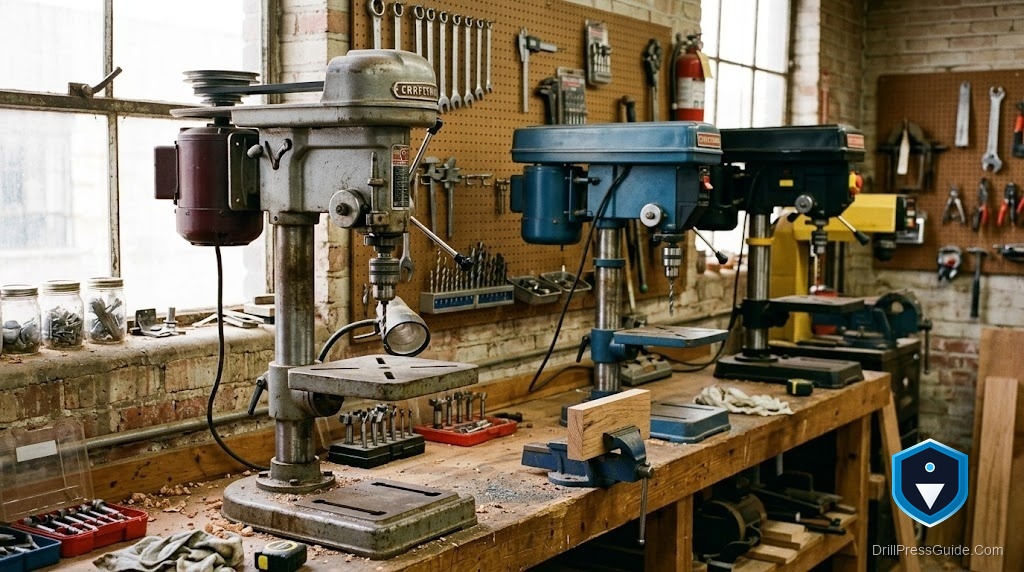
The Craftsman floor drill press has been sold in enough configurations over the decades that shopping for one on the used market is genuinely confusing. Sears offered floor presses under the Craftsman name ranging from a modest 15-inch swing to a capable 17-inch machine, built by different manufacturers at different times, with different motors and speed counts. If you know what a floor press is for and you are deciding whether a Craftsman fits the bill, this guide is your practical map to the lineup.
The Craftsman floor drill press is a series of floor-standing drilling machines sold by Sears under the Craftsman name, spanning 113-prefix Emerson-built machines and 137-prefix later models, in swing sizes from 15 to 17 inches, with belt-driven speeds, 5/8-inch chucks, cast-iron tilting tables, and parts supported through Sears PartsDirect by full model and type number.
Short answer: the Craftsman floor drill press lineup breaks into older Emerson-built 113-prefix machines (well-regarded for build quality, typically lower horsepower, simpler) and newer 137-prefix Rexon-built machines (more speeds, 1-HP maximum-developed motors). Swing sizes run from 15 to 17 inches depending on model. All are belt-change floor presses; none has variable speed. Parts come through Sears PartsDirect by full model number. Here is the practical breakdown.
What a floor press does that a benchtop cannot
The jump from a benchtop press to a floor press brings three real differences:
- More swing: Craftsman floor presses run 15 to 17 inches, centering holes in workpieces up to that width.
- More power and stroke: Floor-press motors and quill travel are typically larger, handling bigger bits, deeper holes, and larger workpieces.
- Height and clearance: A floor press accommodates taller workpieces that would not fit under a benchtop machine.
For the woodworker building furniture, drilling through thick stock, or doing general shop work, a floor press makes those tasks routine.
The lineup by era and prefix
113-prefix (Emerson-built floor presses)
The well-regarded vintage Craftsman floor machines:
- Built by Emerson Electric, the same manufacturer behind the respected benchtop machines.
- Typically a 1/2-HP motor (some models vary).
- Simpler, fewer speeds, but robust cast-iron construction.
- Serial-number dating is possible through VintageMachinery.org.
- Common examples include the 113.213850 and similar 113-series floor machines.
- Parts through Sears PartsDirect and VintageMachinery.org documentation.
137-prefix (Rexon-built floor presses)
The more common modern-used machines:
- Built by Rexon of Taiwan.
- 1-HP maximum-developed motor (8 amps, 120V): a peak figure, not continuous.
- 12 speeds from roughly 250 to 3,100 RPM, belt-change.
- 5/8-inch chuck, 3-1/8-inch spindle travel.
- 13-1/4-inch square tilting table, 60-watt work light, quill lock.
- Parts through Sears PartsDirect by full model number.
Older 8-speed and 12-speed floor presses (113-series, various)
Some 1970s Craftsman floor presses had 8 speeds or 12 speeds in older belt-drive configurations. These are all belt-change machines with varying motor sizes depending on the specific model.
Reading the lineup
Before buying or ordering parts, you need:
- The model number prefix (113 = Emerson; 137 = Rexon).
- The full model number from the ID plate.
- The type number (on some machines) for exact parts matching.
No part from a 113 machine should be assumed to fit a 137 machine. They are different designs from different manufacturers.
Setting one up
- Level and stabilize the floor machine.
- Square the table with a rod and square, two directions.
- Set the belt speed for the bit and material.
- Use the depth stop and quill lock for repeatable holes.
- Service the belt, chuck, and spring first on any used purchase.
The honest flaws
No variable speed. All Craftsman floor presses use belt-driven stepped speeds.
Used-market condition only. These are long out of production.
Parts require the right model. The prefix and full model number are not optional.
“Maximum developed” motor on Rexon machines. The 1-HP label is a peak figure.
Parts and support
Sears PartsDirect (searspartsdirect.com) is the primary source, by full model number. VintageMachinery.org supplements the Emerson machines. Generic belts and 5/8-inch chucks cover most consumable needs. Our Craftsman drill press parts guide covers the ordering flow, and the older Craftsman drill press guide covers the vintage buying approach.
How it compares
Against a Delta 17900 or Delta 16-1/2, the Craftsman floor press is a comparable used-market machine in the same cast-iron, belt-drive floor press class. Against a new floor press like a RIKON 30-230 or JET JDP-17, the Craftsman loses on warranty and variable-speed options but wins on used-market price. Against a benchtop like the WEN 4212T, the Craftsman floor press is a different class entirely: more swing, more power, more stroke.
The verdict
The Craftsman floor drill press lineup is a reliable used-market option for the shop that needs a floor press without floor-press money. The older Emerson-built 113-prefix machines earn the most respect for build quality; the newer Rexon-built 137-prefix machines are the most common and well-documented. Neither has variable speed. Parts come through Sears PartsDirect by full model number, with VintageMachinery.org supplementing the Emerson machines. Inspect any used Craftsman floor press carefully (runout, quill, motor, table, completeness), identify the prefix before ordering parts, and you have a capable, repairable floor press for a reasonable used-market spend.
Frequently asked questions
What floor drill presses did Craftsman make? Craftsman offered floor presses in roughly 15-to-17-inch swing sizes, including Emerson-built 113-prefix machines and Rexon-built 137-prefix machines. Speeds ranged from 8 to 12 belt-driven steps depending on model and era.
Is a Craftsman floor drill press good? For general woodworking and light metal, yes, especially the Emerson-built 113-prefix machines, which are well-regarded for build quality. The Rexon-built 137-prefix machines are capable general-purpose presses. Both are belt-change only and require used-market condition inspection.
What is the difference between the 113 and 137 Craftsman floor presses? The 113-prefix machines are Emerson-built (older, typically 1/2 HP, simpler); the 137-prefix are Rexon-built (newer, 1-HP maximum-developed, 12 speeds). They do not share parts.
Does a Craftsman floor drill press have variable speed? No. All Craftsman floor presses use belt-driven stepped speeds, set by moving the belt between pulley steps.
What chuck does a Craftsman floor drill press use? Most models use a 5/8-inch keyed chuck, giving bit-shank capacity up to 5/8 inch directly.
Where do I get parts for a Craftsman floor drill press? Sears PartsDirect by full model number is the primary source. VintageMachinery.org documentation supplements the older 113-prefix Emerson machines. Generic belts and chucks cover most wear items.
Should I buy a Craftsman floor press or a RIKON 30-230? For a warranty, modern parts support, and a wide 16-speed range, the RIKON 30-230 is the better new purchase. For used-market price and solid cast-iron capability, a clean Craftsman floor press is a legitimate choice. Decide by how much the warranty and modern support matter to you.
References
- Sears PartsDirect, Craftsman floor drill press parts by model: https://www.searspartsdirect.com
- VintageMachinery.org, Craftsman and Emerson drill press documentation: https://vintagemachinery.org
- Fine Woodworking, floor drill press guidance: https://www.finewoodworking.com