Choosing a Milescraft Drill Press Attachment That Fits the Work and the Table
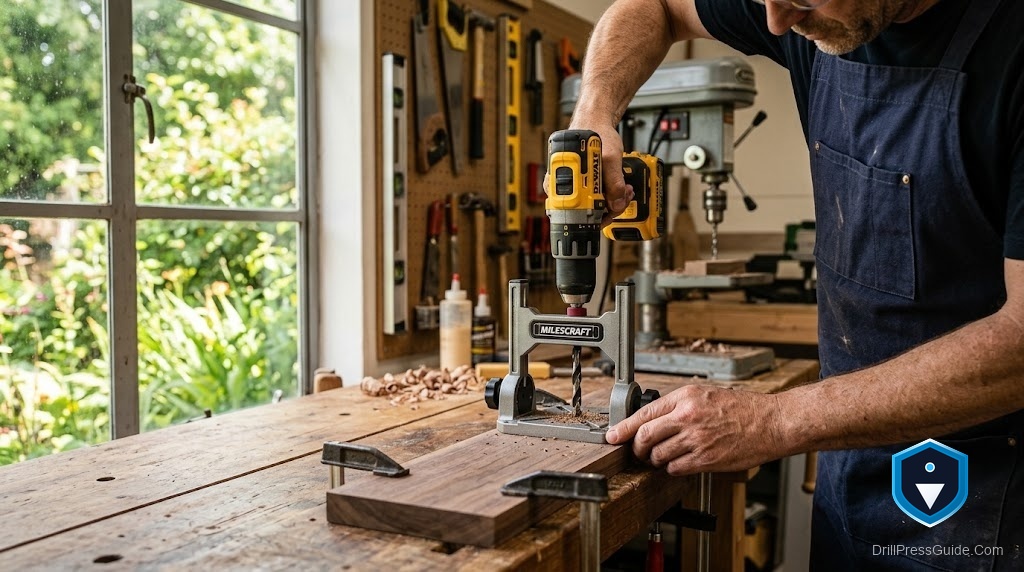
Milescraft makes the kind of accessories that solve one annoyance well: a drilling guide, a mortising setup, a fence, a hold-down. The trouble people run into is not quality, it is fit. They buy an attachment for the job they have in mind, then discover it does not clamp their quill, seat in their chuck, or match their table. Choosing the right Milescraft drill press attachment starts with the machine, not the task.
A drill press attachment is any bolt-on or chuck-mounted accessory that adds a capability, guiding, holding, sanding, mortising, to a press you already own. Milescraft’s line covers several of these. The common thread is that each one interfaces with a specific part of your machine, so the fit to that part decides whether it works.
Short answer: pick a Milescraft attachment by matching its interface to your machine, chuck capacity for chuck-mounted tools, quill and column size for clamp-on tools, and table slots for anything that bolts down. Get that interface right and the attachment does its one job well.
Match the attachment to the interface it uses
Every attachment grips the machine somewhere, and that is where fit lives.
Chuck-mounted tools, like sanding drums or guides that go in the chuck, must fit your chuck capacity and seat straight on the arbor. Clamp-on tools that grip the quill or column need to match those diameters. Table accessories, fences and hold-downs, need to anchor in your table’s slots or holes. Before buying, identify which interface the attachment uses and measure it on your press.
The honest limitation: no attachment overcomes the basics of the machine. A drill press quill is built for downward thrust, so attachments that impose heavy sideways loads, mortising, aggressive sanding, are limited by quill flex no matter whose name is on them. Match the attachment’s demands to what a press can actually do.
Check these before you buy
- Interface. Chuck, quill, column, or table? Identify it and measure that part of your press.
- Chuck capacity. For chuck-mounted tools, confirm the arbor fits within your chuck’s maximum, often on a keyed chuck with an MT2 spindle taper.
- Table slots. For bolt-down tools, confirm your slots or holes match the hardware.
- Speed and load. Match the attachment’s job to a suitable spindle speed and to loads the quill can take.
Attachment versus a dedicated tool
Against a dedicated machine, a Milescraft attachment wins on convenience and storage and loses on capacity and finish. A drilling guide is not a drill press replacement, a sanding drum is not an oscillating sander, and a mortising attachment is not a dedicated mortiser. For occasional use on gear you own, the attachment is the sensible pick.
Be honest about volume. If you use the capability constantly, a dedicated tool pays off. If now and then, the attachment earns its drawer space. You can compare drill press attachment options and, for holding work, a matching drill press hold down clamp.
Setting it up so it performs
- Identify the attachment’s interface and confirm it fits that part of your machine.
- Mount it squarely, chuck-mounted tools seated straight, clamp-on tools gripping fully, bolt-down tools anchored in the slots.
- Set a spindle speed suited to the attachment’s job.
- Clamp the workpiece and test on scrap before real parts.
- Wear eye protection and keep hands clear of the rotating chuck and point of operation, per CCOHS and OSHA.
Who should skip it
If you already own the dedicated tool for a job, an attachment for the same task is redundant. If you want to add a capability occasionally without buying a whole machine, a well-matched Milescraft attachment is a smart, low-fuss way to do it.
Bottom line
Choosing a Milescraft drill press attachment is really about matching its interface to your machine and its demands to what a press can do. Identify whether it mounts in the chuck, clamps the quill or column, or bolts to the table, measure that part, and confirm the load suits the press. Do that and each attachment does its one job well.
- Fit is about the interface: chuck, quill, column, or table.
- Measure that part of your press before buying.
- Match the attachment’s load and speed to what a drill press can handle.
FAQ
How do I know a Milescraft attachment fits my drill press? Identify whether it mounts in the chuck, clamps the quill or column, or bolts to the table, then measure that part of your machine and match it.
Will a chuck-mounted attachment fit any press? Only if its arbor fits within your chuck capacity and seats straight. Check your chuck’s maximum first.
Can an attachment replace a dedicated tool? No. It adds a capability for occasional use but cannot match a dedicated machine’s capacity or finish.
Why does my attachment flex or chatter? Usually it imposes sideways load the quill is not built for. Ease off and match the job to what a press can do.
Do table attachments fit all tables? Only if the hardware matches your table’s slots or holes. Measure them before buying.
What speed should I run? Whatever the attachment’s job calls for, sanding, guiding, or mortising each has a suitable speed range. Set it before starting.
References
- WEN Drill Press FAQs: https://wenproducts.com/pages/drill-press-faqs
- WEN 4214T 12-Inch Variable-Speed Drill Press: https://wenproducts.com/collections/power-tools/products/wen-4214t-12-in-variable-speed-drill-press
- OSHA Woodworking eTool, Drill Press: https://www.osha.gov/etools/woodworking/production/machines-tools/drill-press
- CCOHS, Metalworking Machines - Drill Presses: https://www.ccohs.ca/oshanswers/safety_haz/metalworking/drillpresses.html