Craftsman Drill Press Replacement Belt: A Workshop Troubleshooting Guide
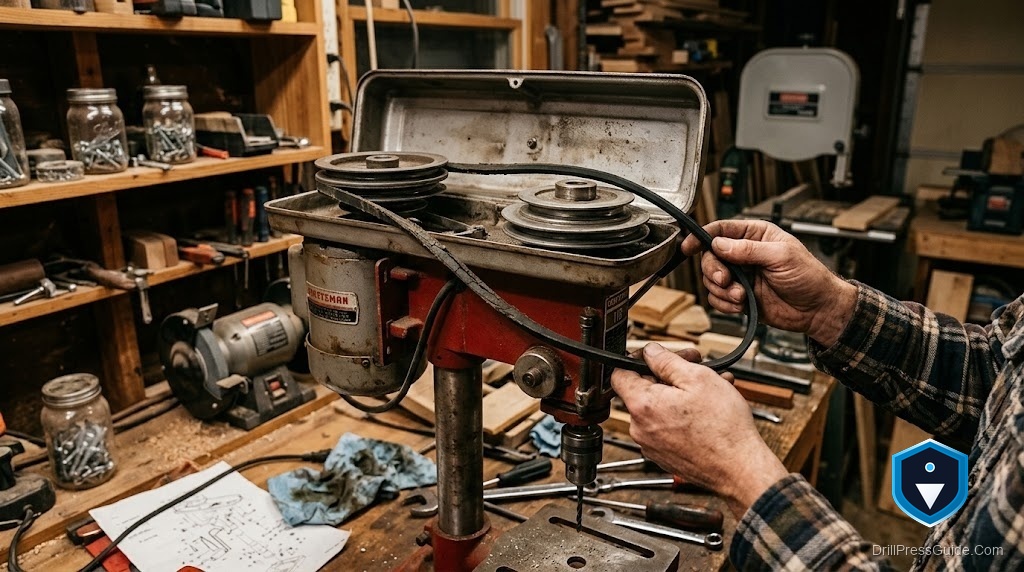
A squealing or slipping belt is the most common complaint on a Craftsman press, and it is also the quickest thing to put right. A Craftsman drill press replacement belt drops in fast, and the key is matching it by profile and length off your own machine, because Craftsman built these presses across many model numbers and belt sizes over the decades.
The belt is the V-belt that transfers motor power to the spindle across the stepped pulleys. On a Craftsman press it is a standard V-belt, so a correct replacement matches the top width and length of the one you are removing, not just the model name.
Short answer: unplug the press, slacken the motor to release tension, measure the old belt’s top width and length, then fit a matching molded V-belt or an adjustable link belt built to that length, and re-tension to about half an inch of deflection.
Troubleshoot before replacing
- Squeal at startup: often a glazed or loose belt. Re-tension and inspect before buying.
- Slip under load: a stretched or worn belt losing grip.
- Cracks or missing chunks: replace it before it fails mid-cut.
- Vibration: check for a flat spot or a set from long storage.
Match by profile and length
Measure two things off the old belt:
- Top width, commonly about 1/2 inch on an A-section.
- Length, by the old belt’s outside measurement or a string wrapped along the pulley path at your usual speed.
The belt to fit
For a common Craftsman size, a Craftsman drill press V-belt matches the profile many of these presses use, so confirm your length against it. When the exact molded length is hard to source, an adjustable link V-belt lets you build the precise length by adding or removing links, and it runs cooler and smooths vibration on an older press.
The honest drawback: a link belt uses more material per foot and can run slightly louder at top speed, while a fixed belt must match your length exactly. Who should skip the link belt: anyone who can confirm the exact molded size, since a matched molded belt runs a touch quieter.
Fitting it, step by step
- Unplug the press and open the pulley cover.
- Loosen the motor mount and slide the motor toward the spindle to slacken the belt.
- Roll the old belt off; fit or build the new belt to length.
- Seat it on the pulley steps for your speed.
- Slide the motor back to set tension, then lock it.
- Spin the spindle by hand to confirm tracking, then close the cover.
Measure your belt, then match it
Replacing a Craftsman belt is quick once you match by profile and length off the old belt rather than trusting the model name. Slacken the motor, measure, fit a molded or link belt, and set tension by feel.
Three takeaways:
- Slacken the motor before removing or fitting the belt.
- Match profile and length off your own belt; sizes vary across Craftsman models.
- A link belt solves a hard-to-source size and runs cooler.
FAQ
What belt does a Craftsman drill press use? A standard V-belt whose size varies across model numbers. Measure the old belt’s top width and length to match rather than relying on the model name.
How do I find the belt length? Measure the old belt’s outside length, or wrap a string along the pulley path at your usual speed and measure that.
Why does my Craftsman belt squeal? Usually a glazed or loose belt. Re-tension and inspect first; replace it if it is cracked, stretched, or worn smooth.
Can I use a link belt? Yes. An adjustable link belt is ideal when the molded size is hard to source, and it runs cooler and smooths vibration on an older press.
How tight should the belt be? About half an inch of deflection midway between the pulleys. Too tight wears the bearings; too loose slips.
My new belt still slips. Why? Usually the wrong profile riding high in the groove, or too little tension. Confirm the profile and set tension correctly.
References
- Sears PartsDirect, Craftsman drill press parts and diagrams: https://www.searspartsdirect.com
- VintageMachinery.org, Craftsman drill press documentation: http://vintagemachinery.org