How to Replace Spring Craftsman Drill Press: What to Check Before You Start
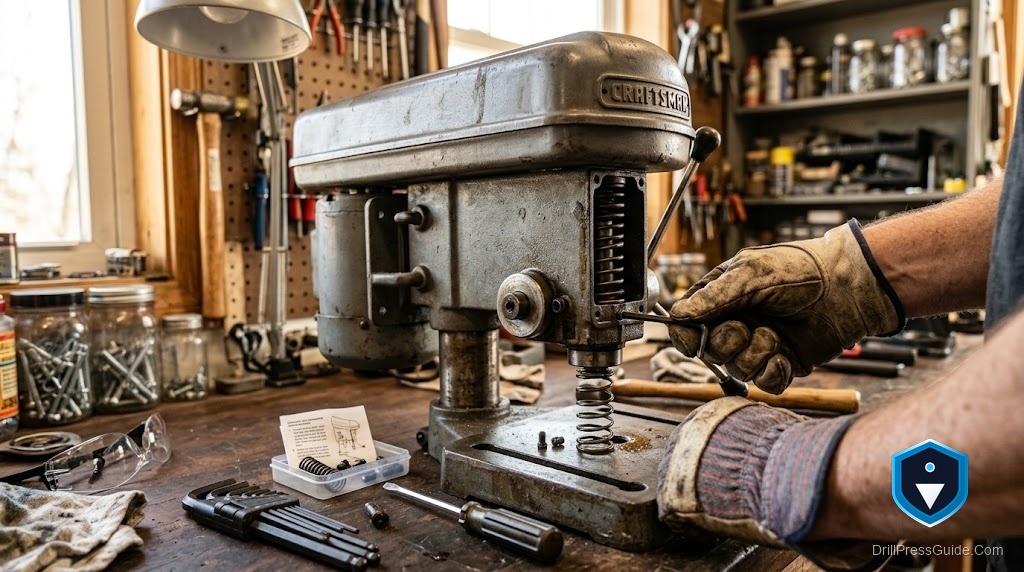
When the quill on your Craftsman press stops snapping back and you have to lift it by hand, the return spring has given out. Replacing the spring on a Craftsman drill press restores that self-returning feed, but this is the one repair that has a reputation for launching a coiled spring across the shop, so what you check before you start matters as much as the swap itself.
The return spring is a flat coil spring in a housing on the side of the head that pulls the quill back up after you feed it down. Replacing it means safely releasing the old spring’s tension, fitting a new coil, and setting the right preload so the quill returns firmly without slamming.
Short answer: before anything, note the spring cap’s position and wear eye protection. Then relieve the old tension under control, fit a matching coil spring assembly, and wind in just enough preload for a full, firm return.
What to check before you start
- Is the spring actually broken? A quill that returns partway usually just lost preload and can be re-tensioned, no new part needed.
- Cap orientation. Mark or photograph the cap position so you can match preload on reassembly.
- Spring size. Craftsman springs vary by press size; note the housing diameter and spring length.
- Safety. The spring is under load. Have eye protection on before you touch the cap.
The replacement part
A drill press quill feed return coil spring assembly is the chrome-housed coil that returns the quill and fits many common Craftsman and other benchtop presses. Match the housing diameter and spring length to your model before ordering, since these come in several sizes.
The honest drawback: springs are sold in a handful of sizes, so a mismatch means a return; measure first. Who should skip replacement: anyone whose spring is intact and only needs winding to restore preload.
Replacing it, step by step
- Unplug the press and put on eye protection.
- Note the cap position, then hold the cap firmly, loosen its retaining nuts, and let it unwind slowly under control. Do not let it fly.
- Lift out the old spring and note how the inner hook engages the quill pin.
- Seat the new spring’s inner hook on the quill pin and fit the cap into the housing.
- Wind the cap to add preload a little at a time, testing until the quill returns fully and firmly.
- Lock the cap, then cycle the quill several times to confirm.
Check first, control the tension, set the return
Replacing a Craftsman return spring is safe and satisfying once you respect the loaded coil and confirm you truly need a new one. Check for a simple re-tension first, release the old spring under control, match the size, and dial in the preload.
Three takeaways:
- A partial return often needs only re-tensioning, not a new spring.
- Release and set spring tension slowly and under control, with eye protection.
- Match the housing and spring size, and set preload for a full, firm return.
FAQ
How do I know the return spring is broken? If the quill does not return at all, or the cap spins freely with no tension, the spring is broken. A partial return usually means lost preload instead.
Can I just re-tension the spring? Yes, if it is intact. Wind more preload into the cap. Replace the assembly only if the spring is broken or the cap has no tension.
Is replacing the spring dangerous? The coil is under load and can fly out if released carelessly. Control the cap as it unwinds and wear eye protection throughout.
How do I know which spring fits my Craftsman press? Match the housing diameter and spring length to your model. Springs come in several sizes, so measure before buying.
How much preload should I set? Enough that the quill returns fully and firmly on its own without slamming. Add tension gradually and test as you go.
What if the feed is notchy rather than weak? That points to a quill or feed rack problem, not the return spring. Inspect the quill and rack instead.
References
- Sears PartsDirect, Craftsman drill press parts and diagrams: https://www.searspartsdirect.com
- VintageMachinery.org, drill press quill and spring documentation: http://vintagemachinery.org