
How to Adjust Spindle Craftsman Drill Press: A Clear, Shop-Ready Method
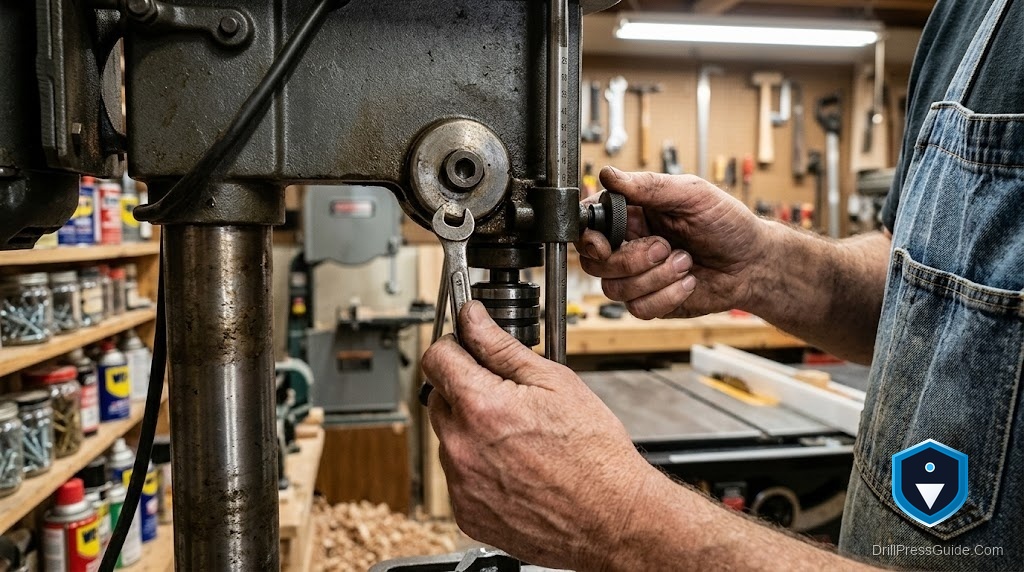
When a Craftsman drill press starts leaving oversized or wandering holes, the spindle is usually telling you something: it has developed play, endfloat, or runout that a few checks and adjustments can fix. Learning how to adjust the spindle on a Craftsman drill press starts with measuring what is actually wrong, because “the spindle feels loose” can mean three different faults, each with its own fix.
The spindle is the rotating shaft that carries the chuck and rides inside the quill on bearings. Adjusting it means removing unwanted movement, side-to-side play, up-and-down endfloat, or a wobble at the bit, by setting bearing preload, tightening retention, or servicing worn parts, so the spindle turns true.
Short answer: measure the fault first. Side play or a wobble usually means worn quill bearings that need replacing, endfloat often means a loose top retaining nut that needs re-setting, and runout at the chuck may just be a dirty taper. Fix the one you actually have.
Diagnose before you adjust
Grip the chuck and test three ways:
- Pull it side to side. Noticeable play points to worn quill bearings.
- Push and pull it up and down. Endfloat points to a loose top retaining nut or preload.
- Spin the spindle and watch the bit tip. Wobble with a clean taper points to bearings or a bent spindle; wobble that clears after cleaning the taper was never a spindle fault.
Making the adjustment
- Unplug the press.
- For endfloat, locate the top retaining nut above the pulley, and set preload so the spindle turns freely with no up-and-down slop. Snug, not tight enough to bind.
- For a dirty-taper wobble, remove the chuck, clean the taper and spindle bore, and reseat.
- For side play or a persistent wobble, the quill bearings are worn and adjustment will not save them; plan to replace them.
When adjustment is not enough
If the play comes from worn bearings, no amount of nut-tightening fixes it, and overtightening only cooks the new bearings. A Craftsman drill press bearing rebuild kit matched to the 113-series presses gives you the correct bearings to restore a true-running spindle. Confirm your model number against the kit’s fitment before ordering.
The honest drawback: replacing quill bearings means pulling the spindle, a bigger job than a simple adjustment. Who should skip the kit: anyone whose only fault was endfloat or a dirty taper, which a nut or a rag fixes.
Measure the fault, then match the fix
Adjusting a Craftsman spindle is really about diagnosis: endfloat, dirty taper, and worn bearings each look like “looseness” but need different fixes. Test the three movements, set the nut or clean the taper when that is the issue, and replace bearings when the play is real.
Three takeaways:
- Test side play, endfloat, and runout separately; each is a different fault.
- Set the top retaining nut for endfloat and clean the taper for a wobble.
- Worn quill bearings need replacing, not adjusting; overtightening will not save them.
FAQ
Why does my Craftsman drill press spindle feel loose? Either endfloat from a loose top retaining nut, or side play from worn quill bearings. Test up-and-down movement versus side-to-side to tell which.
How do I remove spindle endfloat? Set the top retaining nut above the pulley so the spindle turns freely with no up-and-down slop. Snug it just enough to remove the float without binding.
My bit wobbles. Is the spindle bad? Clean the chuck taper and spindle bore first. If a straight bit still wobbles with a clean taper, suspect worn bearings or a bent spindle.
Can I fix side play by tightening a nut? No. Side play comes from worn quill bearings, and tightening the retaining nut will not remove it. The bearings need replacing.
How tight should the retaining nut be? Just enough that the spindle turns freely with no endfloat. Too tight preloads the bearings and shortens their life.
Do I need to remove the spindle to adjust it? Not for endfloat or a dirty taper. You only remove the spindle when the quill bearings need replacing.
References
- Sears PartsDirect, Craftsman drill press parts and diagrams: https://www.searspartsdirect.com
- VintageMachinery.org, drill press spindle and bearing documentation: http://vintagemachinery.org


