
Craftsman Replacement Drill Press Table: Restore the Original or Upgrade the Setup
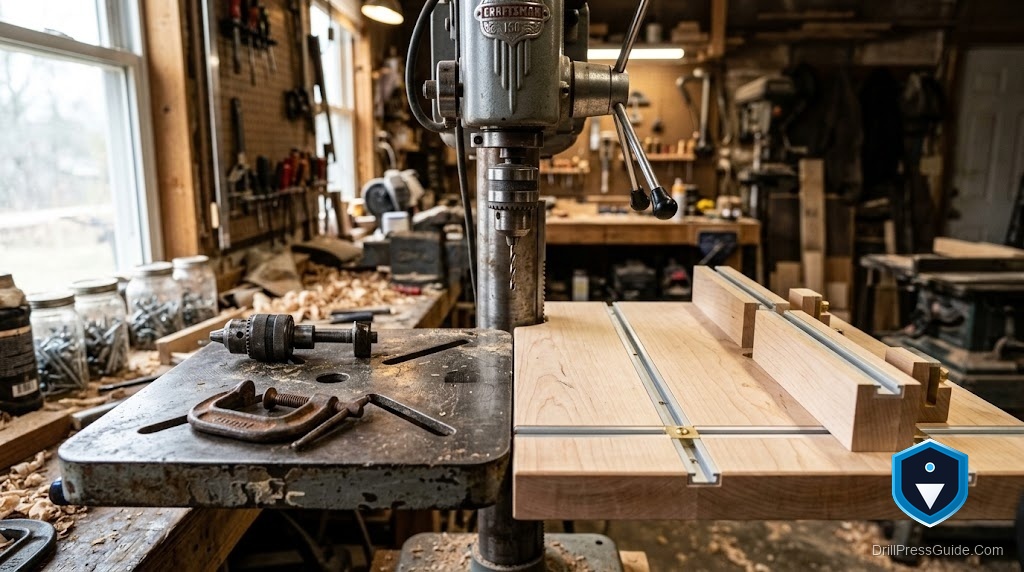
The cast table on an old Craftsman press takes a beating. Years of drilling leave the surface pocked, the center hole wallowed out, and sometimes a corner cracked from a fall. When that happens you face a fork in the road: hunt down an original casting to restore the machine, or bolt on a larger aftermarket table and end up with more capability than you started with. A Craftsman replacement drill press table can go either way, and the right choice depends on how you actually use the press.
The table is the flat work surface that supports your piece and raises or lowers on the column. Its size, its clamping method, and how it mounts to the column are the details that decide what fits.
Short answer: to restore originality, match a Craftsman table to your exact model number and column diameter. To gain work-holding and a fence, bolt an aftermarket upgrade table onto your existing table or mount, which fits a wide range of presses and adds clamping and stops the cast original never had.
Restore or upgrade: pick your lane
Restoring makes sense if you have a collectible or a machine you want to keep period-correct. The catch is availability: Craftsman cast tables for older models can be scarce, and you are matching a specific column diameter and mount.
Upgrading makes sense if you mostly want the press to be more useful. A bolt-on table adds a broad, flat surface, a fence, and hold-down slots, which turns a cramped cast table into a proper drilling station. Most woodworkers land here.
The upgrade table to use
For added surface and real work-holding, a drill press table with a fence and clamping slots mounts on top of your existing table and gives you an adjustable fence, stops, and hold-downs. It fits a wide range of presses because it clamps to the table you already have rather than the column.
The honest drawback: it raises the working surface, which eats into the distance between the table and the chuck, so on a small benchtop press you lose a little drilling height. Who should skip it: anyone restoring a machine to original condition, and anyone whose press is so short on quill travel that the added height would cramp normal work.
Fit checks before you buy
- Column diameter, if you are replacing the whole table with a column-mount unit. Measure the post the table clamps around.
- Table footprint, if you are adding a bolt-on top. Make sure your existing table is large enough to anchor it.
- Lost height. Measure your chuck-to-table maximum and subtract the new table’s thickness to be sure you keep enough room for your longest bits and workpieces.
Match the machine to how you work
A Craftsman drill press table replacement is really a decision about purpose. Restore with a model-matched casting if originality matters; upgrade with a bolt-on table if you want a fence, stops, and a bigger surface. Either way, measure your column and your chuck-to-table height first so the new table fits and still leaves room to drill.
Three takeaways:
- Decide restore versus upgrade based on how you use the press.
- For a bolt-on table, check that you keep enough chuck-to-table height.
- For a replacement casting, match the model and column diameter exactly.
FAQ
Can I put an aftermarket table on a Craftsman drill press? Yes. Most upgrade tables clamp on top of your existing table, so they fit a wide range of presses and add a fence and hold-downs.
How do I find an original Craftsman table? Match your model number (often starting with 113 or 137) and your column diameter. Original castings for older models can be hard to find.
Will an upgrade table reduce my drilling height? Yes, slightly. It sits on top of the existing table, so subtract its thickness from your chuck-to-table maximum before buying.
What do I measure for a column-mount table? The column diameter, the post the table clamps around, so the new table’s collar fits your press.
Do upgrade tables come with a fence? Most do, along with hold-down slots and adjustable stops, which is the main reason to add one.
Is a bigger table worth it on a benchtop press? If you drill larger or longer stock, yes. If your press is very short on quill travel, the added height may cramp you more than the surface helps.
How does the table attach on most presses? The original clamps to the column and locks with a handle; bolt-on upgrade tables anchor to the existing table surface with screws or clamps.
References
- Sears PartsDirect, Craftsman drill press parts and model lookup: https://www.searspartsdirect.com


