
How to Remove the Chuck on a Craftsman 10-Inch 2/3 HP Drill Press: The Checks That Prevent a Bad Repair
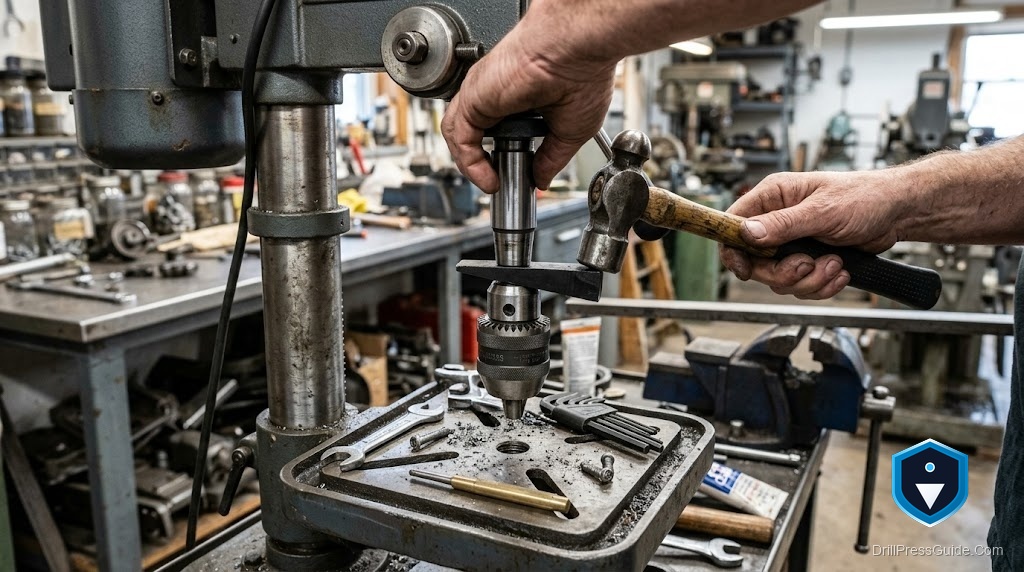
The Craftsman 10 inch bench press with the 2/3 HP motor is a workhorse that turns up in countless garages, and its chuck comes off for the usual reasons: an upgrade, a service, or a wobble that needs a fresh start. Removing the chuck on a Craftsman 10 inch drill press with the 2/3 HP motor is a simple job, but Craftsman built this size through several suppliers, so the checks before you tap decide whether it goes cleanly or damages the parts.
Removing the chuck means separating it from the spindle. On this Craftsman the chuck typically sits on a Jacobs taper arbor, and that arbor seats in the spindle on a Morse taper. Depending on the supplier, some add an internal retaining screw.
The direct answer: unplug the press, check for and remove any internal retaining screw, then drive the chuck off its taper with wedges, or knock the arbor out of the spindle with a taper drift through the access slot. Because Craftsman used several builders for this 10 inch size, confirm your specific machine rather than assuming.
The checks before you tap
With the press unplugged:
- Read the model prefix. A Craftsman model number starting with 113, 137, or similar identifies the supplier, which hints at whether a retaining screw is likely.
- Open the jaws fully and look down the bore for a retaining set screw. It is often reverse threaded, so it may loosen clockwise. Remove it first.
- Find the spindle access slot by feeding the quill down, where a taper drift drives the arbor out.
- Decide the joint. Chuck off the arbor calls for wedges. Whole arbor out of the spindle calls for the drift.
Removing the chuck from the arbor
- Open the jaws fully so the wedge does not mar them.
- Slide drill chuck removal wedges into the gap between the chuck top and the arbor collar, one each side.
- Tap them in evenly, alternating sides, so the chuck lets go square.
- Support the chuck so it does not drop when the taper releases.
Removing the arbor from the spindle
- Feed the quill down to expose the access slot.
- Insert a taper drift, flat side toward the arbor tang.
- Tap it with a soft dead blow mallet. The arbor drops out of the Morse taper, so catch it.
Where people go wrong
The first mistake is assuming this Craftsman matches another and skipping the retaining screw check, then hammering a chuck that is still bolted on. The second is striking the chuck body directly, which dents it and can bend the arbor. The third is using a steel hammer straight on the parts instead of a soft mallet through a wedge or drift.
The verdict
Because the Craftsman 10 inch 2/3 HP press came from several builders, the rule here is to check your specific machine first. Read the model prefix, look for a retaining screw, find the access slot, and let wedges or a drift do the work with light, even, axial taps. Measure the taper if you plan to refit a chuck. Do that and this common bench press gives up its chuck cleanly, ready for the upgrade or service you had in mind.
Three takeaways:
- Read the model prefix; suppliers varied on this size.
- Remove any internal retaining screw before driving the chuck.
- Wedges pull the chuck, a taper drift pulls the arbor.
FAQ
How do I remove the chuck on a Craftsman 10 inch 2/3 HP drill press? Unplug it, remove any internal retaining screw, then drive the chuck off its arbor with wedges, or knock the arbor out of the spindle with a taper drift through the access slot.
Does this Craftsman have a retaining screw? Some do, depending on the supplier. Open the jaws fully and look down the bore. A screw at the bottom is a retaining set screw, often reverse threaded, and must come out first.
Why does the model prefix matter? Craftsman sold this 10 inch size built by several makers. The prefix (like 113 or 137) identifies the builder, which hints at details like whether a retaining screw is fitted.
What taper does it use? Commonly a JT33 Jacobs taper at the chuck and an MT2 Morse taper at the spindle, but measure yours before fitting a new chuck.
Can I just hammer the chuck off? No. Never strike the chuck body. Use wedges or a drift and tap along the axis, or you risk denting the chuck and bending the arbor.
The chuck will not move. What am I missing? Usually an unremoved retaining screw, or uneven wedge taps. Recheck for the screw and drive both wedges evenly.
Will the arbor fall when it releases? Yes. The Morse taper lets go suddenly, so support or catch the arbor and chuck so they do not drop.
References
- Zoro Resource Hub, Morse vs. Jacobs Tapers. https://www.zoro.com/resourcehub/what-are-the-dimensions-and-angles-of-morse-tapers-and-jacobs-tapers/
- Occupational Safety and Health Administration, Woodworking eTool: Drill Presses. https://www.osha.gov/etools/woodworking/production/machines-tools/drill-press


