
Craftsman 2/3 HP Drill Press: What the Rating Really Means, and How to Choose
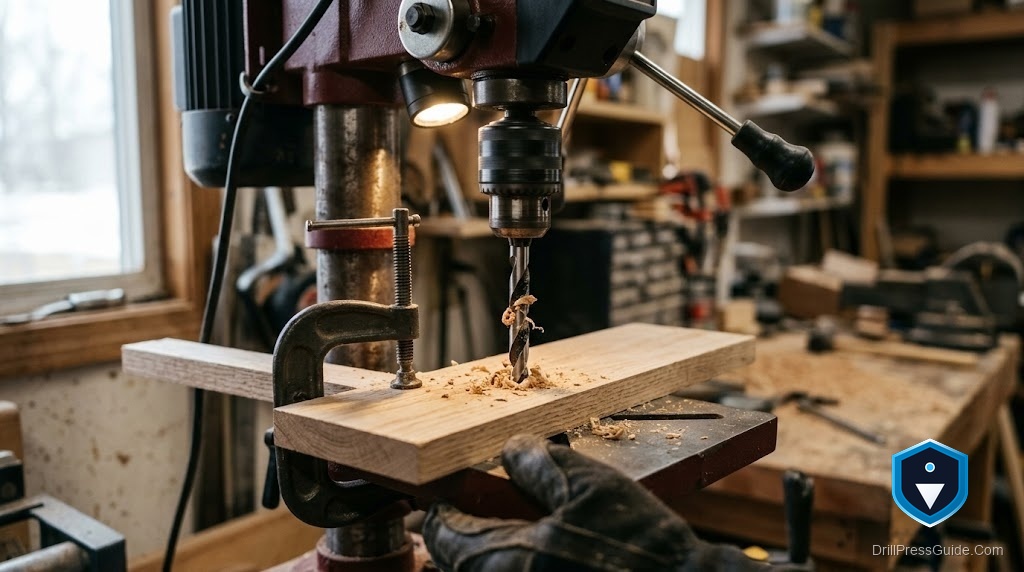
If you have shopped for a Craftsman drill press, new or used, you have run into the “2/3 HP” figure and probably wondered what it actually delivers. Here is the honest answer up front: 2/3 HP on a Craftsman benchtop press is almost always a peak or “maximum developed” rating, not the continuous horsepower the machine puts out all day. That is not a scandal, it is how small benchtop tools are commonly rated, but understanding it changes how you shop and how you use the machine. Get that straight and a 2/3-HP Craftsman is a perfectly good light-to-general press. Here is what the rating means and how to choose.
A Craftsman 2/3 HP drill press is a benchtop machine, typically a 10-inch or 12-inch model such as the Laser Trac 137-series presses, rated at 2/3 horsepower as a peak (“maximum developed”) figure, with a 5-speed belt drive, a 1/2-inch chuck, and a cast-iron table, built for light-to-general drilling in wood, plastic, and thin metal.
Short answer: the Craftsman 2/3 HP rating is a peak figure, so treat the machine as a light-to-general benchtop press, not a heavy-duty one. Match your bits and speeds to it, and it drills clean, accurate holes. Choose it for hobby and general home work; step up in swing and power for large bits and hardwoods. Here is the detail.
What “2/3 HP” really means
On benchtop tools, horsepower is often quoted as “maximum developed” or peak horsepower, the highest output the motor reaches momentarily under load, not the continuous rating it sustains. A 2/3-HP Craftsman benchtop press draws current in the 6-amp range on 120V, which tells the real story: this is a light-to-general motor. That is the honest flaw to know going in. It does not mean the machine is weak, it means you should read “2/3 HP” as “a capable light-duty benchtop,” not “a floor-press workhorse.” Used correctly, it handles common drilling well; pushed with large bits in dense hardwood, it will bog, exactly as its amp draw predicts.
The typical machines
The 2/3-HP rating shows up across Craftsman benchtop models, commonly the Laser Trac 137-series:
- 10-inch Laser Trac (137.219000 / 21900 series): A 10-inch swing, about a 6.0-amp 120V motor, 5 speeds spanning roughly 620 to 3,100 RPM, a 1/2-inch chuck, around 2 inches of spindle travel, a 5-inch throat, and a laser alignment guide.
- 12-inch bench model (137.219120): A larger 12-inch swing, 5 speeds spanning roughly 540 to 3,600 RPM, more table and reach.
Both are stepped-pulley machines: you set speed by moving the belt. The laser helps you line up the bit quickly.
How to choose and use it
Match bits to the machine. Small-to-medium bits in wood, plastic, and thin metal are its sweet spot. For large bits or dense hardwood, expect to feed slowly and let the machine work.
Set the right speed. Slower speeds for larger bits and metal, faster speeds for small bits in wood. Use the speed chart in the manual.
Square the table. Check a rod in the chuck against the table with a square in two directions before trusting your holes.
Mount it solidly. Bolt it to a sturdy bench so it does not rock.
Buy used with eyes open. Many 2/3-HP Craftsman presses are on the used market. Check spindle runout, quill action, motor sound, and belt condition, and budget for a belt and maybe a chuck.
The honest trade-offs
Peak, not continuous, power. The 2/3-HP figure is a maximum-developed rating; the continuous output is lower, so treat it as a light-to-general machine.
Belt-change speeds. Five speeds by moving the belt, no dial.
Modest capacity. A 10-inch or 12-inch swing and a small table limit workpiece size.
Laser is an aid, not a fix. The Laser Trac guide helps alignment but does not replace a center punch for precise metal work.
How it compares
Against a current variable-speed benchtop like the WEN 4212T 10-inch, a 2/3-HP Craftsman trades a speed dial and a fresh warranty for cast-iron simplicity and used-market value. The WEN’s variable speed is genuinely more convenient; the Craftsman’s appeal is availability and price on the used market. For a broader look at Craftsman options, see the Craftsman drill press buying guide, and for older machines specifically, the older Craftsman drill press guide.
The verdict
The Craftsman 2/3 HP drill press is a solid light-to-general benchtop machine once you understand that the 2/3-HP figure is a peak rating, not continuous output. Read it that way, match your bits and speeds to the machine, square the table, and mount it well, and a 2/3-HP Craftsman (the 10-inch or 12-inch Laser Trac models) drills clean, accurate holes for hobby and general home work. Its limits, peak-rated power, belt-change speeds, and modest capacity, are exactly what its 6-amp motor tells you to expect. If you regularly drill large bits in hardwood or steel, step up to a bigger, more powerful press instead.
Frequently asked questions
What does 2/3 HP mean on a Craftsman drill press? It is typically a peak or “maximum developed” horsepower rating, the highest momentary output, not the continuous power the machine sustains. The roughly 6-amp motor draw shows it is a light-to-general benchtop press.
Is a 2/3 HP Craftsman drill press powerful enough? For small-to-medium bits in wood, plastic, and thin metal, yes. For large bits in dense hardwood or heavy steel work, it will bog, so match your bits and feed rate to the machine.
Which Craftsman models are rated 2/3 HP? Commonly the Laser Trac 137-series benchtop presses, including the 10-inch (137.219000 / 21900 series) and the 12-inch (137.219120) models, both 5-speed belt-drive machines.
What is the speed range of a 2/3 HP Craftsman drill press? Roughly 620 to 3,100 RPM on the 10-inch model and about 540 to 3,600 RPM on the 12-inch model, across 5 belt-driven speeds set by moving the belt on the pulleys.
Does the Craftsman 2/3 HP drill press have variable speed? No. It has 5 speeds set by moving the belt between pulley steps, not a variable-speed dial. The Laser Trac models add a laser alignment guide.
Should I buy a used 2/3 HP Craftsman drill press? If it is in good condition, it is a good-value light-to-general press. Check spindle runout, quill action, motor sound, and belt condition, and budget for a belt and possibly a chuck.
What can a 2/3 HP Craftsman drill press drill? Small-to-medium bits in wood, plastic, and thin metal at the correct speed. It is not built for large-diameter bits or heavy continuous metal drilling.
References
- Sears PartsDirect, Craftsman drill press specifications and parts by model: https://www.searspartsdirect.com
- Fine Woodworking, understanding drill press power ratings: https://www.finewoodworking.com
- Popular Mechanics, benchtop drill press buying advice: https://www.popularmechanics.com


