
How to Remove Chuck from Craftsman Drill Press Without Losing Accuracy
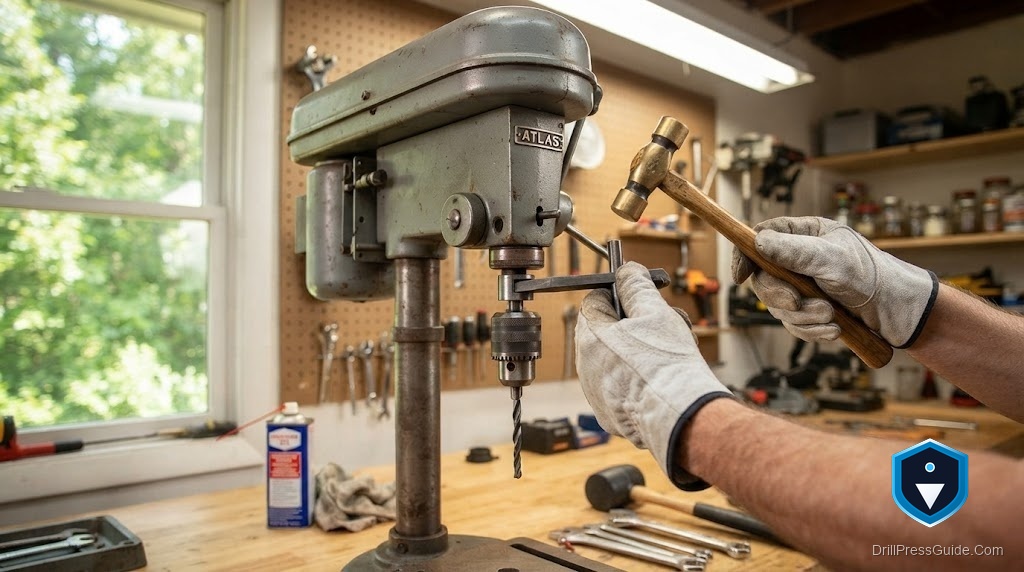
Removing the chuck from a Craftsman drill press — particularly the Sears-era 113.xxxxxx benchtop models like the 113.213850 — follows the same general drift-key method as any JT33-taper machine, but the Craftsman line has a few specific details worth knowing: the location of the drift slot on these machines, what to watch for on older examples, and how to reinstall in a way that preserves the accuracy the machine is capable of. This guide addresses the Craftsman-specific procedure.
Straight answer: Craftsman 113-series drill presses use a JT33 taper spindle. The chuck removes with a drift key inserted into the rectangular slot in the quill housing and one firm mallet blow. Clean the bore dry after removal, install the new chuck dry, seat firmly with a mallet blow through a wood block, and check runout before drilling.
What you are working with: the Craftsman 113-series spindle
The 113.xxxxxx Craftsman benchtop press is a step-pulley belt-driven machine with a JT33 (Jacobs Taper #33) spindle. The chuck presses onto a JT33 arbor, which in turn presses into the JT33 bore of the spindle. There are no threads; the taper’s self-holding friction is the only retention. Key related components include: quill, chuck-removal tool (drift key), quill spring, taper pin, spindle assembly, and the spindle pulley.
The drift slot is typically a rectangular notch cut into the quill housing, visible when the quill is extended downward to near its lowest position. On many 113-series machines, the slot is accessed by looking at the back or side of the quill housing near the chuck end.
Step-by-step removal
Required: Drift key matched to the quill slot (included with some machines; obtainable via SearsPartsDirect or by measurement from a tool supplier), dead-blow or rubber mallet, folded rag or scrap wood on the table below the chuck.
- Power off. Lock the switch. Unplug. Required before any quill work.
- Lower the quill to a comfortable height; lock the quill lock if your model has one.
- Place a folded rag or scrap wood flat on the table directly below the chuck — the chuck will fall when the taper releases.
- Locate the drift slot. On the 113-series, lower the quill fully to make the slot accessible. It is a rectangular cutout in the quill housing; on some models it is at the rear of the housing, on others at the side.
- Insert the drift key into the slot with the tapered face bearing axially against the flat of the arbor tang. The key should fit the slot width without rattling side-to-side.
- Strike the drift key firmly with the mallet — one decisive blow. The chuck drops onto the padding.
- If it does not release, reposition the key to ensure it is bearing correctly (not just against the slot walls), then try one more firm strike. If it still resists, apply penetrating oil to the chuck-to-quill junction, wait 20 minutes, and try again.
After removal: what to inspect on an older machine
On Craftsman 113-series machines, which may be decades old:
- Bore condition: Wipe the bore clean. Inspect for rust or corrosion (common on machines stored in humid environments), nicks from previous improper removal, and old grease (sometimes applied by previous owners who did not know better). Remove corrosion with fine emery cloth; remove grease with isopropyl alcohol on a clean cloth; remove nicks with a fine file, carefully.
- Spindle pulley and taper pin: While the quill is accessible, inspect the taper pin that retains the spindle assembly if you are doing a deeper service. If the chuck alone is the issue, do not disturb the spindle.
- Quill spring: If the quill does not return smoothly when released, the quill spring (torsion spring with spring cap) may be worn or broken — a separate repair.
Reinstalling: preserving accuracy
No oil or grease on the taper. Clean, dry surfaces only. A lubricated taper cannot hold grip and allows the chuck to migrate during drilling, destroying hole accuracy.
- Press the chuck onto the arbor by hand until it cannot go further by hand pressure alone.
- Insert the arbor into the spindle bore.
- Place a wood block on the flat end of the chuck body (not the jaws) and strike the block firmly with the mallet to seat the taper fully.
- Check runout: chuck a straight drill shank, rotate the spindle by hand, watch for wobble at the bit tip. Under 0.005 inches TIR is acceptable for general shop work.
Replacement chucks for Craftsman 113-series presses
Standard JT33 chucks fit directly. Recommended options:
- 5/8-inch keyed chuck with JT33 arbor — direct fit for JT33 spindles, 5/8-inch capacity.
- 1/2-inch keyed chuck JT33, 1/32–1/2-inch range — standard capacity for most work.
- Universal ratcheting chuck key — covers a lost chuck key.
- 4-way chuck key — covers the most common key square sizes in a single tool.
The honest flaws
Two honest points for older Craftsman machines. First, the drift slot on some early 113-series models is in an awkward position that requires the quill to be at a specific extension to access; lower the quill fully before searching for the slot. Second, corrosion inside the bore is common on stored machines; budget time for bore cleaning and light polishing before installing a new chuck.
Conclusion: standard JT33 procedure with Craftsman-specific detail
Craftsman 113-series drill press chuck removal is a JT33 drift procedure with a few model-specific notes.
- JT33 spindle; drift slot in the quill housing (position varies slightly by model).
- Lower the quill fully to access the slot; one firm mallet blow on the drift.
- Inspect bore for corrosion and old grease on older machines; clean before reinstalling.
- Reinstall dry; seat firmly; check runout.
FAQ
What spindle taper does the Craftsman 113-series use? JT33 (Jacobs Taper #33) on virtually all benchtop models.
Where is the drift slot on a Craftsman 113-series press? In the quill housing, accessible when the quill is lowered. The exact position varies slightly by model; lower the quill fully and inspect the housing for the rectangular cutout.
Where do I get the drift key for a Craftsman press? SearsPartsDirect (search by the full 113.xxxxxx model number); also from a machine tool supplier by matching the slot dimensions.
What if the bore is rusty? Clean with fine emery cloth (400-grit), wipe clean, and proceed. Do not install the new chuck into a rusty bore.
What chuck fits the Craftsman 113-series? Any standard JT33 chuck and arbor. The 5/8-inch keyed chuck with JT33 arbor or the 1/2-inch JT33 keyed chuck are direct fits.
What is the quill spring and do I need to replace it? The quill spring (torsion spring and spring cap) returns the quill when the feed handle is released. If the quill does not return after the chuck removal, inspect the spring separately; it is a different repair from the chuck.
References
- SearsPartsDirect, Craftsman 113-series parts: https://www.searspartsdirect.com
- eReplacementParts, Craftsman drill press parts diagrams: https://www.ereplacementparts.com/parts/power-tool/drill/drill-press/craftsman/
- Jacobs Taper arbor reference: https://www.jacobs-chuck.com


