
Is the Craftsman 34-Inch Radial Drill Press Right for Your Shop?
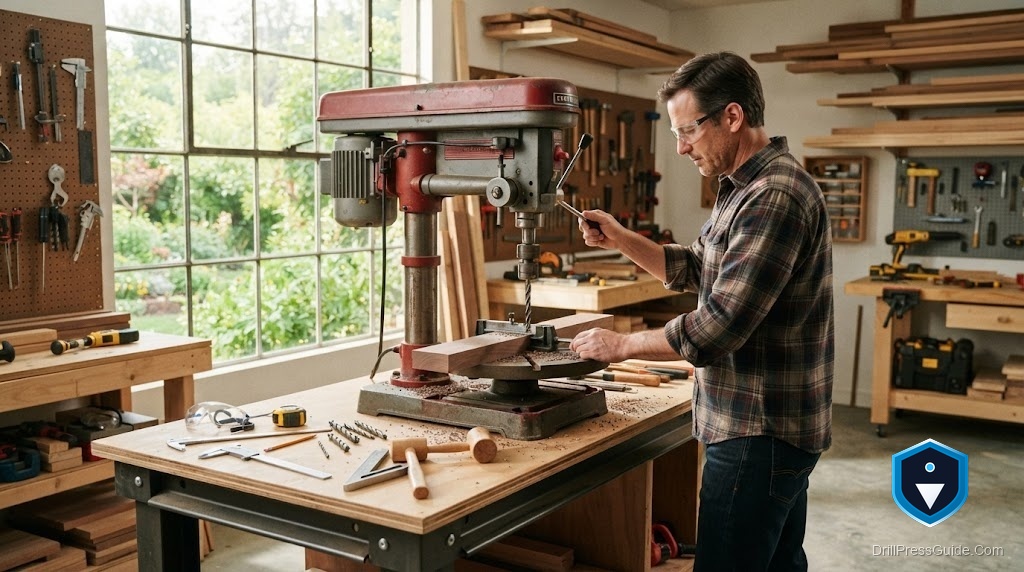
The Craftsman 34-inch radial drill press is a benchtop radial arm drill press from the Sears-era Craftsman 113-series line, built to allow the head to swing out over a wide radius rather than drilling straight down on a fixed column like a conventional press. The “34-inch” designation refers to the machine’s radial reach or swing — the diameter of the work area the head can cover by rotating around the column — which is its defining practical advantage over a fixed-head press. That advantage comes with specific trade-offs that determine whether this machine belongs in your shop.
This is a discontinued vintage machine. Key specifications vary by suffix in the 113.xxxxxx model number (for example, 113.213850 is one specific variant), but typical figures for the 34-inch class include a 2/3 HP or 1/3 HP induction motor, five or more belt-driven speeds, a 1/2-inch keyed chuck on a JT33 taper spindle, a pivoting and tilting table, and a cast-iron head casting that can be rotated around the column. The radial arm allows drilling off-center on large workpieces without moving the workpiece itself — the critical feature for woodworking, furniture, and repetitive off-center hole patterns.
Straight answer: the 34-inch Craftsman radial press is valuable if you regularly drill multiple holes in precise positions on large panels or frames, because the swinging head saves fixture time. It is less compelling than a conventional press if most of your work involves single holes in small stock, where the radial feature gives no advantage and the older machine gives up convenience compared to a current press.
What the radial head does for you
On a fixed-column press, drilling multiple holes in different positions on a large board means either repositioning the workpiece for each hole or using a compound table (cross vise) to move the work. On a radial press, the head swings on the column and locks in position, so you can reposition the bit over successive hole locations without moving heavy stock. For frame joinery, cabinetry, and long panel work, this saves significant setup time.
The tilt table adds compound-angle drilling — the table tilts relative to the head, allowing angled holes without tilting the workpiece. A conventional press can do this if the table tilts, but the radial head allows angle drilling at multiple positions on a panel without multiple repositioning steps.
The buying case for a vintage machine
The Craftsman 34-inch radial press is a used-market machine. If you find one in good condition, the case for buying it rests on three points: the cast-iron construction is durable and rigid; the repair path uses universal consumables (belt, chuck) matched by measurement; and the price of a working used example is typically well below what a comparable new machine would cost. Parts availability for structural components (spindle, head casting, switches) requires the Sears parts ecosystem or used-donor sourcing, which is the expected reality for a discontinued machine.
For the chuck: a 5/8-inch keyed JT33 chuck fits the JT33 spindle directly. A universal ratcheting chuck key covers a lost key. For the belt: measure the old belt’s section and circumference, then cross to an FHP equivalent. A Craftsman-compatible V-belt (45-inch L-section) fits several 113-series models; confirm your size from the machine’s label or parts diagram.
Who should look elsewhere
Look elsewhere if your typical work involves small stock and individual holes — the radial advantage does not help. Also look elsewhere if you need current parts support without sourcing from old stock, or if the machine you are considering shows signs of wear at the column clamp, head pivot, or table lock, as those are the critical precision-holding components and replacement is not straightforward.
Honest flaws
Two honest flaws. First, the radial head introduces an additional source of alignment error that a fixed-column press does not have: the head must be properly locked and aligned to drill square, and a worn or loose column clamp degrades precision. Second, as a vintage machine, it does not carry a warranty, and structural parts require used-market sourcing. Both are manageable in a well-maintained example; neither is acceptable in a worn one.
Conclusion: a strong fit for large-panel work, a limited fit for general single-hole drilling
- The 34-inch radial arm swing allows repositioning the head over large stock without moving the workpiece.
- Typical specs: 2/3 HP or 1/3 HP, 5+ speeds, JT33 chuck, cast iron, 113.xxxxxx model number.
- Belt and chuck are universal by measurement; structural parts require Sears parts ecosystem or used sourcing.
- Inspect column clamp, head pivot, and table lock before buying a used example.
FAQ
What does “34-inch” mean on this drill press? The radial swing (the arm’s reach diameter), not the machine’s height or table size.
What spindle taper does it use? JT33 on most 113-series variants. Confirm from the machine’s parts diagram.
Where do I find parts? Belt and chuck by universal measurement. Structural parts via SearsPartsDirect or used-donor machines on eBay.
Is it worth buying a used example? Yes, if the column clamp, head pivot, and table lock are in good condition. Inspect those components before buying.
Why does column clamp condition matter so much? The radial head’s precision depends entirely on the column clamp holding the head firmly at the set position. Wear at that joint causes bit wander.
What is the motor size? Typically 1/3 HP or 2/3 HP depending on the specific 113.xxxxxx variant. Confirm from the machine’s label.
References
- SearsPartsDirect, Craftsman 113-series drill press parts: https://www.searspartsdirect.com
- eReplacementParts, Craftsman drill press parts by model: https://www.ereplacementparts.com/parts/power-tool/drill/drill-press/craftsman/
- VintageMachinery.org, Craftsman drill press production records: https://www.vintagemachinery.org


