Finding Craftsman Drill Press Parts Replacement Without Guessing at Compatibility
Craftsman sold drill presses for decades, under its own name but built by several different manufacturers, and that is exactly why finding the right replacement part can feel like guesswork. Two Craftsman presses that look alike can take completely different belts, chucks, and switches. The good news is that Craftsman used a model-number system that, once you know how to read it, points you straight to the correct parts. This guide shows how to find Craftsman drill press parts without guessing at compatibility.
Craftsman drill press replacement parts fall into two groups: model-specific parts (pulleys, quill assemblies, switches, castings, spring assemblies) that must match your exact model number, and universal consumables (V-belts, chucks, chuck keys, vises) that fit by measurement rather than by brand. The key to both is the full Craftsman model number stamped on the machine, typically a 113.xxxxxx or 137.xxxxxx number.
Straight answer: start by finding the complete model number on the nameplate, because that number, not the word “Craftsman,” is what identifies the correct parts. Use it to look up the official parts diagram, order model-specific parts by their part number, and match consumables by measuring. Never order a Craftsman part on brand alone.
Step 1: read the model number
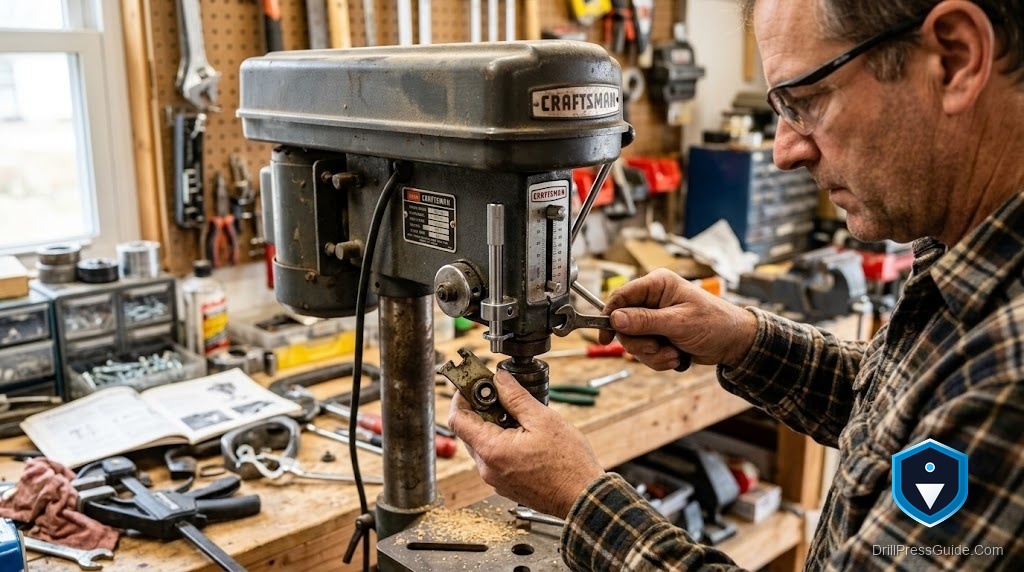
Every Craftsman drill press carries a model number on a plate or label, usually on the head or column. The prefix tells you who built it: 113 numbers were made by Emerson (the same lineage as many Delta-style presses), and 137 numbers by later suppliers. Write down the full number exactly, including the digits after the decimal. This is the single most important step, because Sears PartsDirect and archived parts diagrams are organized by this number, and it is the only reliable way to know which version you have.
If the label is missing or unreadable, you can sometimes identify the machine by matching its castings and pulley layout to diagrams, but the number is far more reliable.
Step 2: separate model-specific from universal parts
Once you have the model number, sort what you need:
- Model-specific parts: Pulleys, the quill and spindle assembly, the head casting, switches, the spring cap and torsion spring, taper pins, retaining rings, and bearings often differ by model. Order these by the part number listed in your model’s diagram.
- Universal consumables: The V-belt, chuck, chuck key, and vise are matched by size, not by model. A worn chuck is replaced by confirming your spindle taper (many Craftsman presses use a JT33 or Morse taper mount) and fitting the right chuck; a lost key is a universal ratcheting chuck key; an aging belt is replaced by measuring the old loop and matching it, and a Craftsman-style replacement drill press V-belt fits many models by size.
Step 3: measure before you order consumables
For belts and chucks, measurement beats assumption. For a belt, measure the old belt’s length and top width, or measure the pulley spacing if the belt is missing, and match the size; note that some larger Craftsman presses use two belts. For a chuck, identify the spindle taper (JT33, MT2, or similar) and the capacity you need, then fit a chuck and arbor to match, such as a 5/8-inch keyed chuck with an MT2 arbor on MT2 machines. A drill press vise is a universal accuracy and safety upgrade for any Craftsman table.
The honest flaws
Two honest points. First, because Craftsman presses were built by multiple makers, some model-specific parts for older models are discontinued with no direct replacement, so a broken proprietary casting or pulley can be hard or impossible to source, and a used donor machine is sometimes the only fix. Second, guessing wastes money: a belt or chuck that looks right but is the wrong size will not work, which is why measuring and model-number lookup are worth the few minutes. Neither means Craftsman presses are unsupportable, just that method matters.
Who can fix theirs easily, and who should reconsider
You can source parts confidently if your machine has a readable model number, you need consumables or documented model-specific parts, and the press is otherwise complete and sound. Most Craftsman presses fall here, and keeping one running is worthwhile.
Reconsider if the machine needs a discontinued proprietary casting, quill, or pulley with no replacement, or if it is missing several structural parts. At that point the cost and hunt can exceed the machine’s worth, and a running used press or a new one is the better call. Do not pour money into parts that no longer exist.
Conclusion: the model number ends the guessing
Finding Craftsman drill press parts is straightforward once you work from the model number instead of the brand.
- Read the full model number (113.xxxxxx or 137.xxxxxx) off the nameplate first.
- Order model-specific parts (pulleys, quill, switch, castings) by their diagram part number.
- Match universal consumables (belt, chuck, key, vise) by measurement, not brand.
- Some older model-specific parts are discontinued; a used donor may be the only fix.
FAQ
Where is the model number on a Craftsman drill press? On a plate or label, usually on the head or column. It typically starts with 113. or 137. Record the full number.
Why do parts differ between Craftsman presses? Craftsman presses were built by several manufacturers over the years, so similar-looking machines can use different model-specific parts.
How do I choose the right belt? Measure the old belt’s length and top width (or the pulley spacing) and match the size. Some larger models use two belts.
How do I replace the chuck? Identify your spindle taper (JT33, MT2, or similar) and capacity, then fit a matching chuck and arbor. Keep a universal chuck key on hand.
Are Craftsman drill press parts still available? Universal consumables are readily available. Some older model-specific parts are discontinued with no direct replacement.
Where do I find the parts diagram? Sears PartsDirect and archived diagrams organize parts by the full Craftsman model number, so look up your exact number.
What if I cannot read the model number? You can sometimes match by castings and pulley layout, but the model number is far more reliable. Try to recover it first.
References
- Sears PartsDirect, Craftsman drill press parts by model number: https://www.searspartsdirect.com
- Craftsman drill press manuals archive: https://craftsman.manymanuals.com
- VintageMachinery.org, Craftsman/Emerson-built machine references: http://vintagemachinery.org