A Closer Look at the Craftsman 3/4 HP Drill Press
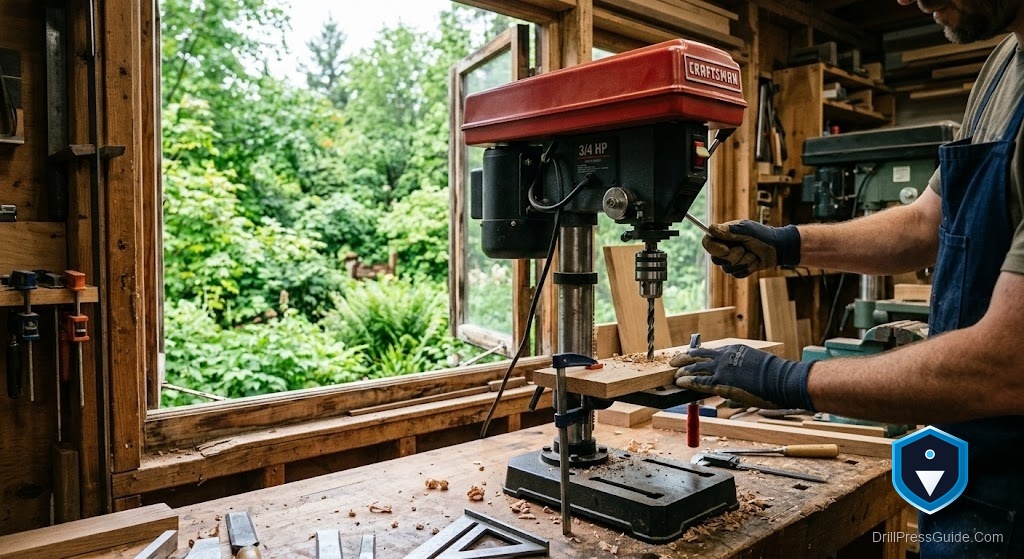
Walk through enough garages built in the 1980s and 1990s and you will keep meeting the same machine: a sturdy Craftsman drill press, bought at Sears, still running decades later. The “3/4 HP” label is one people search for constantly, and it sits at the more powerful end of the Craftsman drill-press range, above the many 1/3 and 1/2 HP bench models. A closer look at the Craftsman 3/4 HP drill press is really a look at a family of well-built, now-discontinued Sears machines, and at what it takes to keep one honest today.
Craftsman drill presses were made for Sears by various manufacturers and identified by model numbers beginning with a 113 prefix, such as the 15-inch 113.213850. The larger floor and heavy bench models carried motors up to 3/4 HP, driving a multi-step V-belt system, a keyed chuck, and a cast-iron head and table. They are no longer produced, so ownership means used machines, salvaged parts, and universal consumables.
Straight answer: a Craftsman 3/4 HP press is worth owning if the machine is complete and running, because the cast-iron builds from this era are rigid and long-lived. The catch is parts: Sears is gone as a tool maker, so anything model-specific comes from used donors or the vintage community, while belts, chucks, and keys are still easy to replace with standard hardware.
What the 3/4 HP class actually was
Craftsman sold drill presses across a wide power range, and the horsepower is the quickest way to place a machine in that lineup. The small bench units ran 1/3 or 1/2 HP; the bigger 15-inch bench and floor presses is where the 3/4 HP motors appeared, paired with 12-speed belt systems and larger tables. More horsepower here meant the confidence to bore large-diameter holes and drill steel without bogging, which is why these heavier Craftsman presses earned their loyal following.
Because “3/4 HP” spans several model numbers, the single most useful thing you can do is read the nameplate and record the full 113-prefix model number. That number, not the horsepower alone, unlocks the correct manual and parts diagram through Sears PartsDirect and the vintage-machinery archives.
Keeping one running
The good news is that the parts that wear are the parts you can still buy. The V-belt is the usual first replacement, and a replacement Craftsman drill press V-belt covers many of these machines once you confirm the length against your old belt. The chuck is a keyed unit on a Morse taper or JT33-style mount depending on the model; a worn one is replaced with a 5/8-inch keyed chuck and MT2 arbor after you confirm your spindle taper, and a lost key is solved with a universal ratcheting chuck key. A drill press vise improves workholding on the big table.
Wear items aside, the head castings, quill, pulleys, and motor are the parts that turn a cheap machine into a stalled project. Inspect those before buying.
The honest flaws
The flaw is not the machine, it is the support. These presses are mechanically excellent and often outperform new budget presses on rigidity, but Sears no longer backs them, so model-specific spares are a scavenger hunt. A press missing its spindle, pulley set, or a proprietary casting can be genuinely hard to complete. The other honest note is weight and size: the 3/4 HP floor and large bench models are heavy and need real space and a solid mount, which is a feature when drilling and a nuisance when moving.
Who should buy one, and who should skip it
Buy a Craftsman 3/4 HP press if you find a complete, freely running example and you value cast-iron rigidity over modern conveniences like variable speed and a digital readout. It will likely outlast a new budget machine.
Skip it if it is incomplete, if the motor or spindle is questionable, or if you want plug-and-play convenience with a warranty and available parts. In that case a current benchtop press like a variable-speed WEN, or a new floor press, is the more sensible buy. Do not pay serious money for a partial machine hoping the missing castings will turn up.
Conclusion: a good machine, if it is complete
The Craftsman 3/4 HP drill press represents the strong end of a durable Sears lineup, and a complete one is a keeper.
- The 3/4 HP class covers the larger 15-inch bench and floor Craftsman presses, above the 1/3 and 1/2 HP models.
- Record the full 113-prefix model number to find the right manual and parts.
- Belts, chucks, and keys are easy to replace; model-specific castings are not.
- Buy a complete runner; skip incomplete machines and choose a new press if you want convenience and support.
FAQ
Which Craftsman drill presses are 3/4 HP? The larger 15-inch bench and floor models, above the common 1/3 and 1/2 HP bench units. Confirm by the nameplate rather than by appearance.
Are Craftsman drill presses still made? Not these Sears-era 113-prefix models. They are discontinued, so parts come from used donors, the vintage community, and universal consumables.
How do I find the manual for mine? Record the full model number beginning with 113 and look it up through Sears PartsDirect or the vintage-machinery archives.
What belt does a Craftsman drill press use? A V-belt whose length depends on the model. Measure your old belt before ordering a replacement.
What chuck and taper does it use? A keyed chuck on a Morse taper or JT33-style mount depending on the model. Confirm your spindle taper before buying a replacement.
Is a used Craftsman 3/4 HP press worth it? Yes when complete and running, thanks to rigid cast-iron construction. A machine missing key castings is better treated as a parts donor.
What are the hardest parts to find? Model-specific castings, the quill, pulley sets, and the original motor. Wear items like belts and chucks remain easy to source.
References
- Sears PartsDirect, Craftsman drill press parts and manuals: https://www.searspartsdirect.com/
- VintageMachinery.org, Sears/Craftsman publications (113-prefix models): https://vintagemachinery.org/mfgindex/detail.aspx?id=1698
- Craftsman 113.213850 15-inch Drill Press Owner’s Manual reference: https://craftsman.manymanuals.com/power-tools/113-213850/owners-manual-4808