
Finding Craftsman 113 Drill Press Parts Without Guessing at Compatibility
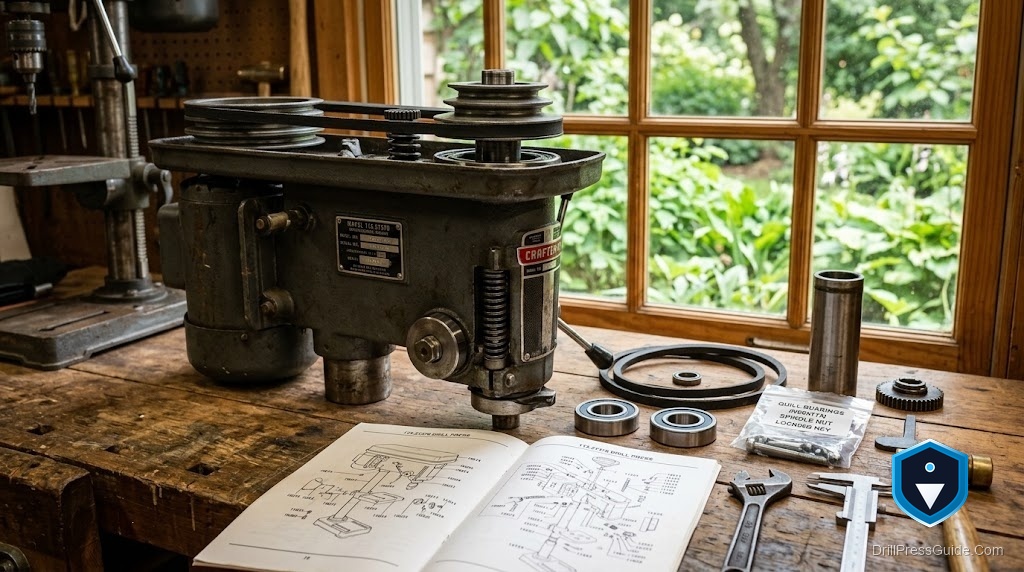
The Craftsman 113-series drill press is probably the most widely owned vintage bench and floor drill press in American garages. Sears sold millions of them from the 1950s through the 1990s, in sizes from small 10-inch benchtops to full 15½-inch floor models. The 113-series was the workhorse of the line — cast iron throughout, a solid induction motor, and a multi-step pulley system that gave you a useful range of spindle speeds.
Finding parts today requires knowing which specific model you have — not just “113” — because the 113-series covers machines built across four decades with evolving specs.
The 113-Series Model Number System
Craftsman 113-series model numbers look like 113.213850, 113.213870, or 113.24520. The digits after “113.” encode the size class, year of manufacture, and specific features.
The most commonly referenced models:
- 113.213850: The classic 15½-inch floor drill press, 12-speed
- 113.213870: Similar to the 213850, slight variations in the head casting
- 113.24520: 15½-inch, later production
- 113.24560: Another late-production variant
Parts are not fully interchangeable between all these models, even though they look similar. Spindle travel, pulley sizes, and table bracket designs evolved across production years.
The Head Casting and Spindle Assembly
The head casting on 113-series machines is a robust single-piece casting. Unlike budget imports, the bearing bores in Craftsman 113 head castings are machined to close tolerances. If you’re dealing with excessive spindle runout, the ball bearings are more likely to blame than the casting itself.
The spindle assembly uses JT33 taper for chuck mounting on most models. The spindle is supported by two deep-groove ball bearings in the head casting. Standard bearing dimensions — measure the OD, ID, and width to source replacements from any industrial bearing supplier.
Center Pulley and Retaining Ring
The center pulley — the main multi-step driven pulley on the spindle — is secured to the spindle shaft by a retaining ring (snap ring). This is a known weak point on 113-series machines: the retaining ring can fail, allowing the pulley to shift on the shaft. If your machine has been producing inconsistent spindle speeds or the belt keeps jumping off, check the retaining ring before ordering any other parts.
Retaining rings of the correct size are available from any hardware store or McMaster-Carr. The groove in the shaft is standardized.
Motor Pulley and Motor Bracket
The motor pulley is the driver pulley on the motor shaft. Check the set screw (often a cup-point set screw bearing directly on the motor shaft) for tightness. A loose motor pulley is the single most common cause of belt slipping and inconsistent speed on these machines.
The motor bracket pivots on a hinge to allow belt tensioning. The mounting bolts through the bracket can loosen with vibration. Check and torque these before assuming the belt is the wrong size.
Belt Replacement
The 113-series machines use V-belts in the 4L (half-inch top width) series. The exact length depends on your motor pulley position and head geometry. Measure the existing belt or calculate from center-to-center distance.
A link belt is the upgrade that makes the most difference on these vintage machines. Old rubber belts develop a permanent set at the splice joint (where the two ends are joined in manufacturing), which causes a once-per-revolution vibration pulse. A link belt eliminates this entirely and makes the machine feel noticeably smoother.
Chuck and Chuck Key
The factory chuck on most 113-series machines is a Jacobs-pattern keyed chuck mounted on a JT33 taper. After decades of use, the jaws wear, the spring mechanism weakens, or the arbor develops runout. A quality JT33 keyed chuck is a direct replacement and costs far less than a full machine replacement.
The chuck key for the 113-series is a standard Jacobs-pattern key. Measure the pinion hole diameter in your chuck to confirm the correct pilot size before ordering a spare.
Torsion Spring and Spring Cap
The torsion spring returns the quill after each plunge. On machines that have sat idle for years, the spring may have taken a permanent set or broken entirely. The spring cap is the retaining cover over the spring; on 113-series machines it’s usually secured by a taper pin or clip.
Replacement springs are available from eReplacementParts.com by model number. If yours has an unusual failure (spring broke mid-use), inspect the quill for burrs or corrosion that could be causing excessive friction on return.
Spindle Pulley and Locking Switch
The spindle pulley on 113-series machines is a multi-step cast iron component. If a step is cracked or chipped, replacement pulleys have been reproduced by several small suppliers and appear regularly on eBay. Search for your specific model number and “spindle pulley.”
The locking switch is a safety feature that prevents the machine from being started without the key. These switches age and develop intermittent contact. Standard replacement toggle switches of the correct amperage are an acceptable substitute.
Pre-Order Checklist
- ✅ Full model number (113.XXXXXX)
- ✅ Confirmed JT33 spindle taper
- ✅ Belt size from existing belt or head measurement
- ✅ Retaining ring checked on center pulley
- ✅ Chuck key pilot size measured
- ✅ Motor pulley set screw inspected
SEO Metadata


