
Craftsman 103 Drill Press Parts: How to Identify the Correct Version
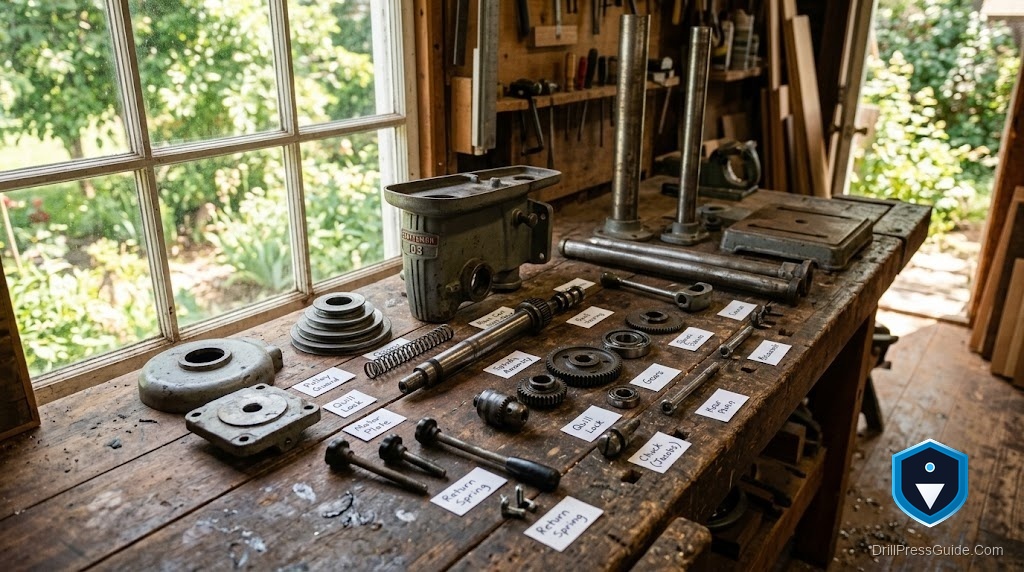
The Craftsman name has been on drill presses for the better part of a century, which is part of the charm and part of the problem. When you search for Craftsman 103 drill press parts, you’re potentially looking at a machine made during any one of several decades, under several different manufacturing arrangements, with parts that may or may not cross between them.
The good news: if your machine has a model number that starts with 103, you’re working with a Sears-era cast-iron benchtop drill press from the mid-20th century. These were well-built machines, and parts sourcing is entirely feasible once you know what you’re actually looking for.
Understanding the Craftsman 103 Model Numbers
Craftsman used a multi-part numbering system where the first three digits identified the product category and the remaining digits identified the specific model and revision. The 103.XXXXX series covers benchtop drill presses — typically 8-inch swing machines in the compact “junior” size category.
This is distinct from the 113.XXXXX series (the larger 10-inch and 15½-inch floor and benchtop models) and the 335.XXXXX series (later-era machines).
Before ordering any part, confirm:
- Your full model number (stamped on the head casting or a label on the column)
- Whether your machine is the 103 series or a different series
- The specific suffix digits that identify your production run
Head Casting and Spindle Assembly
The head casting on the 103-series machines is a single-piece casting that contains the spindle bearings, quill bore, and motor mount. If the casting is cracked, you’re looking at a parts machine situation — these castings are not reproduced.
The spindle assembly — the actual shaft that carries the chuck — runs on ball bearings pressed into the head casting. Over decades of use, these bearings develop play. The good news is that the bearings themselves are standard industrial dimensions. Measure the bearing OD and ID, find the equivalent, and press in replacements. No special tooling required beyond a bearing puller and a steel bar to press them in.
The spindle taper on most 103-series machines is JT33 (Jacobs Taper #33). This means the chuck seats directly on the spindle via the Jacobs taper, without a separate arbor on most configurations. When the chuck is worn or damaged, a quality JT33 replacement chuck seats directly on the spindle.
Chuck Key
The original chuck key for 103-series Craftsman presses is a Jacobs-pattern key with a specific pilot diameter to match the chuck. These go missing constantly. A replacement chuck key in the correct pilot size is the fastest way to get back to work. Measure your chuck’s pinion hole diameter with a caliper before ordering.
V-Belt and Pulley Configuration
The 103-series machines use a single V-belt running between the motor pulley and the spindle pulley. These are typically fractional-horsepower belt sizes — 3L or 4L series in modern sizing.
To find the right belt:
- Check for a size stamp on your existing belt
- Measure the belt circumference with a fabric tape
- Match the cross-section width
A link belt is an excellent upgrade on any vintage drill press. It installs without dismounting the motor, adjusts to exact length, and runs far smoother than an old rubber belt that’s been sitting for years.
Quill Return Spring (Torsion Spring)
The torsion spring that returns the quill after each plunge is one of the most common failure parts on older drill presses. When the spring breaks, the quill drops freely with no return tension. Replacement springs are available from eReplacementParts.com using your full model number.
The spring cap that houses the torsion spring is usually a retained part — it unscrews or unclips from the quill housing. Handle it carefully; the spring is under tension.
Motor Bracket and Motor Pulley
The motor bracket on 103-series machines mounts the motor and allows for belt tensioning by pivoting. The set screws on the motor bracket loosen over decades of vibration — check that the motor is secure before attributing belt slip to other causes.
The motor pulley is keyed to the motor shaft. If it wobbles or has a loose key, belt wear accelerates dramatically. A loose set screw is the most common cause — check and retighten before replacing the pulley.
Locking Switch
The locking switch on vintage Craftsman drill presses is a paddle-style switch that locks in the “off” position to prevent unauthorized use. These switches develop contact issues with age. A standard replacement toggle switch in the correct amperage rating is an acceptable substitute if the original style is no longer available.
Comparison: 103 vs. 113 Series
If you’re shopping for a Craftsman drill press and considering both series:
| Feature | 103 Series | 113 Series |
|---|---|---|
| Swing | 8 in (typical) | 10–15½ in |
| Table size | Small | Larger |
| Motor | Small induction | ½ HP induction |
| Parts availability | Moderate | Better |
| Best for | Compact bench use | Full shop use |
For compact hobby use and light metalwork, a 103-series machine in good condition is entirely capable. For serious production work, the 113-series machines have more table real estate and spindle travel.
Pre-Order Checklist
- ✅ Full model number (103.XXXXX)
- ✅ Spindle taper confirmed (JT33 for most 103-series)
- ✅ Belt size measured or stamped size noted
- ✅ Bearing OD/ID measured if replacing bearings
- ✅ Chuck key pilot size measured
SEO Metadata


