
A Closer Look at the Craftsman 13-Inch Drill Press 2/3 HP
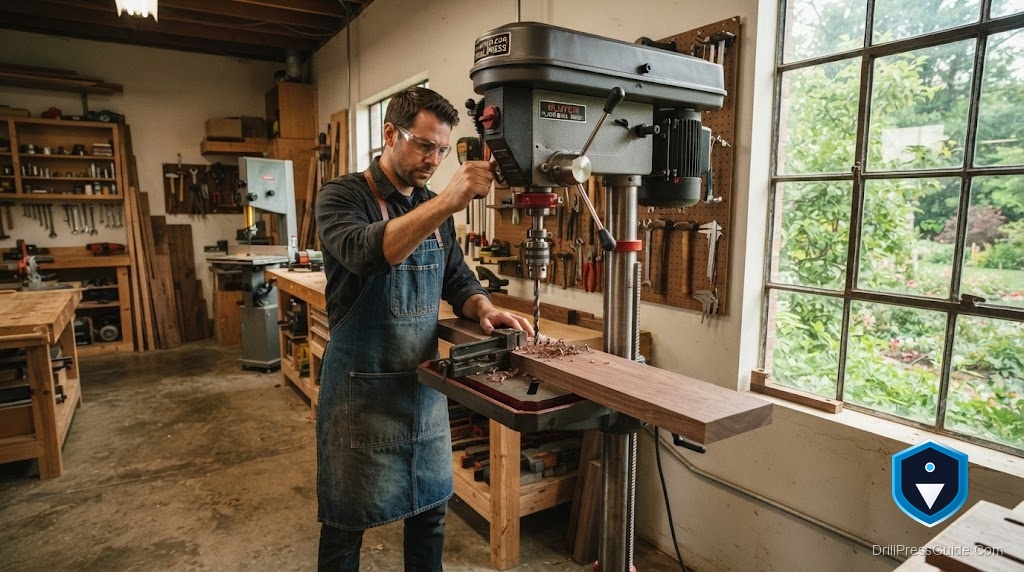
There’s a logic to how drill press sizes stack. The 10-inch is the entry door—compact, light, affordable, enough for occasional work. The 15-inch floor press is where serious production happens. And sitting quietly between them is the 13-inch, a machine that a lot of buyers skip over without fully understanding what it offers. The Craftsman 13-inch 2/3 HP drill press—both the old Sears-era models and the current CMXPTSG1030019—is worth a closer look, because it represents a meaningful step up in real working capacity without requiring a floor footprint or a floor-press budget.
Two Eras of the Craftsman 13-Inch
Like the 10-inch model, the Craftsman 13-inch drill press comes in two distinct lineages.
Sears-Era Models (Pre-2017) These machines carry model numbers in the 113.xxxxxx format, the same designation system Sears used for all its shop machinery. Some were built in the US in earlier decades; later production moved overseas. The 113.213850 is one of the most referenced model numbers in this class, though it actually straddles the 10”/12” range depending on the specific variant—confirm your actual swing measurement if you’re sourcing parts.
What matters for buyers of used Sears-era machines: the parts network is excellent. The V-belt, chuck key, quill spring, depth stop collar, and most hardware are available through Sears PartsDirect and eReplacementParts.com. If you find one of these machines in solid mechanical condition at an estate sale or Craigslist, it’s often a better buy than a new entry-level machine.
Current Production (CMXPTSG1030019) This is the current Craftsman 13-inch 2/3 HP benchtop model sold through Lowe’s and online retailers. Manufactured under Stanley Black & Decker’s Craftsman brand, it reflects the current production standard for this price category: cast and stamped construction, five-speed step pulley, reasonable table, workable depth stop. It won’t win a beauty contest, but it does the work.
Full Specs: Craftsman 13-Inch 2/3 HP (CMXPTSG1030019)
| Spec | Value |
|---|---|
| Swing | 13 inches |
| Spindle Centerline to Column | 6.5 inches |
| Motor | 2/3 HP, 120V single-phase |
| Speeds | 5-speed step pulley |
| Speed Range | ~530–3,100 RPM |
| Chuck | 5/8” JT33 keyed chuck |
| Spindle Travel | 3-1/8 inches |
| Table Size | ~9.5” x 9.5” |
| Table Tilt | ±45° |
| Table Swivel | 360° on column |
| Depth Stop | Rod-and-collar with adjustable stops |
| Work Light | No (some retail bundle variants differ) |
| Net Weight | ~44–48 lbs |
| T-Slots | Check your specific SKU |
That 6.5-inch spindle-to-column distance matters in practice. Compared to the 10-inch model’s 5-inch reach, you gain 1.5 inches of working width—which means a 13-inch wide workpiece can be center-drilled. For cabinet shelf pins, drawer hardware, and wide stock, the difference is felt immediately.
What the Step Up to 2/3 HP Actually Means
Going from 1/2 HP to 2/3 HP sounds incremental—and it is, in terms of raw wattage. But in benchtop drill press terms, it makes a noticeable difference in two places:
1. Forstner Bits in Hardwood With 1/2 HP, a 1-3/8” or 1-1/2” Forstner bit in hard maple or white oak at 620 RPM minimum will labor. The motor lugs, the belt slips a little, the hole wanders. With 2/3 HP, you have more reserve torque to push through without stalling. You still need to use appropriate speed (low) and not force the feed, but the motor doesn’t protest as loudly.
2. Larger Twist Bits Running a 1/2” twist bit through 3/4” plywood repeatedly is easy with either motor. Running a 1/2” twist bit through 2” of hard maple ten times in a row is where the extra torque headroom starts to matter.
This is not a machine for drilling 1-inch holes in 1/2” aluminum plate all day—that belongs with a more serious floor model. But for woodworking, light metalwork, and general shop use, 2/3 HP is a real improvement over 1/2 HP.
The Belt Drive: What to Know
The CMXPTSG1030019 uses a standard V-belt step pulley system with five speeds. The V-belt cross-section and circumference are specific to this machine—always check the label inside the head cover or the parts diagram before ordering a replacement belt. Do not guess.
The first upgrade every owner of this machine should make: swap the OEM molded V-belt for a link belt. The vibration reduction is substantial, and a link belt also stays in tension adjustment better than a molded belt that wants to stretch unevenly. This is a 15-minute job and it will change how you feel about the machine.
Parts Sourcing
Current CMXPTSG1030019:
- Craftsman’s own support channels and authorized service centers
- Lowe’s return/warranty program if purchased there
- Amazon and eBay for generic compatible parts (belts, chuck keys, depth stop hardware)
- The JT33 chuck is universal—aftermarket options are plentiful
Vintage Sears-Era Models:
- Sears PartsDirect (searspartsdirect.com): best for model-specific parts
- eReplacementParts.com: good exploded diagrams and parts lookup
- The 113-series machines share many components across size ranges, which helps
- Common wear parts: V-belt, quill return spring, chuck key, table clamp handle, depth stop collar
A quick note on the JT33 chuck upgrade: even if the stock chuck is functional, after a few years of use the jaws can wear unevenly. A fresh quality JT33 chuck is inexpensive and seats directly without any modification. Buy a spare chuck key at the same time.
Accessories That Elevate the Machine
Drill Press Vise The 13-inch model has a larger table than the 10-inch, which opens up better workholding options. For most work, a WEN 3” drill press vise is the right size—it holds small to medium parts securely without overrunning the table. For larger stock or metalwork, upgrade to a 4” drill press vise, which has more jaw capacity and a heavier base.
Work Light Neither era of the Craftsman 13-inch typically includes a useful work light. A gooseneck LED lamp mounted to the bench provides directional, adjustable light at the bit without creating shadows from your hands. A magnetic LED light that attaches directly to the column head is an even simpler solution—it travels with the machine if you ever need to relocate it.
How It Compares: Craftsman 13” vs. WEN 4212 vs. JET JDP-15B
| Feature | Craftsman 13” CMXPTSG1030019 | WEN 4212 | JET JDP-15B |
|---|---|---|---|
| Swing | 13” | 12” | 15” |
| Motor | 2/3 HP | 3/4 HP | 3/4 HP |
| Speeds | 5-speed | 12-speed | 12-speed |
| Speed Range | ~530–3,100 RPM | ~580–3,200 RPM | ~200–3,630 RPM |
| Table | Steel stamping | Steel (larger) | Cast iron |
| Spindle Travel | 3-1/8” | 3-1/8” | 3-3/4” |
| Depth Stop | Rod-collar | Micro-adjust | Micro-adjust |
| Street Price | ~$200–$250 | ~$200–$250 | ~$650–$750 |
| Warranty | 3 years | 2 years | 2 years |
The WEN 4212 is the closest natural competitor to the Craftsman 13”. At a similar price, the WEN offers 12 speeds (versus 5 on the Craftsman), a slightly heavier motor, and a larger table. The Craftsman’s advantage is brand familiarity and parts availability. For a new buyer without an existing Craftsman relationship, the WEN 4212 is a strong argument.
The JET JDP-15B is a different conversation entirely. It costs roughly two to three times as much, uses a cast iron table, has a wider low-end speed range, and has a 15-inch swing. If you’re considering the Craftsman 13” because you genuinely need 13 inches of swing and no more, it makes sense. If you’re considering it because it’s the most you can afford right now but you know you’ll want more capacity in two years—save up and buy the JET once.
What the 13-Inch Swing Really Gets You
The swing spec is the most important dimension on a drill press, and it’s worth being precise about what it means. Swing = twice the distance from the spindle centerline to the column. A 13-inch swing means your maximum workpiece width for center-drilling is 13 inches.
Practically:
- 10” swing → center-drill up to 10”-wide stock
- 13” swing → center-drill up to 13”-wide stock (covers most standard lumber widths up to 1x12)
- 15” swing → center-drill up to 15”-wide stock
For a woodworker building furniture, that jump from 10” to 13” covers a lot of real-world situations—drilling shelf pin holes in a 12”-deep bookcase side, centering a hole in a 12”-wide door stile, etc.
Honest Limitations
- Five speeds is limiting. The ~530 RPM minimum is workable but not ideal for large Forstner bits—you’d want 350–400 RPM ideally. A 12-speed machine in the same price range gives you more flexibility.
- The table isn’t cast iron. For precision work or use as a flat reference surface, a steel-stamped table requires periodic checking.
- Depth stop is basic. The rod-and-collar system works but isn’t as positive or repeatable as the micro-adjust stops on higher-end machines.
- No T-slots on all SKUs. Confirm before you buy if you need to bolt down a vise.
- Column flex under load. At 2/3 HP pushing a large bit, you can feel the column deflect slightly. Keep feed pressure steady rather than aggressive.
Who Is the Craftsman 13-Inch 2/3 HP Best For?
Buy it if:
- You’re doing regular woodworking and need 12–13 inches of working capacity.
- You run Forstner bits regularly and want more motor reserve than 1/2 HP provides.
- You want a new machine with warranty coverage at a moderate price.
- You already have Craftsman tooling or prefer the brand ecosystem.
Consider the WEN 4212 instead if:
- You want more speed steps for versatility at the same price.
Step up to the JET JDP-15B if:
- You need the extra swing, cast iron table, and wider speed range.
- You use the machine daily or semi-daily in a production context.
Frequently Asked Questions
Q: What is the model number for the current Craftsman 13-inch 2/3 HP drill press? A: The current production model is the CMXPTSG1030019, sold through Lowe’s and Amazon. Older Sears-era 13-inch models use 113.xxxxxx numbering.
Q: What chuck does it use? A: A 5/8” capacity JT33 keyed chuck. Any JT33 aftermarket chuck is a direct fit.
Q: What belt does the CMXPTSG1030019 use? A: Check the label inside the head cover or the parts diagram on eReplacementParts.com for the specific cross-section and circumference. A link belt in the correct size is a recommended upgrade.
Q: How does 2/3 HP compare to 1/2 HP in practice? A: The difference is most noticeable with large Forstner bits and repeated drilling in dense hardwood. It’s not dramatic—you’re still in the light-duty benchtop category—but the extra torque headroom is real.
Q: Is the CMXPTSG1030019 good for metalworking? A: For occasional, light metalwork—drilling small holes in aluminum or thin mild steel with cutting fluid—yes. For regular metalwork, look at a dedicated metalworking drill press.
Q: Where do I find parts for my old Sears Craftsman 13-inch? A: Sears PartsDirect and eReplacementParts.com. Have your 113-series model number ready. Common parts like belts, chuck keys, and depth stop hardware are generally available.
Q: What is the maximum Forstner bit size this machine can handle? A: In wood, experienced users run 1-1/2” to 1-3/4” Forstner bits at the lowest available speed. Beyond that, the motor will labor. Use proper technique: slow speed, moderate feed, let the bit do the work.
Q: Can I add a fence to this drill press? A: Yes—an aftermarket drill press fence that clamps to the table or uses the table hole for mounting works with this machine. Measure your table dimensions before ordering to confirm fit.
Q: How does the Craftsman 13-inch compare to the Craftsman 15-inch? A: The 15-inch models typically include a larger table, deeper spindle travel, more motor (often 3/4 HP or 1 HP), and in some versions floor-standing design. If you regularly work with stock wider than 13 inches, the 15-inch is worth the step up in price.
Q: What is the warranty on the CMXPTSG1030019? A: Three years limited warranty through Craftsman/Stanley Black & Decker.
Final Verdict
The Craftsman 13-inch 2/3 HP drill press is the right machine for the woodworker who has outgrown a 10-inch press and doesn’t need a floor model. The swing covers most furniture-making scenarios, the motor handles the work without the constant complaint of a smaller 1/2 HP machine, and—especially for vintage Sears-era models—the parts availability makes it a practical long-term tool. Throw a link belt on it, grab a solid vise, and it’ll serve your bench for years.
SEO Metadata


