
Is the Craftsman 10-Inch Drill Press 1/2 HP Right for Your Shop?
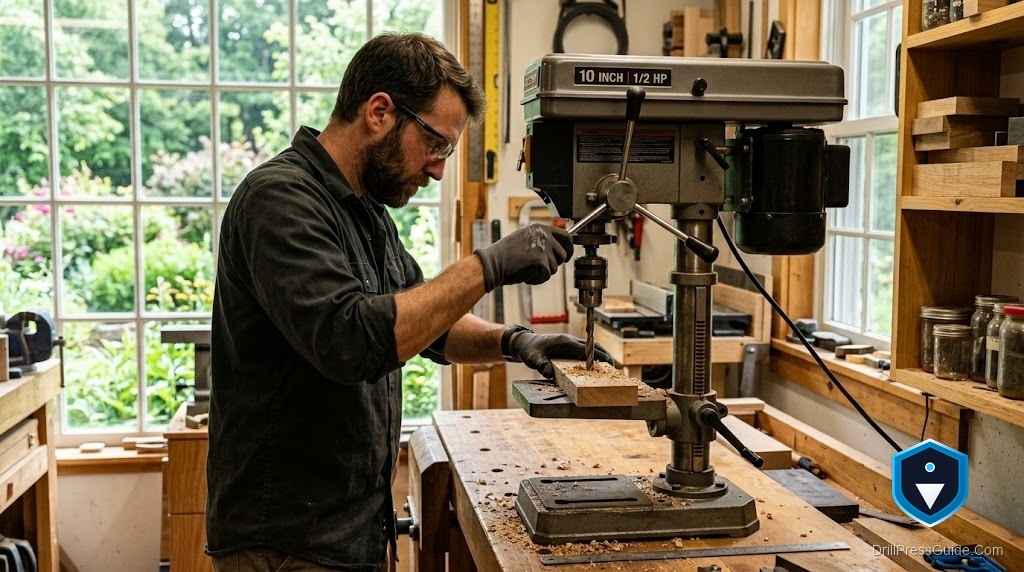
There’s a particular kind of drill press that shows up in garages across America—a little beat-up, maybe missing the chuck key, with a speed chart that’s been obscured by 20 years of sawdust. Nine times out of ten, it’s a Craftsman. The 10-inch, 1/2 HP benchtop model has been in production in one form or another since the Sears catalog days, and it keeps showing up because, for light-duty shop use, it holds up. But is it the right machine to buy new today? Let’s work through it honestly.
A Little History: Who Makes Craftsman Drill Presses Now?
If you’re old enough to have bought tools at Sears, you probably think of Craftsman as a Sears brand. That was true for decades. In 2017, Stanley Black & Decker acquired the Craftsman brand from Sears Holdings. Today, new Craftsman power tools and benchtop machinery are designed and distributed by Stanley Black & Decker and sold through Lowe’s, Amazon, Ace Hardware, and craftsman.com.
The old Sears-era Craftsman drill presses (model numbers like 113.213850, 113.213851, etc.) were manufactured by various OEMs in the US and later overseas under contract for Sears. Those machines have a robust parts ecosystem through Sears PartsDirect and eReplacementParts.com—decades of aftermarket support makes them excellent used buys if you find one in decent shape.
Current production 10-inch models sold under the Craftsman name today are typically manufactured in China, as is true for virtually all entry-level benchtop machinery at this price point.
Typical Specs: Craftsman 10-Inch 1/2 HP Drill Press
Different SKUs carry slightly different numbers, but the current 10-inch Craftsman 1/2 HP benchtop press clusters around these specs:
| Spec | Value |
|---|---|
| Swing | 10 inches |
| Motor | 1/2 HP, 120V single-phase |
| Speeds | 5-speed step pulley |
| Speed Range | ~620–3,100 RPM |
| Chuck | 5/8” JT33 keyed chuck |
| Spindle Travel | 2 inches |
| Table Size | ~6.5” x 6.5” |
| Table Tilt | ±45° |
| Depth Stop | Yes (basic rod-and-collar) |
| Work Light | No (some SKUs) |
| Net Weight | ~33–38 lbs |
The 10-inch swing means the spindle centerline sits 5 inches from the column—that’s the working reach you have for large workpieces. It’s tight. For drawer pulls, small box hardware, or drilling 2×4 framing lumber, it works. For a full cabinet door or a wide shelf, you’ll be fighting the column.
The 5-speed system via stepped V-belt pulleys is simple and proven. Belt changes require loosening a tension bolt, shifting the belt, and re-tensioning—a 90-second job once you’ve done it twice. The speed range of roughly 620 to 3,100 RPM handles most wood drilling well, though the low end is a little high for large-diameter bits in hardwood (ideally you’d want 250–400 RPM for a 1-1/2” Forstner in hard maple; you can do it at 620, just take it slow).
What the 1/2 HP Motor Actually Means
Half a horsepower is, frankly, the minimum useful motor for a drill press. It’s plenty for:
- Twist bits up to 1/2” in softwood and most hardwood
- Forstner bits up to 1-1/4” in wood (at appropriate low speed)
- Small-diameter bits in thin aluminum or plastic
It starts to protest when you push:
- 1-1/2”+ Forstner bits in dense hardwood
- Large spade bits (they tend to grab and stall)
- Any aggressive feed rate in metal
The motor in this class is an induction motor—quiet, reliable, long-lived as long as you don’t cook it. Keep it cool, don’t force a stall, and it’ll run for 20 years.
Comparison: Craftsman 10-Inch vs. Ryobi DP103L vs. WEN 4208
| Feature | Craftsman 10” 1/2 HP | Ryobi DP103L | WEN 4208 |
|---|---|---|---|
| Swing | 10” | 10” | 8” |
| Motor | 1/2 HP | 1/2 HP | 1/3 HP |
| Speeds | 5 | 5 | 5 |
| Speed Range | ~620–3,100 RPM | ~620–3,100 RPM | ~740–3,140 RPM |
| Chuck | 5/8” JT33 | 1/2” JT33 | 1/2” JT33 |
| Table | Steel stamping | Steel stamping | Steel stamping |
| Weight | ~35 lbs | ~33 lbs | ~24 lbs |
| Street Price | ~$160–$200 | ~$130–$160 | ~$90–$130 |
The Ryobi DP103L is a near-identical twin to the Craftsman in most specs—both are OEM products assembled from the same general supply chain. The Ryobi typically costs slightly less and comes with a laser, which the basic Craftsman model often omits. The tradeoff: Craftsman has a somewhat broader parts and support ecosystem in the US.
The WEN 4208 is one step smaller—8-inch swing and 1/3 HP—and is the right choice if budget is the primary constraint and your work is truly occasional light drilling. Don’t expect it to chew through anything demanding.
Parts Availability
This is where the Craftsman 10-inch genuinely shines for buyers of used machines.
For vintage Sears-era models (113.xxxxxx model numbers):
- Sears PartsDirect (searspartsdirect.com) still carries a surprising range of belts, springs, chuck keys, and hardware for these machines. The older the model, the more aggressive you’ll need to be with the search, but they’re there.
- eReplacementParts.com carries the exploded diagrams and parts with reasonable pricing.
- Common wear items: V-belt (check the model-specific width and length before ordering), quill return spring, chuck key, depth stop collar.
For current SBD-era Craftsman models:
- Parts support through Craftsman’s own service network and retailers.
- The JT33 chuck is a universal taper—aftermarket chucks drop right in, and a JT33 keyed chuck from a quality supplier is a frequent first upgrade.
- Always keep a spare chuck key on hand. The included one disappears, and the machine is useless without it.
Common Upgrades That Make a Big Difference
Link Belt The biggest bang-for-buck upgrade on any belt-drive drill press. A link belt replaces the molded V-belt and eliminates the vibration caused by a belt that’s taken a set from sitting in a box. On a light machine like the Craftsman 10”, the difference in smoothness is significant. The link belt also self-tensions over time, so belt changes stay in adjustment longer.
Drill Press Vise The stock table has a center hole for hold-downs, but no T-slots on many SKUs. A small WEN 3” vise with a bolt-through setup gives you real workholding for metal and small parts. Clamp it down before you drill metal—a spinning part is a dangerous part.
Work Light The Craftsman 10-inch rarely includes a work light. A magnetic LED work light that attaches to the column or head casting transforms the working view, especially in a windowless shop.
Honest Limitations
- The table is small. At roughly 6.5 x 6.5 inches, large workpieces need auxiliary support.
- No T-slots on some SKUs. Check before you buy if workholding is important.
- Runout varies. Like all machines in this price range, spindle runout can vary piece to piece. 0.003–0.008” is typical; some owners get lucky, some don’t.
- The fence is basic or absent. If you need a fence for repetitive work, add an aftermarket solution.
- Column flex. Under aggressive feed pressure, a 10-inch benchtop column will deflect more than a 15-inch floor model. Keep feed pressure moderate.
Who Is the Craftsman 10-Inch 1/2 HP Best For?
Buy it if:
- You drill occasionally—a few times a month, not a few times a day.
- Your workpieces are small to medium (under 8 inches wide).
- You’re on a tight budget and need something reliable out of the box.
- You want parts availability, especially if buying used.
Look elsewhere if:
- You need a 12”+ swing for wide cabinet work.
- You’re drilling metal regularly.
- You want variable speed or a wider RPM range.
- You expect heavy daily use.
Frequently Asked Questions
Q: Who makes Craftsman drill presses today? A: Stanley Black & Decker owns the Craftsman brand since 2017 and manufactures/sources current Craftsman machinery. They’re sold at Lowe’s, Amazon, and craftsman.com.
Q: What chuck does the Craftsman 10-inch use? A: A standard JT33 taper keyed chuck. Aftermarket JT33 chucks are universally compatible.
Q: Where can I find a belt for my old Sears Craftsman drill press? A: Sears PartsDirect and eReplacementParts.com both carry belts for vintage 113-series Craftsman drill presses. Measure the belt circumference and cross-section before ordering.
Q: Can I use the Craftsman 10-inch on metal? A: For light work—drilling 1/4” holes in aluminum or thin mild steel—yes, with cutting oil and appropriate slow speed. Don’t push it for production metalwork.
Q: Is 1/2 HP enough for Forstner bits? A: For bits up to 1-1/4” at low speed, yes. For larger Forstner bits in hardwood, you’ll want to slow down and accept that it will labor.
Q: How do I change the belt speed? A: Loosen the motor tension bolt, shift the V-belt to the appropriate pulley step, re-tension. The speed chart is printed on the inside of the head cover—keep it clean.
Q: What’s the chuck capacity? A: 5/8 inch maximum shank diameter on current models. Some older Sears-era models shipped with a 1/2” chuck.
Q: What are common problems with this machine? A: Chuck key loss (get a spare immediately), V-belt vibration (link belt fixes it), quill return spring weakness on older units (replaceable), and table alignment drift (re-square periodically).
Final Verdict
The Craftsman 10-inch 1/2 HP drill press is a utility player. It’s not glamorous, it won’t impress anyone at a cabinet shop, and it’ll strain under pressure. But for a hobbyist who needs an honest, compact drill press that sits on a corner of the bench and gets occasional use, it earns its place. Buy new if you want the warranty coverage, or buy used if you find a solid Sears-era model with good bones—either way, throw a link belt on it the first week and thank yourself later.
SEO Metadata


