
Is the Craftsman 8-Inch Drill Press (1/3 HP) Right for Your Shop?
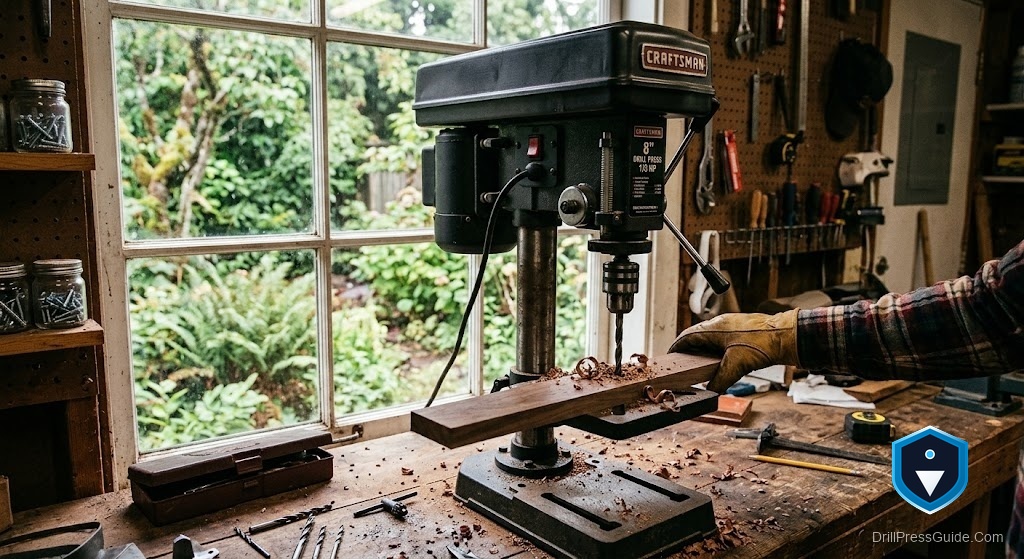
A neighbor offers you an old Craftsman 8-inch drill press for the price of a decent lunch, and you are standing in the garage trying to decide. The paint is chipped, the chuck wears a little rust, but the spindle spins true and the motor hums without a rattle. Do you take it home?
I have cleaned up a few of these small Sears bench presses, and I can save you the guessing. The Craftsman 8-inch drill press with a 1/3 HP motor is a light-duty bench tool for punching holes in wood, plastic, and thin metal. It is honest about what it is. For a hobby bench, a garage, or a maker who drills a few holes a week, a good one is worth grabbing.
The short answer
The Craftsman 8-inch, 1/3 HP drill press (the common model is 113.213080) is a three-speed bench machine. It runs at 620, 1,300, and 3,100 RPM by moving a single V-belt across stepped pulleys. The 1/3 HP figure is listed as “maximum developed” horsepower, which is a peak number, not a steady rating, so treat this as a small-hole tool. It shines with twist bits in wood and light metal. It fights you on large Forstner bits and hole saws.
If you want a lifetime shop press for cabinet work or metal, this is not it. If you want a compact, repairable machine that keeps your holes square, it earns its bench space.
What you actually get
The “8-inch” name means the swing. There is about 4 inches from the bit to the column, so you can reach the center of an 8-inch-wide board. The table tilts and has a bevel scale for angled holes, and a lock to hold it.
The motor is a small induction motor, roughly 1,725 RPM, wired for 110 to 120 volts. Speed changes happen by hand at the belt, not with a dial. Three speeds cover most wood and small metal jobs.
The chuck is keyed. Many of these shipped with a 1/2-inch capacity chuck, though some carry a 3/8-inch chuck, so measure the jaws and check the number stamped on the chuck body before you buy bits or a replacement key.
Where it does well
Small, accurate holes are the whole point. A drill press keeps the bit vertical, which a handheld drill cannot promise. For dowel holes, pilot holes, and light metal drilling, this Craftsman does clean work.
It is also easy to live with. The head is light enough to lift onto a bench alone. Parts are simple. Belt changes take a minute once you learn the pulley layout printed inside the guard.
The honest flaws, and who should skip it
Power is the ceiling. A 1/3 HP motor bogs down under big bits, and forcing it glazes the belt and heats the motor. Large hole saws in hardwood are a bad match.
Quill travel is short on these small presses, often around 2 inches, so deep holes need repositioning. The three fixed speeds also skip the very slow range that large bits and metal want.
Skip this press if you drill steel daily, run 1-inch-plus Forstner bits, or need a slow spindle for big twist drills. Step up to a 12-inch or larger press instead. Buy it if your work is small, your bench is tight, and you value a tool you can actually fix.
How the 8-inch stacks up against a bigger press
| Feature | Craftsman 8-inch (1/3 HP) | Typical 12-inch bench press |
|---|---|---|
| Swing | 8 inches | 12 inches |
| Motor | 1/3 HP (max developed) | 1/3 to 1/2 HP |
| Speeds | 3 fixed | 5 or more |
| Quill travel | about 2 inches | 2 to 3-1/4 inches |
| Best use | small holes, light metal, wood | wider stock, more range |
Buying a used one: what to check first
Spin the spindle by hand. It should turn smoothly with no grinding and no side-to-side wobble at the chuck. Rough or gritty rotation points to worn bearings.
Pull the quill down by the feed handles and let it return. It should glide and spring back on its own. A sticky quill or dead return spring is fixable, but it tells you the machine sat neglected.
Check the chuck jaws for chips and the taper for rust. Look at the belt for cracks and glazing. Run the motor and listen for a steady hum, not a buzz or a scream. Finally, wiggle the table on the column to confirm the lock holds.
Parts and where owners really find them
These presses are old, so treat them as a rebuild project, not a warranty item. Sears PartsDirect still lists diagrams and the owner’s manual for the 113.213080, which is the fastest way to match a key number to a part. eReplacementParts and similar OEM parts sellers carry belts, springs, and hardware for many Craftsman presses.
For the small stuff, a quill return spring, set screws, and a fresh belt cover most tune-ups. If a specific casting is gone, watch estate sales and online listings for a parts machine of the same model.
Accessories worth adding
A drill press vise keeps your hands clear and your holes consistent, especially in metal and small parts. The WEN 3-inch drill press vise bolts to most tables and grips wood, plastic, and metal. Its throat is shallow, so tall workpieces still need clamps.
A matching chuck key saves headaches if yours is missing. Read the number stamped on your chuck, then match it. Many Jacobs-style chucks in this size take a Jacobs K3 chuck key, but confirm your stamped number first, since the wrong pilot will not seat.
Good light removes guesswork on layout lines. A magnetic-base LED work light sticks to the head and bends where you need it. The gooseneck can drift under vibration, so reposition it after heavy drilling.
The verdict
The Craftsman 8-inch, 1/3 HP drill press is a keeper for small, careful work and a poor pick for heavy drilling. Bought clean and treated as light-duty, it will outlast tools that cost far more.
Your quick takeaways:
- Match the machine to small holes in wood and light metal, not big bits.
- Confirm smooth spindle rotation and a working quill return before buying used.
- Verify your chuck size and stamped key number before ordering bits or a key.
- Add a vise and a work light to get accurate, repeatable results.
FAQ
How much horsepower does the Craftsman 8-inch drill press have? It carries a 1/3 HP motor listed as maximum developed horsepower. That is a peak figure, so plan for light-duty drilling in wood, plastic, and thin metal rather than heavy metal work.
How many speeds does it have? The common 8-inch model has three speeds, roughly 620, 1,300, and 3,100 RPM. You change speeds by moving the V-belt across stepped pulleys under the guard.
What size chuck is on a Craftsman 8-inch drill press? Many came with a 1/2-inch keyed chuck, though some carry a 3/8-inch chuck. Measure the jaws and read the chuck body to be sure before buying bits or a replacement.
Can it drill steel? Yes, for small holes with sharp bits and cutting oil. Its lowest speed is still fast for large metal bits, so keep hole sizes modest and let the bit do the work.
Is a Craftsman 8-inch drill press worth buying today? If it runs smoothly and the price is fair, yes for a hobby or garage bench. It is compact, simple, and repairable. Buyers who need heavy drilling should look at a larger press.
Where can I find the manual and parts? Sears PartsDirect hosts the owner’s manual and parts diagrams for the 113.213080. OEM parts sellers carry belts, springs, and hardware.
What speed should I use for wood versus metal? Use higher speeds for small bits in wood and lower speeds for larger bits and metal. Set the belt to the slowest practical speed when the bit gets bigger.
Why does the spindle wobble or feel rough? Rough rotation usually means worn spindle bearings, while a loose chuck can mimic wobble. Check the chuck mount first, then plan a bearing replacement if the grinding continues.
References
- Sears PartsDirect, Craftsman 113.213080 drill press parts and owner’s manual: https://www.searspartsdirect.com/model/3zq8id8bi0-000247/craftsman-113213080-drill-press-parts
- Sears PartsDirect, Craftsman drill press owner’s manual (bench model, 1/3 HP): https://c.searspartsdirect.com/mmh/lis_pdf/OWNM/L0904330.pdf


