
Craftsman 10-Inch Drill Press 2/3 HP: What Owners Should Check Before Buying or Repairing
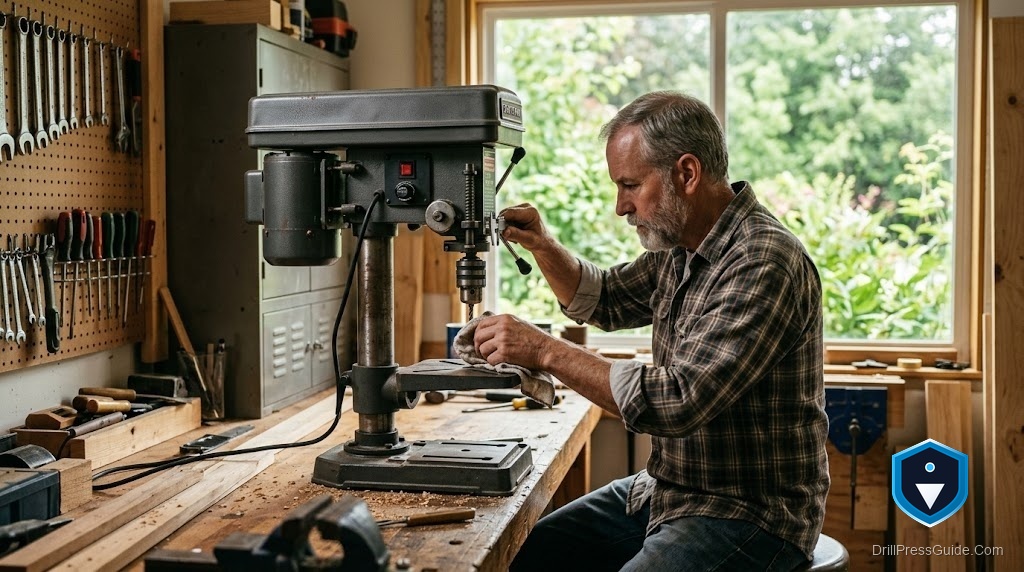
I found my first small drill press under a folding table at an estate sale, a coffee can of rusty bits balanced on its head. The seller just wanted it gone. If you are looking at a Craftsman 10 inch drill press with a 2/3 HP rating, you are weighing the same thing I was: a compact bench machine that promises more bite than its footprint suggests. Before you hand over cash or start tearing one apart on your bench, here is what that rating really means and what to check first.
A Craftsman 10 inch drill press is a benchtop machine with a 10 inch swing, which means it can reach the center of a 10 inch circle (about 5 inches from the column to the spindle). The 2/3 HP number is a “maximum developed” figure, a peak the motor touches for a moment, not the power it holds all day. Treat it as a light to medium duty press for wood, plastic, and the occasional pass through thin steel.
What “2/3 HP maximum developed” actually buys you
This is the honest part most listings skip. “Maximum developed” is a stall or peak rating. Continuous running power sits lower, often around a third of a horsepower on these small heads. That is fine for a 3/8 inch bit in pine and workable for a 1/2 inch bit in hardwood if you feed slowly and let the bit clear chips.
Where it struggles: large Forstner bits, hole saws over about 2 inches, and repeated drilling in steel. The motor bogs, the belt slips, and you start feeding harder, which is exactly when things wander. If your work is metal-heavy or you live on big Forstner bits, skip this size and look at a 13 or 17 inch press instead.
Specs at a glance
These figures track the 10 inch Craftsman bench press sold with the Laser Trac guide, one of the more common 2/3 HP versions.
| Feature | Spec |
| Swing | 10 in |
| Motor | 2/3 HP maximum developed, 6.0 A, 120 V |
| Speeds | 5 (620 to 3100 RPM) |
| Chuck | 1/2 in |
| Spindle travel | 2 in |
| Throat | 5 in |
| Table | 7-5/8 in x 6-1/2 in, tilts 45 degrees left or right |
That 2 inch spindle travel is the quiet limitation. You cannot bore deep in one plunge, so plan on pecking and resetting for anything past a couple of inches.
1/2 HP versus 2/3 HP: which 10-inch did you find?
Sears sold more than one 10 inch bench press, and the plate on the back of the head tells you which. The older 113.213090 carries a 1/2 HP maximum developed motor. The Laser Trac version steps up to 2/3 HP and adds a laser crosshair.
| Trait | 113.213090 (1/2 HP) | Laser Trac (2/3 HP) |
| Swing | 10 in | 10 in |
| Motor | 1/2 HP max developed | 2/3 HP max developed |
| Speeds | 5 | 5 (620 to 3100 RPM) |
| Laser guide | No | Yes |
| Chuck | 1/2 in | 1/2 in |
The real-world gap between them is small. The laser is handy for lining up marked stock but drifts out of alignment over time and needs occasional adjustment. If someone tells you the 2/3 HP model is in a different class, it is not. Buy on condition, not on that extra fraction of a horse.
What to check before you buy a used one
Estate sale presses hide their sins until you get them home. Run through this quickly, in front of the seller if you can.
- Spindle runout. Chuck a straight bit or a ground rod, spin it by hand, and watch the tip. A visible wobble points to a tired quill bearing or a bent spindle. A little is normal on a light press. A lot means a rebuild.
- Quill return. Pull the feed handles down and let go. The quill should snap back cleanly. Sluggish return usually means a weak or slipped torsion spring in the spring cap.
- Belt and pulleys. Open the guard. A glazed, cracked, or oil-soaked V-belt is normal on an old press and cheap to fix. Check the motor pulley and center pulley for chewed grooves.
- Play in the quill. Extend the quill fully and rock it. Side-to-side slop means worn bearings or a worn quill tube.
- The switch. Many of these use a removable locking switch key. Missing keys are common and replaceable, but confirm the switch itself works.
- Table and column. Look for cracks around the table bracket and check that the head locks tight to the column with no droop.
If the head spins true and the quill returns, most of the rest is maintenance.
Common repairs and where the parts come from
These presses are out of production, so forget the big-box shelf. Owners keep them running through a few reliable channels. Sears PartsDirect still hosts the original owner’s manuals and exploded parts diagrams by model number, which is the fastest way to match a retaining ring, ball bearing, or spring cap to your exact head. eReplacementParts carries overlapping OEM stock and posts the same diagrams.
The repairs that come up most: replacing the V-belt, swapping the quill return spring, and refreshing the spindle bearings. None of these is hard with the manual open. The belt is the single most common fix, and because length varies by model, measure your old one and match it by size rather than trusting a generic “fits Craftsman” claim.
Accessories worth adding
The chuck on this press is 1/2 inch, and many of these heads use a common JT33 taper on the spindle nose. Confirm your taper before ordering, then a keyed replacement like this JT33 1/2-inch keyed drill chuck drops in. Its flaw: import chucks can show a few thousandths of runout out of the box, so if you do precision metal work, hold out for a name-brand Jacobs instead.
For holding small parts, a vise beats your fingers every time. A WEN 4-inch drill press vise bolts to the table through its slots and grips wood, plastic, and light metal. It is light, and the jaws can rack under hard clamping pressure, so if you plan to hold large or heavy stock, step up to a heavier tool like the Palmgren 4-inch drill press vise with its replaceable steel jaws and machined base. For a light bench press, though, the WEN is all most owners need.
The verdict
The Craftsman 10 inch 2/3 HP drill press earns its bench space if you drill wood and plastic, work with bits up to about 1/2 inch, and value a compact machine you can lift onto a shelf. It is the wrong tool for steady metal work, deep bores, or large-diameter cutters, and the 2 inch spindle travel will frustrate anyone doing repetitive deep holes.
Three things to hold onto:
- Buy on mechanical condition, not on the 2/3 HP badge. The 1/2 HP version does nearly the same work.
- Check spindle runout and quill return before anything else. Those two tell you whether it is a tune-up or a project.
- Keep the model number handy. Every belt, bearing, and spring you order later starts with that plate on the back of the head.
FAQ
What does 2/3 HP mean on a drill press? It is a maximum developed rating, the peak the motor reaches briefly under load. Continuous running power is lower, often around a third of a horse on these small heads. It is a light to medium duty rating, not a workshop workhorse.
Is a Craftsman 10 inch drill press 2/3 HP good for metal? For thin steel and small bits, yes, if you slow the speed and feed gently. For steady metal drilling or bits over 1/2 inch, it bogs down. A larger press suits metal better.
What size chuck is on a Craftsman 10 inch drill press? Most 10 inch Craftsman bench presses use a 1/2 inch chuck. Many heads carry a JT33 spindle taper, but confirm yours before buying a replacement.
What speeds does the Craftsman 10 inch drill press run? The common Laser Trac version offers 5 speeds from 620 to 3100 RPM, set by moving the belt across stepped pulleys.
Where can I get a Craftsman 10 inch drill press owners manual? Sears PartsDirect hosts the original owner’s manuals as free PDFs, searchable by model number such as 113.213090. The manual includes the parts diagram you will need for repairs.
Can I still get parts for an old Craftsman 10 inch drill press? Yes. Sears PartsDirect and eReplacementParts both stock OEM parts and post exploded diagrams. Belts, bearings, and springs are the most common items.
What is the difference between the 1/2 HP and 2/3 HP versions? Mostly the motor rating and, on the 2/3 HP Laser Trac model, a laser crosshair guide. Real-world capability is close, so condition matters more than the horsepower label.
How do I know if a used Craftsman drill press is worth buying? Spin a straight bit in the chuck to check for wobble, let the quill snap back to test the return spring, and open the guard to inspect the belt and pulleys. A true-running spindle and clean quill return mean the rest is maintenance.
References
- Craftsman 113.213090 drill press owner’s manual and parts, Sears PartsDirect: https://www.searspartsdirect.com/manual/36w1x6dto8-000247/craftsman-113213090-drill-press-parts
- Operator’s Manual, 10-inch Drill Press with Laser Trac, Sears PartsDirect (PDF): https://c.searspartsdirect.com/mmh/lis_pdf/OWNM/1203099L.pdf
- Craftsman drill press parts index, eReplacementParts: https://www.ereplacementparts.com/parts/power-tool/drill/drill-press/craftsman/


