A Closer Look at the Craftsman 10-Inch Drill Press 1/2 HP
Somebody offers you a used Craftsman 10-inch drill press with a 1/2 HP motor for the price of a nice dinner, and you feel the pull. I have felt it too. These old Sears-built benchtop presses show up at estate sales and on marketplace listings every week, and a good one is a genuinely handy machine. A rough one is a project. This guide helps you tell the two apart, keep a good one running, and decide when a modern press makes more sense.
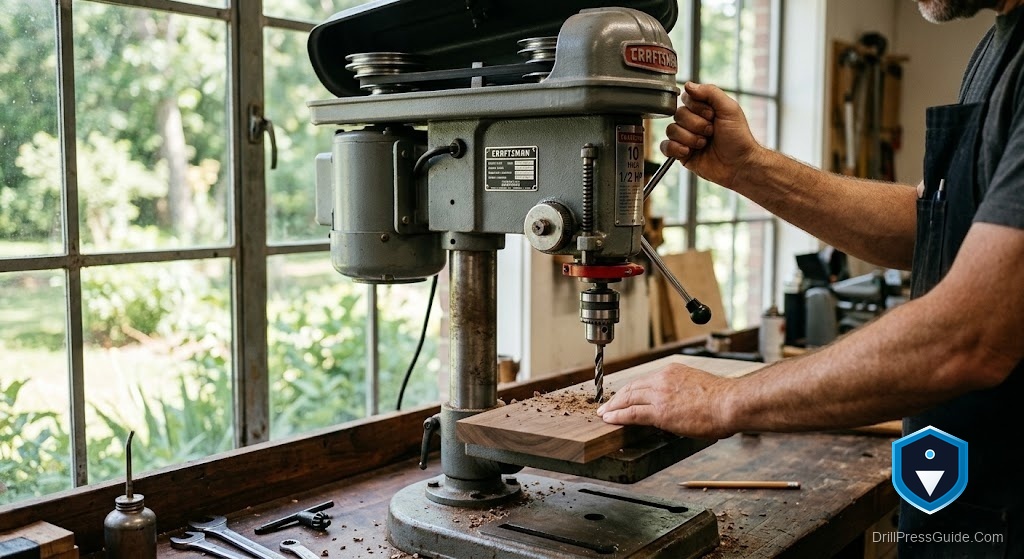
Here is the honest summary. The Craftsman 10-inch drill press 1/2 HP refers to a family of vintage Sears benchtop presses, sold under model numbers like 113.213090 and 113.213092, with a 10-inch swing, a 1/2 HP motor, a V-belt step-pulley drive, and a tilting cast table. They were built well, they are discontinued, and parts now come from Sears PartsDirect and the used market rather than a store shelf. If you find one that runs true and shifts speeds cleanly, it is worth owning. If the bearings growl or key parts are missing, walk away.
What you are actually looking at
The 113-prefix tells you Sears sold it, and the number after the dot identifies the exact model. That matters, because parts diagrams are model-specific. A typical 10-inch 1/2 HP bench model spins through several speeds by moving a V-belt across step pulleys, drives the quill down with a three-spoke feed handle, and clamps a 1/2-inch or 5/8-inch keyed chuck on a JT33-style spindle. The table tilts for angled drilling, and the head, table, and base are cast iron, which is why a 40-year-old example can still run smooth.
Common parts you will see named on the diagrams include the V-belt, the center pulley and motor pulley, the ball bearings, the quill return torsion spring and its cap, the chuck and chuck key, the spindle assembly, and the head casting. Knowing those names makes ordering parts and reading a listing far easier.
What to check before you buy a used one
Buying used is where most of the risk lives, so slow down and inspect.
- Runout. Chuck a straight bit, spin it by hand, and watch the tip. A little wobble is normal on an old press, a lot means a bent spindle or a tired chuck.
- Bearings. Spin the spindle and listen. Growling or grinding means a bearing rebuild is in your future.
- Belt and pulleys. A cracked, glazed V-belt is cheap to replace. Chewed or cracked pulleys are not.
- Return spring. The quill should return smoothly on its own. A broken torsion spring or missing spring cap is a common fault.
- Chuck and key. Make sure the chuck grips and the correct chuck key is present. Missing keys and worn chucks are everywhere.
- Switch and cord. Old locking switches and brittle cords are a safety issue. Budget to replace anything questionable.
- Model plate. Read the number on the rear of the head and write it down. You need it for every part you order later.
Keeping a good one alive
The good news is that these presses are simple, and simple machines reward a little care. Two upgrades make the biggest difference on a vintage 10-inch Craftsman.
First, the belt. If the original V-belt is cracked or the press vibrates and squeals, an adjustable link V-belt is the fix owners rave about. You add or remove links to set the exact length, it installs without pulling the spindle, and it runs quieter and smoother than a stiff rubber belt. Match the 1/2-inch (A/4L) profile most of these presses use, and confirm your pulley groove before ordering.
Second, the chuck. If yours is worn or missing, a 1/2-inch JT33 keyed drill chuck with key mounts on the common JT33 taper these presses use and brings your grip and accuracy back. Tap it home on a clean taper with a soft mallet, no threads involved.
For anything mechanical, pull the model number and search Sears PartsDirect first. It hosts model-specific parts diagrams and manuals for the 113-series presses, and it still lists many wear items. Where a part shows as no longer made, owners turn to used-parts sellers, eReplacementParts, and machinist forums.
When to buy new instead
A vintage press is not always the smart buy. If you cannot find one in good shape, or you want a warranty and a manual, the current Craftsman 10-inch benchtop drill press (model CMXEDAX69434601) is the modern equivalent. It runs a 4.1-amp motor across five speeds from 620 to 3,070 RPM, has a cast iron table that tilts 0 to 45 degrees, adds a rack-and-pinion table crank and an LED work light, gives 3.5 inches of spindle travel, and ships with a chuck key. Note that Craftsman rates it in amps, not horsepower, and it is a lighter machine at about 53 pounds, so it is less rigid than a heavy vintage casting. It is sold through Craftsman, Lowe’s, and Ace rather than Amazon.
Here is the honest trade. The old 1/2 HP presses often feel more solid and can be had for very little, but you inherit their age and chase parts. The new CMXEDAX69434601 is lighter and less stout, but it is current, supported, and has modern touches like the LED and the rack-and-pinion table. Buy the vintage press if you enjoy tinkering and find a clean one. Buy new if you want to plug in and drill today.
The verdict
A Craftsman 10-inch drill press with a 1/2 HP motor is a good machine hiding inside a used-tool gamble. Judge the specific unit, not the badge. Keep these takeaways in hand.
- Inspect runout, bearings, the return spring, the belt, and the chuck before money changes hands.
- Write down the 113-series model number, since every part and manual is model-specific.
- A link V-belt and a fresh JT33 chuck fix the two most common complaints for very little effort.
- Use Sears PartsDirect for diagrams and parts, and lean on used sellers for anything discontinued.
- If a clean vintage press is not around, the current Craftsman CMXEDAX69434601 is the honest modern stand-in, lighter build and all.
FAQ
What horsepower is the Craftsman 10-inch drill press? The classic bench models in this family use a 1/2 HP motor. Some related Craftsman presses used 1/3 HP or higher, so check the model plate to confirm.
Are Craftsman 10-inch drill presses still made? The vintage 113-series 1/2 HP models are discontinued. Craftsman currently sells a 10-inch benchtop drill press, model CMXEDAX69434601, as the modern equivalent.
Where do I get parts for an old Craftsman drill press? Start at Sears PartsDirect using your exact model number for diagrams and available parts. For discontinued items, try used-parts sellers, eReplacementParts, and machinist forums.
What size chuck does it use? Most of these presses use a 1/2-inch or 5/8-inch keyed chuck on a JT33 taper. A replacement JT33 keyed chuck mounts by friction on the tapered spindle.
What belt does a Craftsman 10-inch drill press take? They use a V-belt, commonly a 1/2-inch (A/4L) profile. Many owners switch to an adjustable link V-belt for quieter, smoother running and easier speed changes.
How many speeds does it have? Vintage 10-inch bench models are step-pulley presses with several speeds set by moving the belt. The current CMXEDAX69434601 offers five speeds from 620 to 3,070 RPM.
Is a used Craftsman drill press worth buying? Yes, if it runs true, the bearings are quiet, and the key parts are present. A rough one with missing parts or a bent spindle is usually more trouble than it saves.
How do I find my model number? Look on the rear of the head for a plate showing the 113-series number and serial number. Record both before ordering parts or a manual.
References
- Craftsman, 10-in Benchtop Drill Press (CMXEDAX69434601) product page: https://www.craftsman.com/en-us/product/cmxedax69434601/10-benchtop-drill-press-41-amp
- Sears PartsDirect, Craftsman drill press parts and diagrams: https://www.searspartsdirect.com/combo/0247-1234675/craftsman-drill-press-parts
- Sears/Craftsman benchtop 10-inch drill press owner’s manual, model 113.213090 (PDF): https://c.searspartsdirect.com/mmh/lis_pdf/OWNM/L0803615.pdf