
A Closer Look at the Craftsman 8-Inch Drill Press 1/3 HP 3-Speed
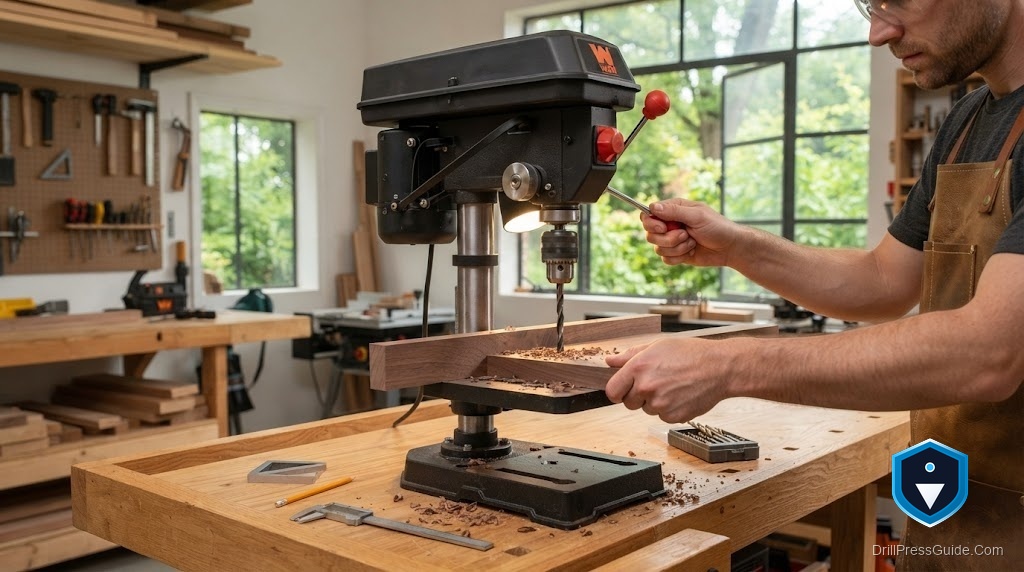
You open the garage door and the Craftsman bench press is right there, just as it has been for decades. The nameplate on the rear of the head reads something like 113.213080. You want to know what you actually own, what it can do, and whether you should keep using it or start looking at current machines. This article gives you straight answers.
An 8-inch drill press is defined by its swing: the maximum diameter circle you can center under the chuck, which means you have a 4-inch throat. Three-speed models use a step-pulley system, where you physically move the drive belt between pulley grooves to change the spindle’s RPM. There is no electronic speed control. The motor is always running at one fixed speed; the pulley ratio does the work.
Bottom line up front: the Craftsman 8-inch 1/3 HP 3-speed drill press is a capable light-duty benchtop tool for softwood, plastics, and occasional light metalwork. Its limitation is straightforward: three speeds means a narrower RPM range than a 5-speed machine, and that limits your material flexibility without workarounds.
What Models Are We Talking About?
Sears sold several 8-inch 3-speed benchtop presses under the 113.21XXXX numbering system over the decades. The best-documented 3-speed 1/3 HP model in this family is the 113.213080, whose original owner’s manual confirms the motor rating and three spindle speeds: 620 RPM, 1300 RPM, and 3100 RPM. The manual identifies the motor as a 1725 RPM unit wired for 110 to 120 volts, 60 Hz AC. The chuck accepts bits up to 1/2 inch.
Other closely related numbers appear in Sears Parts Direct archives, including 113.213843, which documentation confirms as a 1/3 HP 1725 RPM unit. If your model number is different but in the 113.21XXXX range and the head plate says 1/3 HP, the specs are likely similar. Always verify on the actual plate before ordering parts.
The Three Speeds: What They Mean in Practice
| Speed Setting | RPM | Best For |
|---|---|---|
| Low | 620 | Large bits (over 1/2 inch) in softwood, plastics |
| Mid | 1300 | General softwood drilling, light aluminum |
| High | 3100 | Small bits (1/8 to 1/4 inch) in wood |
The OSHA drill press eTool and CCOHS guidance both note that higher spindle speed combined with larger bit diameter generates excessive heat, dulls bits faster, and risks workpiece damage. At 3100 RPM maximum, this machine is well-suited for small-diameter bits but you will want to use the low or mid setting for anything above 1/2 inch.
A 5-speed machine gives you two additional rungs on that ladder. For most hobbyist work in softwood and plastics, the three-speed configuration is workable. Where you feel the gap is when you want to drill 1/4-inch steel or run a Forstner bit at the exact right surface footage for clean results in figured maple.
Setup and Operation
Step-pulley speed changes require the machine to be off and unplugged. The process takes about 90 seconds once you know it:
- Open the belt guard.
- Loosen the motor bracket adjustment to slack the belt.
- Move the belt to the desired pulley step. The inside of the belt guard has a speed chart showing which step produces which RPM.
- Re-tension the belt so it deflects about 1/2 inch under moderate finger pressure at the midpoint.
- Close the guard before starting.
The CCOHS guidelines emphasize that the belt guard must be closed before operation. On these older Craftsman machines the guard is a simple hinged cover. Do not operate with it open.
Workpiece setup matters as much as speed selection. Clamp or fence your stock. A spinning brad-point bit can catch an unclamped board and spin it hard enough to cause injury. OSHA’s drill press eTool makes this point clearly.
The Honest Flaw: Only Three Speeds
Three speeds is the machine’s real limitation, and it is worth naming directly. You cannot split the difference between 1300 and 3100 RPM. If a bit size or material calls for, say, 2000 RPM, you pick the closest option and adjust feed pressure to compensate. For experienced operators this is a minor inconvenience. For someone new to drill press work who wants to do everything by the book, it is genuinely restrictive.
Who should skip this machine: Anyone wanting to drill a wide range of materials, including hardwood at large diameters, steel of any meaningful thickness, or thin materials where precise low-speed control matters. A 5-speed press gives you meaningfully more flexibility without a large footprint increase.
Comparing to the WEN 4208T
| Feature | Craftsman 113.213080 (3-speed, 1/3 HP) | WEN 4208T (5-speed, 2.3A) |
|---|---|---|
| Swing | 8 inches | 8 inches |
| Speeds | 3: 620, 1300, 3100 RPM | 5: 740, 1100, 1530, 2100, 3140 RPM |
| Motor | 1/3 HP, 1725 RPM | 2.3A induction |
| Chuck | 1/2 inch keyed | 1/2 inch keyed |
| Table | Steel | Cast iron, tilts 45 degrees each direction |
| Availability | Secondhand only | New |
The WEN 4208T is available new: WEN 4208T. It matches the Craftsman 5-speed on speed count and spindle travel while adding a cast iron table and current parts availability.
If you already own the Craftsman and it runs well, the case for replacement is mostly about speed range and parts availability going forward. If you are buying a press today, the WEN 4208T wins the comparison on every practical axis.
Parts Sourcing for a Discontinued Machine
Sears Parts Direct (searspartsdirect.com) is the starting point. Enter your model number and you will see which components are still listed. For the 113.213080 and similar models, common items like chuck keys, replacement belts, and table lock handles occasionally appear. For rarer components like the quill assembly or spindle pulley, eBay and forums like Garage Journal and LumberJocks are worth searching.
The chuck on these machines is a standard 1/2-inch keyed design. A Jacobs-compatible replacement chuck is straightforward to source independently. Verify the taper size (typically a Jacobs No. 33 taper on this class of Craftsman press) before ordering.
Verdict and Takeaways
The Craftsman 8-inch 1/3 HP 3-speed drill press (model 113.213080 and close relatives) is a functional, honest benchtop tool. It earns its place in a shop where the work is mostly softwood, plastics, and light hobby use. Three speeds is the machine’s meaningful limitation.
- The 620/1300/3100 RPM speed range handles most softwood and plastic work but leaves gaps for other materials.
- Speed changes require the machine to be off, unplugged, and the belt guard open.
- Parts sourcing is still possible through Sears Parts Direct and secondhand channels, but plan for patience.
- If five speeds and a cast iron table matter to you, the WEN 4208T is the practical current alternative.
FAQ
What model numbers are the Craftsman 8-inch 1/3 HP 3-speed drill press? The best-documented model is 113.213080. Related models include 113.213843. Check the plate on the rear of the head for your specific number.
What are the three speeds on the Craftsman 113.213080? 620 RPM, 1300 RPM, and 3100 RPM, as documented in the owner’s manual.
Can this press drill metal? Light, thin non-ferrous metals at the correct (low) speed with appropriate lubrication, yes. Thick steel or hardened materials, no.
How do I change speeds? Power off and unplug. Open the belt guard, loosen motor bracket tension, move belt to the desired pulley step, re-tension, close the guard.
Where can I get parts? Sears Parts Direct (searspartsdirect.com) is the primary source. eBay and woodworking forums are secondary options.
Is the chuck replaceable? Yes. The chuck uses a standard Jacobs taper. Verify the taper size before ordering a replacement chuck.
How does the 3-speed compare to a 5-speed press? A 5-speed press gives you two additional RPM steps, which helps you match the correct surface footage for more materials and bit sizes. For light softwood work, the difference is modest. For varied material use, it is noticeable.
What is the spindle travel on the 113.213080? The manual does not specify; community reports suggest approximately 2 inches, typical for 8-inch benchtop presses of this era.
What is the current best alternative? The WEN 4208T: WEN 4208T.
References
- Sears Parts Direct, Craftsman 113213080 drill press manual: https://www.searspartsdirect.com
- WEN Drill Press FAQs: https://wenproducts.com/pages/drill-press-faqs
- OSHA Woodworking Drill Press eTool: https://www.osha.gov/etools/woodworking/production/machines-tools/drill-press
- CCOHS, Drill Presses: https://www.ccohs.ca/oshanswers/safety_haz/metalworking/drillpresses.html


