
Understanding the Craftsman 15-Inch 12-Speed 1/2 HP Drill Press: Setup, Limits, and Support
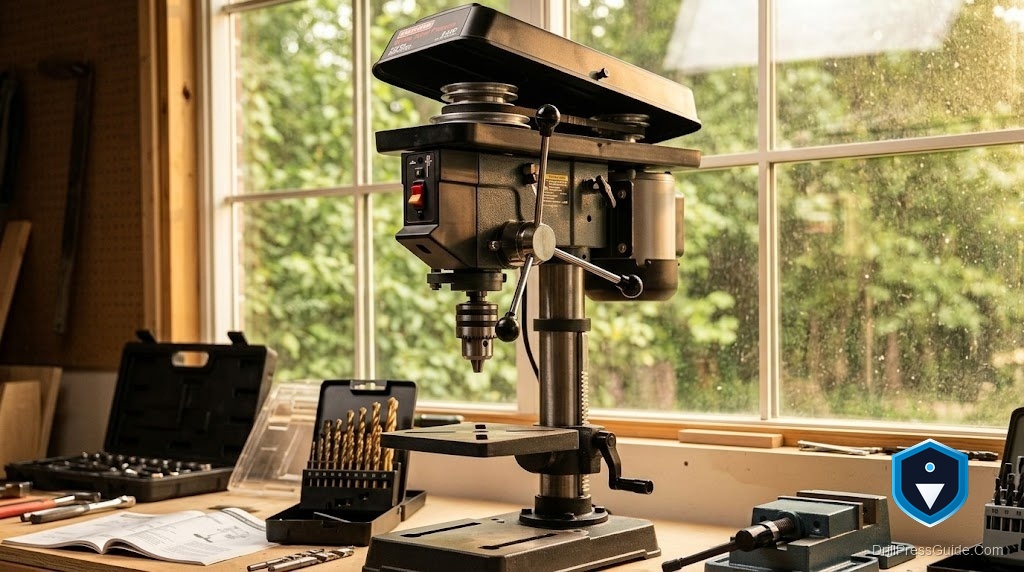
Open the belt guard on a Craftsman 15-inch 12-speed 1/2 HP drill press and you meet the machine’s whole personality at once: three pulleys, one V-belt, and a chart telling you which of twelve speeds each belt position gives you. This is a fixed-column floor press built around that 12-speed belt setup, and getting the speeds right is most of getting good results out of it.
A drill press like this is a stationary machine with a motor driving a spindle down a fixed vertical column, using a belt-and-pulley system to set the drilling speed. The 15-inch label is the swing, meaning it can drill to the center of a 15-inch-wide circle, roughly 7.5 inches from the column. The 12-speed part tells you how many spindle speeds the pulley steps give you.
What should you know first? Three things: the 12 speeds run from about 250 to 3,100 RPM, the motor is a 120-volt induction unit that delivers around 1/2 HP in real use, and every speed change means moving the belt by hand. That belt-driven speed range is wide enough for large-diameter wood bits at the low end and small twist bits at the top. Set the speed to the material and bit, and this press does clean, repeatable work.
What does the 12-speed belt setup actually give you?
The 12 speeds exist so you can match spindle RPM to the bit and material, and the belt layout is how you select them. Craftsman ran this 15-inch press (model 137.229151 and the closely related 137.229150) with a stepped pulley on the motor, an intermediate pulley, and a pulley on the spindle. Moving the belt across those steps yields twelve speeds spanning roughly 250 to 3,100 RPM.
Low speeds (down near 250 RPM) are for large Forstner bits and holesaws, which must turn slowly to cut cleanly and stay cool. High speeds (up toward 3,100 RPM) are for small twist bits in wood. The chart inside the guard maps each belt position to its speed, so the setup is less about guesswork and more about reading the table and moving one belt.
How much can the 1/2 HP motor really handle?
The 1/2 HP motor is honest for mid-size drilling and reaches its limit on the biggest bits. The plate reads 1 HP maximum developed, but that is Sears marketing shorthand: the 120-volt, 8-amp induction motor delivers around 1/2 HP continuously, and that is the figure that matters under a cut. At 1/2 HP it drives twist bits, spade bits, and mid-size Forstners in hardwood without drama.
The honest flaw is what happens at the extremes. Drop to the lowest speed for a 2-inch-plus Forstner or a large holesaw in hard maple and you can feel the motor labor if you feed too fast. In steel, small and mid-size bits are fine, but large-diameter holes ask more than 1/2 HP wants to give. The other physical gripe owners raise is the table-height crank: on this generation it can bind and feels coarse, so raising a heavy table mid-setup is a two-hand chore.
Who should skip this: if you routinely bore large holes in hardwood or thick steel, a 3/4 HP or larger press will hold speed under those bits, and this 1/2 HP machine will slow you down.
How does the 15-inch 12-speed compare to the bigger 17-inch Craftsman?
Choose the 15-inch 12-speed for general wood and light metal, and step up to the 17-inch 16-speed only if you need more swing and power. Set side by side, the differences are clear. The 15-inch reaches the center of a 15-inch circle and offers 12 speeds on a 1/2 HP motor. The larger Craftsman 17-inch press swings 17 inches, adds four more speeds (16 total, roughly 200 to 3,630 RPM), and runs a stronger motor rated near 3/4 HP. If your stock is small and your bits are modest, the 15-inch is the right size and the extra swing is weight you do not need. If you drill wide panels or big metal, the 17-inch is the honest answer.
Verdict on the 15-inch 12-speed: a genuinely useful shop press for the person doing everyday wood and occasional metal, and an easy machine to keep running because parts are still around. It is not the tool for heavy production drilling, and it does not pretend to be.
Where do you get manuals and parts support?
Sears PartsDirect hosts the owner’s manual and parts diagrams for the Craftsman 137.229151 and related 15-inch presses. Search the model number from the plate on the head to pull the correct schematic, then order belts, chuck keys, and pulleys against that diagram. When a factory belt is out of stock, a correctly sized A-section V-belt from any supplier works. Follow the usual drill press safety while you set up: clamp the workpiece, never hold it freehand, use eye protection, and set the recommended speed for the material, as OSHA and CCOHS both advise.
Conclusion
The Craftsman 15-inch 12-speed 1/2 HP drill press is a well-matched machine for a home or hobby shop, built around a 12-speed belt system that covers most wood and light metal work. My verdict: keep or buy one if your drilling is everyday-scale, and step up to a 17-inch only if swing and power are holding you back.
Concrete takeaways:
- The 12 speeds (about 250 to 3,100 RPM) are the machine’s strength; learn the guard chart and match speed to the bit.
- The motor is honestly around 1/2 HP despite the 1 HP maximum-developed label, and it labors on the largest bits.
- The table-height crank can bind, so expect a coarse two-hand adjustment.
- Manuals and parts for model 137.229151 are available through Sears PartsDirect.
FAQ
What is the speed range of the Craftsman 15-inch 12-speed drill press? The twelve speeds run from roughly 250 to 3,100 RPM. Low speeds suit large Forstner bits and holesaws, while high speeds suit small twist bits in wood.
Is the motor really 1/2 HP? In continuous use, yes. The plate reads 1 HP maximum developed, but the 120-volt, 8-amp induction motor delivers around 1/2 HP under load, which is the working figure.
What model number is the 15-inch 12-speed Craftsman? Common examples are model 137.229151 and the closely related 137.229150. Check the plate on the head to confirm yours before ordering parts.
How do I change speeds on this drill press? Open the belt guard, loosen the belt tension, and move the single V-belt across the stepped pulleys to the position shown on the chart inside the guard, then re-tension. There is no variable-speed dial.
Can it drill metal as well as wood? Yes for small and mid-size holes. Slow the speed for steel and clear chips often. Large-diameter metal drilling pushes past what a 1/2 HP motor handles comfortably.
What chuck size does it use? This press uses a 5/8-inch chuck, which accepts most common wood and metal bits directly.
Where can I download the manual? Sears PartsDirect hosts the owner’s manual for model 137.229151 and related units. Search the model number to find the manual and parts diagrams.
Why does my table crank feel rough? The table-height mechanism on this generation is known to bind and feel coarse. Cleaning and greasing the column and rack helps, but the crank was never smooth on these presses.
References
- Sears PartsDirect, Craftsman 137.229151 drill press manual and parts: https://www.searspartsdirect.com/manual/5v8pz0mik8-000247/craftsman-137229151-drill-press-parts
- Craftsman 137.229151 Operator’s Manual (12 speeds, 250 to 3,100 RPM, 15-inch): https://wiki.asmbly.org/images/c/c1/Craftsman_137-229151_manual.pdf
- OSHA Woodworking eTool, Drill Press safety: https://www.osha.gov/etools/woodworking/production/machines-tools/drill-press
- CCOHS, Drill Presses safety guidance: https://www.ccohs.ca/oshanswers/safety_haz/metalworking/drillpresses.html


