
Is the Craftsman 34-Inch Radial Drill Press 2/3 HP Right for Your Shop?
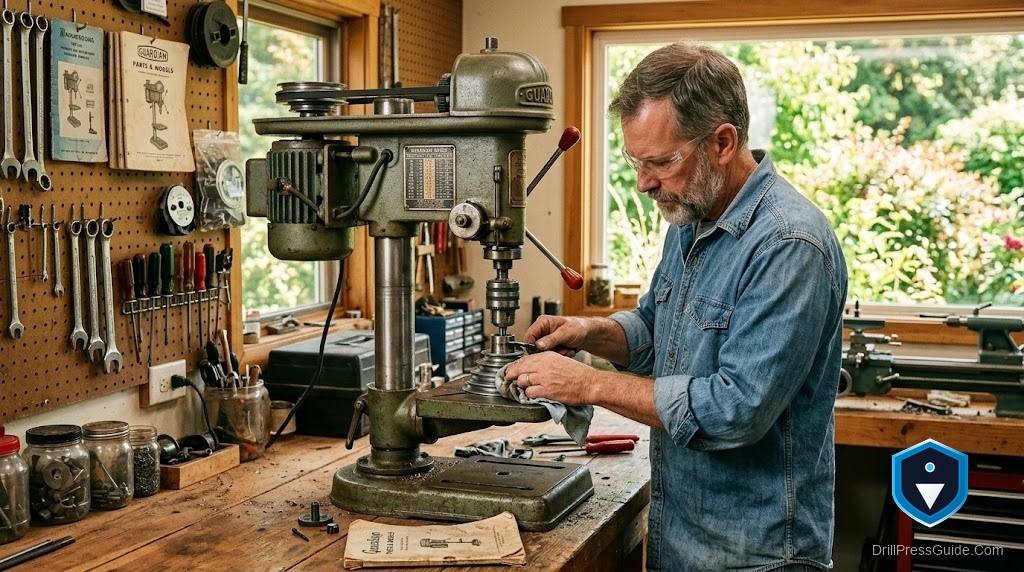
Picture a long steel bracket clamped to the table, a 1/2-inch bit biting into it, and the spindle holding its speed instead of moaning to a crawl. That is the moment the Craftsman 34-inch radial drill press 2/3 HP earns its keep over the lighter 1/3 HP version. Same arm, same 34-inch reach, more motor, and it changes what you can drill without babying the machine.
A radial drill press mounts its head on an arm that slides and pivots away from the column, so the bit can sit far from the base and over the middle of wide stock. The Craftsman 34-inch radial adds a rotating, tilting head for angled work. The 2/3 HP model is the mid-power version of that design, sitting between the light 1/3 HP unit and the later 3/4 HP builds.
Is it right for your shop? Yes, if you drill metal or large bits and still want the radial reach; no, if your work is light enough that the 1/3 HP already covers it. The extra power is the reason to choose this version. It holds spindle speed through bigger Forstner bits and thicker steel, which is exactly where the 1/3 HP stalls. You give up nothing but a slightly heavier motor for a real gain in what the machine will finish.
How does the 2/3 HP change what the radial can do versus the 1/3 HP?
The 2/3 HP motor raises the drilling ceiling without touching the reach or the flex. Both versions share the 34-inch swing, the five belt-driven speeds, the 1/2-inch chuck, and the same pivoting arm. Under a cut, though, the gap shows.
| Task | 1/3 HP radial | 2/3 HP radial |
|---|---|---|
| Small bits in wood | Easy | Easy |
| 2-inch Forstner in hardwood | Slows, may stall | Holds speed better |
| 1/2-inch bit in steel | Bogs down | Manages with slow speed and chip clearing |
| Reach and runout | 34 inches, some deflection | 34 inches, same deflection |
The takeaway from that table: more motor buys you capacity, not rigidity. If you compare the two head to head, choose the 2/3 HP the moment metal or large-diameter drilling is on your list, and save the 1/3 HP only for the lightest shelf-pin and dowel work.
What is the honest downside of this radial?
The weak point is the arm itself, and no motor fixes it. The pivot and slide joints that give you the 34-inch reach also carry play, so the spindle can deflect under side load and runout grows the farther you extend the head. You also change speeds by hand, opening the guard and walking the V-belt across the pulleys, which is slow and grease-prone. The round table is small, giving you little to clamp against on odd-shaped parts.
Who should skip this: if you drill mostly small parts that fit under a standard press, or you need repeatable precision in metal, a fixed-column press holds tolerance better and the radial reach goes to waste.
Verdict on the Craftsman 2/3 HP radial: the version I would actually hunt for used, because it keeps the design’s whole point (reach) while removing the frustration of a motor that quits under load. It is a strong pick for a mixed wood-and-metal shop and a poor one for precision-only work.
What if you would rather buy new?
If you want a warranty and current parts, the Shop Fox W1669 is the closest machine you can order today. It is a 34-inch benchtop radial with a 1/2 HP motor, five speeds from 550 to 3,470 RPM, a 5/8-inch chuck, and a JT-33 arbor, and its head slides out for the same wide reach. In independent shop testing it drilled a 2-inch Forstner into maple at a steady pace and measured about 0.012 inch of runout.
The W1669’s honest flaw matches the Craftsman’s: testers found the manual belt speed changes cumbersome, and the round table plus light base give you little clamping surface and a machine that can feel tippy at full extension. Who should skip the W1669: anyone who needs a large rectangular table or fast variable speed, since this benchtop radial offers neither.
Head to head, the used Craftsman 2/3 HP gives you a touch more motor than the W1669’s 1/2 HP, while the W1669 gives you a larger chuck and a fresh warranty. Pick the Craftsman if you find a clean one and want power; pick the Shop Fox if you want current support out of the box.
Whichever you run, clamp the work and never drill freehand, and match the spindle speed to the material, as OSHA and CCOHS both spell out for drill presses.
Conclusion
The Craftsman 34-inch radial drill press 2/3 HP is the version of this design most home shops should want. It keeps the 34-inch reach and adds the motor the 1/3 HP was missing, so large bits and metal drilling stop being a fight. My verdict: buy it used if you find a clean one, or step to the Shop Fox W1669 for a new machine in the same class.
Concrete takeaways:
- The 2/3 HP raises drilling capacity over the 1/3 HP while sharing the same 34-inch reach.
- The arm joints still flex and add runout; that is the design’s fixed limit, not a defect.
- Speed changes are manual belt moves on both the Craftsman and the W1669.
- For a new machine, the Shop Fox W1669 is the same radial class with a 5/8-inch chuck and warranty.
FAQ
How much stronger is the 2/3 HP than the 1/3 HP Craftsman radial? The 2/3 HP roughly doubles the rated output, so it holds spindle speed through larger Forstner bits and thicker steel where the 1/3 HP slows or stalls. Reach, chuck size, and runout stay the same between them.
Does the 2/3 HP version have more reach than the 1/3 HP? No. Both share the 34-inch swing and the same sliding, pivoting arm. Only the motor differs, so reach and rigidity are identical.
What chuck and arbor does the Craftsman 34-inch radial use? Most units use a 1/2-inch chuck. The comparable Shop Fox W1669 uses a 5/8-inch chuck on a JT-33 arbor, which is the current-production alternative if you want larger bit shanks.
Is the Shop Fox W1669 a direct replacement for the Craftsman radial? It is the same 34-inch benchtop radial concept with a 1/2 HP motor and five speeds, so it fills the same role. It is not an identical machine, but it is the closest one you can buy new.
How much runout should I expect from a radial press? Around 0.012 inch is typical for this class, based on independent testing of the W1669. That is acceptable for woodworking and loose for precision metalwork.
Can this radial drill angled holes? Yes. The head rotates and tilts, and the table also tilts, so you can set compound angles that a fixed-column press cannot reach.
Where do I find parts for the Craftsman 2/3 HP radial? Sears PartsDirect hosts diagrams and manuals by model number. Read the plate at the rear of the head first, since belts and chucks vary between production runs.
References
- Fine Woodworking, Shop Fox W1669 radial-arm drill press test: https://www.finewoodworking.com/2007/06/01/w1669-radial-arm-drill-press-review
- Grizzly / Shop Fox W1669 specifications: https://www.grizzly.com/products/shop-fox-34-benchtop-radial-drill-press/w1669
- Sears PartsDirect, Craftsman radial drill press parts and manuals: https://www.searspartsdirect.com
- OSHA Woodworking eTool, Drill Press safety: https://www.osha.gov/etools/woodworking/production/machines-tools/drill-press
- CCOHS, Drill Presses safety guidance: https://www.ccohs.ca/oshanswers/safety_haz/metalworking/drillpresses.html


