
Craftsman 34-Inch Radial Drill Press 1/3 HP: Specs, Capacity, Parts, and Owner Notes
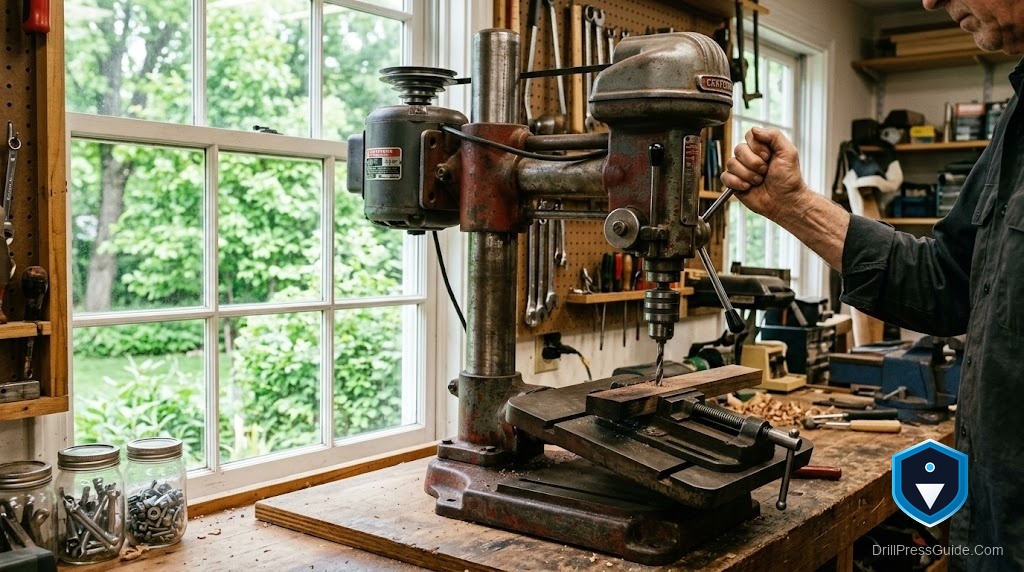
You slide the head out over the center of a 30-inch plywood panel, line up the bit above a shelf-pin mark no fixed-column machine could ever reach, and drill a clean hole in the middle of the sheet. That reach is the whole reason the Craftsman 34-inch radial drill press 1/3 HP still turns up in home shops decades after Sears stopped selling it. The head rides on an arm that pivots and slides, so the working swing stretches to a full 34 inches instead of the 7 or 8 inches a normal benchtop press gives you.
A radial drill press is a machine whose drilling head is mounted on a horizontal arm that extends away from the column, letting you position the bit far from the base. On this Craftsman, the head also rotates and tilts, so you can drill angled holes and reach past wide stock. That flexibility, not raw power, is the point of the design.
So is the 1/3 HP version worth owning? Yes, for light woodworking and occasional small-diameter metal drilling where reach matters more than muscle. The 1/3 HP motor is the lightest one Craftsman fitted to this radial, so it suits pilot holes, shelf pins, dowels, and bits up to roughly 3/8 inch in wood or soft metal. Push it into large Forstner bits or thick steel and it bogs down. For that work, look at the 2/3 HP version instead.
What are the real specs of the Craftsman 34-inch radial 1/3 HP?
Here are the figures owners report consistently across Craftsman 34-inch radial units, alongside the working range of comparable radial presses still in production.
| Spec | Craftsman 34-inch radial (1/3 HP) |
|---|---|
| Swing (max reach) | 34 inches with the head slid out |
| Motor | 1/3 HP, 120V |
| Speeds | 5, changed by moving the belt on stepped pulleys |
| Speed band (class) | roughly 550 to 3,470 RPM on comparable radials |
| Chuck | 1/2 inch |
| Head | rotates and slides along the arm, tilts for angled holes |
| Table | small round table, tilts and rotates |
| Mounting | benchtop, or bolted to a shop-built stand |
Craftsman sold this radial under more than one model number over the years, so check the plate at the rear of the head before ordering parts.
What can the 1/3 HP motor actually handle?
The 1/3 HP motor handles light drilling well and struggles with anything heavy. In pine, plywood, and MDF it spins twist bits and small Forstners without complaint. In aluminum and thin steel it drills small holes if you slow the belt down and clear chips often. Where it gives up is large-diameter work: a 2-inch Forstner in hard maple or a 1/2-inch bit in thick steel will slow the spindle and heat the belt.
The honest flaw here is structural, not just the motor. Every radial arm trades rigidity for reach. The pivot and slide joints carry some play, and the farther you extend the head, the more the spindle can deflect and the more runout you feel at the chuck. Comparable radial presses measure around 0.012 inch of runout in independent testing, which is fine for wood and rough for precision metal. Add the small round table (little surface to clamp against) and the 1/2-inch chuck (smaller than the 5/8-inch chucks on newer presses), and you have a machine built for access, not tight tolerances.
Who should skip this: if you drill mostly small parts that fit under a normal press, or you need repeatable precision in steel, a fixed-column press will hold tolerance better and gives up only the reach you were never going to use.
1/3 HP versus 2/3 HP: which radial should you get?
Get the 1/3 HP if your work is light and the 2/3 HP if you drill metal or large bits. The two share the same arm, chuck, and speed setup, so the reach and the flex are identical. The difference is under load. The 1/3 HP is content with shelf pins and dowels. The 2/3 HP holds speed through bigger Forstners and thicker steel, which is the ceiling the lighter motor keeps hitting. If you already know you will chuck up large bits, buy the stronger version once rather than fighting a stalling spindle later.
Where do you find parts and manuals?
Parts diagrams and owner’s manuals live at Sears PartsDirect, which still hosts exploded views for the Craftsman radial models. Search the model number from the head plate to pull the correct schematic, since chucks, belts, and pulleys differ slightly between production runs. For common wear items like V-belts and chuck keys, generic replacements sized to the machine work fine when the factory part is out of stock.
Is a vintage radial worth it, or should you buy new?
Buy the vintage Craftsman if you find a clean one and want maximum reach; buy new if you want a warranty and current parts support. A well-kept Craftsman radial still does the one thing it was built for. If you would rather start fresh, the Shop Fox W1669 is the same 34-inch benchtop radial class in current production, with a 1/2 HP motor and a 5/8-inch chuck. Either way, follow basic drill press safety: clamp the workpiece, never hold it freehand, and use the recommended spindle speed for the material, as OSHA and CCOHS both stress.
Conclusion
The Craftsman 34-inch radial drill press 1/3 HP earns its place on reach alone. It puts the bit over the middle of a wide panel, drills angled holes a fixed column cannot, and does light wood and metal work cleanly. My verdict: a smart pickup for a woodworker who values access, and the wrong tool for anyone chasing precision or drilling heavy steel.
Concrete takeaways:
- The 34-inch swing and pivoting head are the reason to own it; nothing else in a home shop reaches that far.
- The 1/3 HP motor tops out at small bits; step up to the 2/3 HP for metal and large Forstners.
- Expect arm-joint play and around 0.012 inch of runout, fine for wood, loose for metal.
- Confirm the model number on the head plate before ordering parts through Sears PartsDirect.
FAQ
What is the swing on the Craftsman 34-inch radial drill press? The swing reaches 34 inches when the head is slid fully out along the arm. That measurement is the distance from the bit to the column at full extension, which is what lets you drill the center of a wide board.
How much power does the 1/3 HP version have compared to bigger Craftsman radials? The 1/3 HP is the lightest motor Craftsman used on this radial. It handles small bits in wood and soft metal but slows under large-diameter or heavy steel drilling, where the 2/3 HP and later versions hold speed better.
What size chuck does it use? Most Craftsman 34-inch radial presses ship with a 1/2-inch chuck. Newer radial presses from other makers use a 5/8-inch chuck, so bits above 1/2 inch may need a reduced shank on the Craftsman.
How many speeds does it have and how do you change them? It has five speeds, changed by opening the belt guard and moving the V-belt across stepped pulleys. There is no dial or variable-speed control, so plan speed changes before a run.
Where can I get a manual and replacement parts? Sears PartsDirect hosts owner’s manuals and parts diagrams for the Craftsman radial models. Match the model number stamped at the rear of the head to get the correct schematic.
Is a radial drill press accurate enough for metalwork? It is accurate enough for general metal drilling but not for tight-tolerance work. The pivoting arm introduces some deflection and runout, which grows as you extend the head, so precision metal jobs are better on a rigid fixed-column press.
Can I mount it on a bench or does it need a stand? Both work. Many owners bolt it to a workbench or a shop-built plywood base for stability, since the small factory footprint can feel tippy when the head is fully extended.
References
- Sears PartsDirect, Craftsman radial drill press models and manuals: https://www.searspartsdirect.com
- OSHA Woodworking eTool, Drill Press safety: https://www.osha.gov/etools/woodworking/production/machines-tools/drill-press
- CCOHS, Drill Presses safety guidance: https://www.ccohs.ca/oshanswers/safety_haz/metalworking/drillpresses.html
- Fine Woodworking, Shop Fox W1669 radial-arm drill press test (comparable class): https://www.finewoodworking.com/2007/06/01/w1669-radial-arm-drill-press-review


