Craftsman 15-1/2 Inch Drill Press Belt: What Owners Should Check Before Buying or Repairing
The belt on your Craftsman 15-1/2 inch drill press lets go mid-hole, the motor spins free, and the spindle coasts to a stop. Now you are staring at a stepped pulley trying to figure out which Craftsman 15-1/2 inch drill press belt to order so this does not happen again next month. The good news: the belt on these old Sears presses is a plain V-belt, and once you measure it correctly you can source a replacement almost anywhere. The trap is ordering by model name alone, because Sears sold several near-identical 15 to 15-1/2 inch presses that do not all use the same belt.
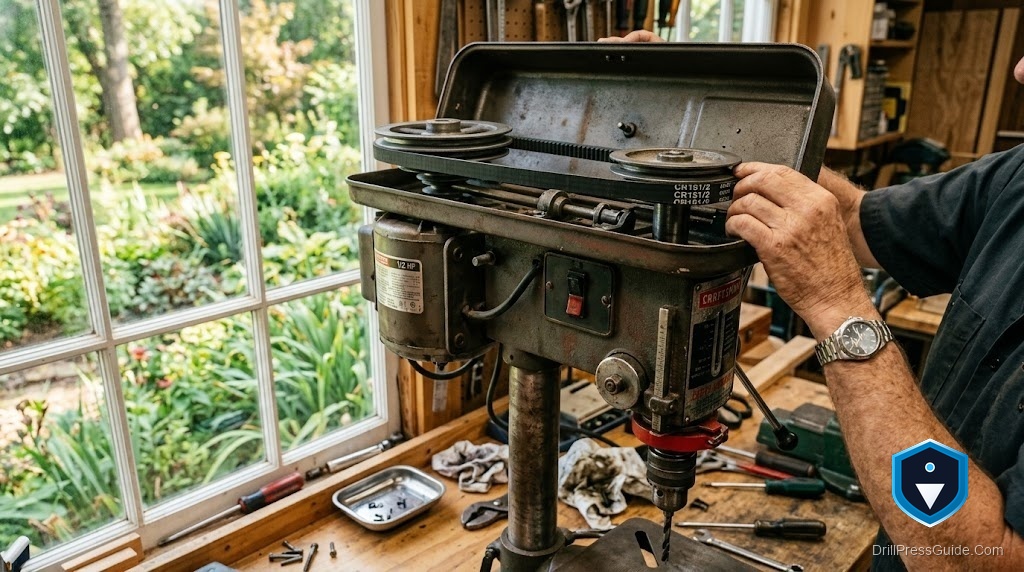
A drill press V-belt is a rubber drive belt with a trapezoidal cross-section that grips the sides of the pulley grooves and transfers power from the motor pulley to the spindle pulley. On these Craftsman presses you change speed by moving that belt between pulley steps, so the belt takes wear every time you shift ranges.
The correct replacement is the belt that matches your measured top width and outside length, cross-referenced to a standard V-belt. Do not order on the model number alone. Measure the old belt, or the pulley span if the belt is gone, then match the size.
How do you measure the belt correctly?
Measure two things: the top width and the outside length. Lay the old belt flat and measure across the wide top face for the top width, which on these presses generally falls between 3/16 inch and 1/2 inch depending on the version. Then measure around the outside of the belt for the outside length, which typically runs from about 24 inches to 32 inches on this family of presses. Write both numbers down.
If the belt is broken or missing, measure the center-to-center distance between the motor pulley shaft and the spindle pulley shaft, then use a belt-length calculator to estimate the loop you need. That figure gets you close enough to confirm against a listing.
Why does the exact model matter so much?
Because two Craftsman presses that both read “15-1/2 inch” can take different belts. The parts list for model 113.213850 calls out an OEM V-belt of roughly 3/8 inch top width by about 24 inches. A sibling such as 113.21371 is commonly served by a belt around 3/16 inch top width by about 45 inches. Those are not interchangeable. If you order the 45-inch belt for a machine that wants the shorter one, it will not tension, and if you guess the width wrong it will ride high or bottom out in the grooves and slip.
That is the whole argument for measuring: the model number points you at a parts diagram, but the belt on your machine may have been swapped before you owned it. Your measurement is the source of truth, and the parts list confirms it.
What replacement belt should you request?
Once you have the top width and outside length, ask for a standard fractional-horsepower V-belt in the matching size. A 3/16 inch to 3/8 inch top width points to a light-duty 3L-section belt; a wider belt near 1/2 inch points to a 4L or A-section belt. Give the supplier both the width and the outside length and let those numbers, not the drill press name, drive the order. A general hardware store, a belt specialist, or the parts channel can all match a V-belt by dimension.
How do you tension the new belt?
Tension it firm, not tight. On these Craftsman heads you release the belt-tension lock handles on each side of the head, slide the motor to loosen the belt, seat the belt in your chosen pulley steps, then pull the motor back to take up slack and lock the handles. Check the tension by pressing the middle of the belt span with a finger: it should deflect about 1 to 2 percent of the span length. Too tight wears the spindle and motor bearings; too loose lets the belt slip and glaze. Recheck after the first hour of running, since a new belt seats and relaxes.
Where do the belt diagram and speed chart live?
The motor-and-pulley assembly diagram and the spindle speed chart both live in the owner’s manual and in the Sears PartsDirect exploded views. The speed chart, which tells you which pulley steps give which rpm, is also printed inside the belt guard on the machine itself, so lift the guard before you assume anything. The 113.213850 owner’s manual archive and the Sears PartsDirect model page carry the same figures.
Verdict and takeaways
The Craftsman 15-1/2 inch drill press belt is an easy fix that people overcomplicate by shopping on the model name. Measure first, confirm against the parts list second, and tension by feel third.
- Measure top width and outside length off the old belt (or the pulley span) before ordering anything.
- Expect a plain V-belt, roughly 3/16 inch to 1/2 inch wide and about 24 inches to 32 inches long depending on your version.
- Request a standard 3L or 4L V-belt by dimension rather than by drill press model.
- Tension for about 1 to 2 percent deflection at mid-span and recheck after the belt seats.
FAQ
What belt does the Craftsman 113.213850 use? Its parts list specifies an OEM V-belt of roughly 3/8 inch top width by about 24 inches. Confirm by measuring your own belt, because a prior owner may have fitted something different.
Can I use any V-belt that fits? You can use any standard V-belt that matches your measured top width and outside length and seats properly in the pulley grooves. The brand does not matter; the cross-section and length do.
How do I measure a belt that already snapped? Lay the pieces end to end for a rough length, or measure the center-to-center pulley distance and use an online belt-length calculator, then measure the top width off a surviving section.
Why does my new belt keep slipping? Usually tension or seating. Check that the belt is fully in the pulley grooves, that the pulleys align, and that mid-span deflection is only about 1 to 2 percent. Glazed or oil-contaminated belts also slip and should be replaced.
How tight should the belt be? Firm enough that pressing the middle deflects it only 1 to 2 percent of the span. Over-tightening wears bearings; under-tightening causes slip and heat.
Where is the speed chart? Inside the belt guard on the machine, and in the owner’s manual. It shows which pulley step combinations produce which spindle speeds.
Does the belt affect drilling speed? Yes. Speed changes on this press come entirely from moving the belt between pulley steps, so the belt must be the right size and properly tensioned for the speed chart to hold true.
References
- Craftsman 113.213850 Owner’s Manual and Parts List: https://craftsman.manymanuals.com/power-tools/113-213850/owners-manual-4808/21
- Sears PartsDirect, Craftsman 113213850 drill press parts: https://www.searspartsdirect.com/model/uwyhcr0kgb-000247/craftsman-113213850-drill-press-parts
- OSHA Woodworking eTool, drill press: https://www.osha.gov/etools/woodworking/production/machines-tools/drill-press
- CCOHS, drill presses safety: https://www.ccohs.ca/oshanswers/safety_haz/metalworking/drillpresses.html