
Vintage Craftsman Drill Press: What to Know Before You Buy or Restore One
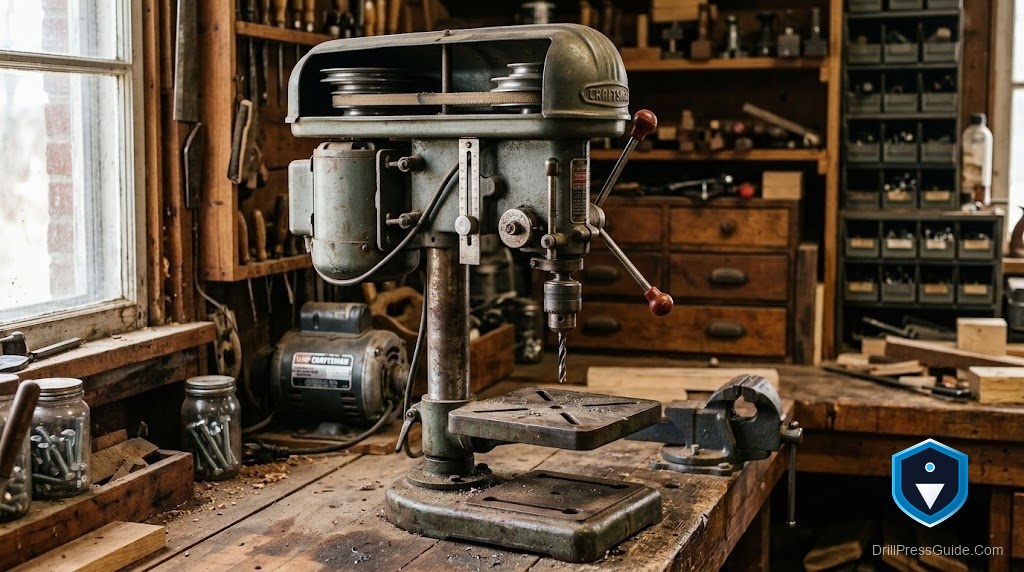
A vintage Craftsman drill press is a specific kind of temptation. It sits in an estate sale or garage with a few decades of dust, heavy cast-iron construction that modern lightweight machines cannot match, and a price that seems absurdly low for what you are looking at. The trap is that “vintage Craftsman” covers an enormous range of machines built by multiple companies over multiple decades, and buying one without knowing what you are getting can turn a bargain into a time-consuming restoration project. Knowing how to identify what you have, and what to inspect before buying, changes everything.
A vintage Craftsman drill press is any drill press sold under the Sears Craftsman badge from the mid-20th century onward, built by contract manufacturers such as King-Seeley, Atlas, Dunlap, and Emerson Electric, using all-cast-iron construction and stepped-pulley belt drives. These machines are known for durability and repairability but require inspection for wear, rust, and runout before purchase.
Short answer: a vintage Craftsman in good mechanical condition is a legitimate, long-lasting shop machine worth buying and restoring, provided you verify the spindle runs true, the quill moves freely, and the motor runs quietly. The cast iron is the asset; the unknowns are the years of use and storage. Here is how to evaluate one.
Who built it and why it matters
Sears never manufactured these machines. The work went to outside contractors, and the maker tells you a great deal about quality and parts availability:
- King-Seeley: Built many of the mid-century Craftsman stationary tools. Solid, serviceable iron.
- Atlas Press Company: Atlas-built Craftsman machines are well-regarded, with a community of collectors and restorers and some surviving parts support.
- Dunlap: Sold under a Sears sub-brand before the Craftsman consolidation; similar construction era.
- Emerson Electric: The most common maker of later Craftsman stationary tools, identified by model numbers beginning with 113. Broad parts support through Sears PartsDirect.
The model number on the ID plate tells you who built it. Record it and use it to identify the machine and its documentation before anything else.
What to inspect before buying
Cast iron, age, and unknown storage conditions mean you must check the machine rather than assume it is fine:
Spindle runout. Chuck a straight bit or gauge pin and spin it by hand. Watch the tip: visible wobble indicates a worn chuck, a bent arbor, or worn spindle bearings. A worn chuck is cheap to fix. The others are significant restoration items.
Quill action. Extend the quill by hand through its full travel and retract it. It should move smoothly with light spring tension return. Grinding, sticking, or loose side-to-side rattle indicates wear, corrosion, or missing lubrication.
Motor condition. Plug it in or arrange a direct test and run it. A good motor hums smoothly and accelerates cleanly. Rough running, excessive vibration, or reluctant starting suggests bearing wear or older capacitor issues.
Column and table rust. Surface rust on the table is cleanable. Deep pitting affects flatness and is harder to address. Check the column for rust that interferes with table height adjustment.
Belt and pulleys. Old V-belts crack and harden and are a guaranteed replacement on any machine that has sat for years. Factor in a belt; it is inexpensive and easy to source.
Parts and restoration resources
For Emerson-built 113-series machines, Sears PartsDirect is still a functioning source for many components, including belts, bearings, the return spring, chuck keys, and switches. For Atlas-built machines, the Atlas/Craftsman collector community maintains parts cross-references and a small supply of NOS and reproduction parts. For earlier makers, VintageMachinery.org is the best starting point for documentation and scanned manuals.
A typical restoration covers cleaning, belt replacement, lubrication of the quill and column, and often a new or rebuilt chuck. None of these are difficult. Our Craftsman drill press parts guide covers ordering for current Sears PartsDirect-supported models.
The honest trade-off versus a new machine
A vintage Craftsman’s appeal is cast-iron mass, repairability, and cost. What it does not offer is variable-speed convenience, a laser, a warranty, or certainty about its condition history. If those matter to you, a current machine like the WEN 4214T gives you dial-and-read speed and a warranty for a reasonable new price. The vintage machine earns its place when the iron and repairability outweigh the lack of convenience features, and when the price genuinely reflects a used machine rather than a collectible premium.
The verdict
A vintage Craftsman drill press in good mechanical condition is one of the better used-tool values in small-shop equipment. The all-cast-iron construction and simple mechanics outlast most modern lightweight alternatives, and many can be fully restored with a belt, lubricant, and a replacement chuck. The work is to identify the maker from the model number, verify spindle runout and quill action, and confirm the motor runs cleanly before paying. Do that, and a modest sum buys a machine that will serve for decades more.
Frequently asked questions
Who made vintage Craftsman drill presses? Sears contracted production to companies including King-Seeley, Atlas Press, Dunlap, and Emerson Electric. The model number prefix identifies the maker: 113-series machines were made by Emerson.
Are vintage Craftsman drill presses any good? Many are excellent. All-cast-iron construction, simple mechanics, and repairability make them genuinely long-lasting machines, and Emerson-built 113-series models have particularly strong parts support.
How do I identify my vintage Craftsman drill press? Find the ID plate on the head casting, base, or column and record the full model number. The prefix identifies the manufacturer. Use the number to search Sears PartsDirect or VintageMachinery.org for the manual.
What should I check on a vintage Craftsman drill press before buying? Spindle runout (spin a bit by hand and watch for wobble), quill action (smooth travel with spring return), motor condition (quiet, smooth start), column and table rust, and belt condition.
Can you still get parts for a vintage Craftsman drill press? For Emerson-built 113-series machines, many parts are available through Sears PartsDirect. Atlas-built machines have community parts sources. Earlier makers require VintageMachinery.org and patience.
What belt fits a vintage Craftsman drill press? Belt size varies by model. Find the cross-section and length specification in the manual, or measure the old belt if readable. V-belts in common sizes are inexpensive and widely available.
Is it worth restoring a vintage Craftsman drill press? Usually yes if the spindle runs true and the motor is sound. A typical restoration (belt, lubrication, chuck) is inexpensive and straightforward. A machine with a bent arbor or dead motor requires a harder cost-benefit assessment.
References
- Sears PartsDirect, Craftsman drill press parts by model number: https://www.searspartsdirect.com
- VintageMachinery.org, Craftsman, Atlas, and Emerson tool documentation: https://vintagemachinery.org
- Popular Woodworking, used tool buying and restoration guidance: https://www.popularwoodworking.com


