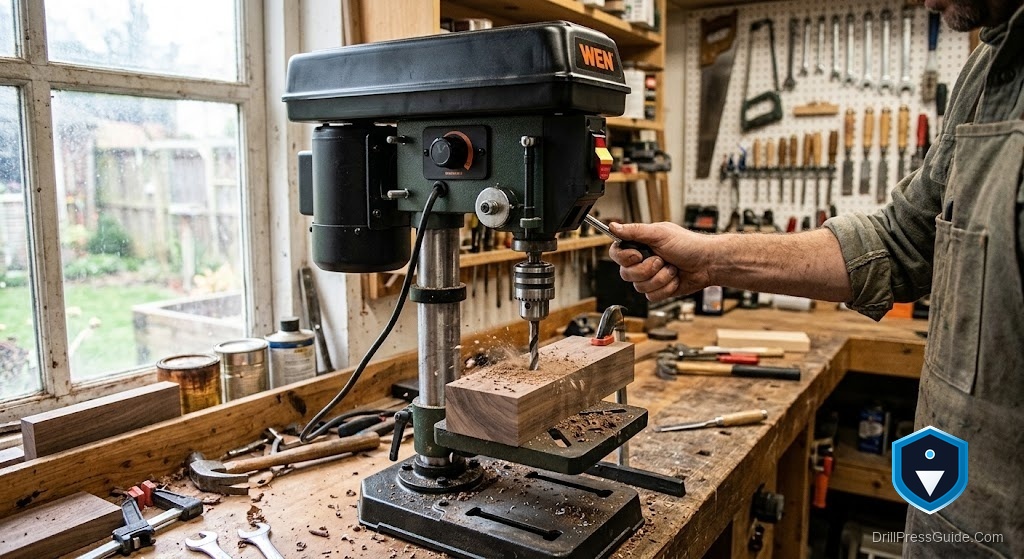
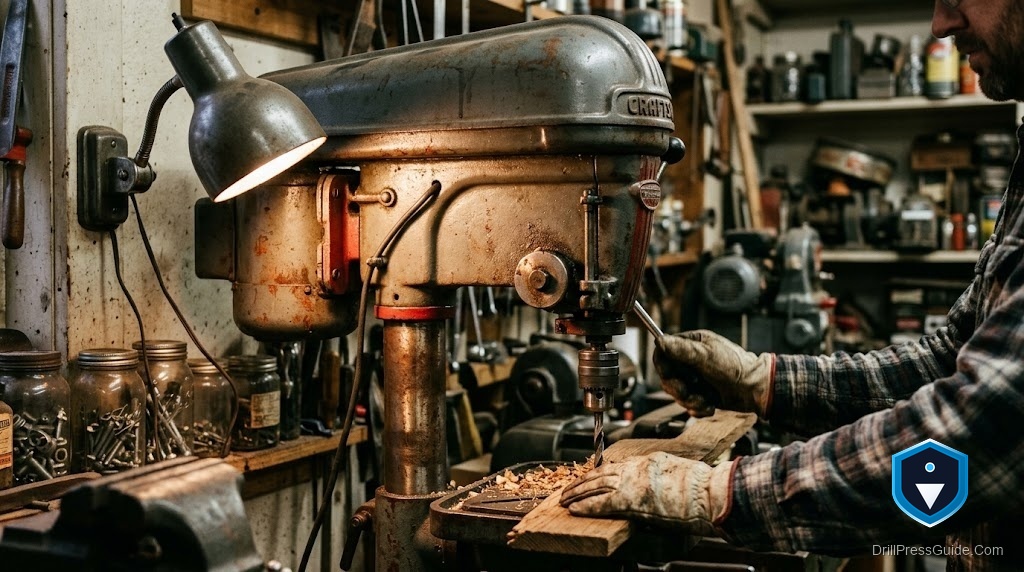
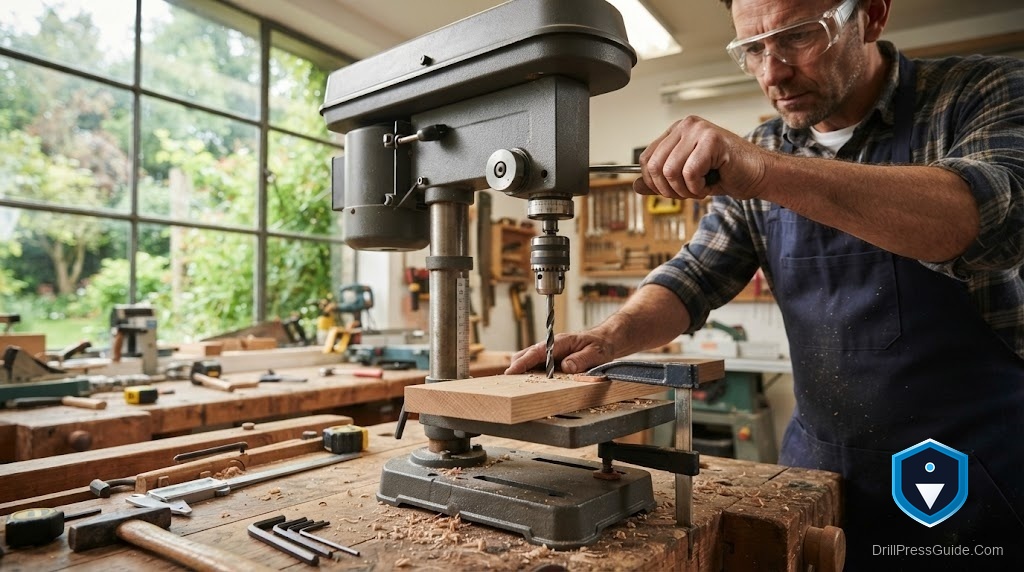
Sears Craftsman Heavy-Duty 15-1/2 Inch Drill Press: Setup, Limits, and Getting Parts Today
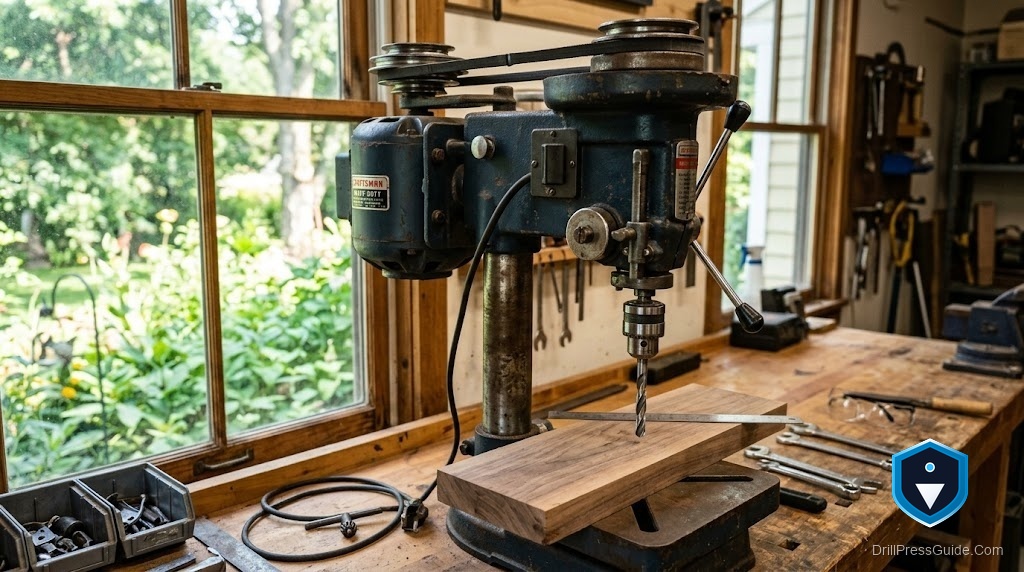
The machine came with the garage, or from an estate sale, or down from a relative who swore by it: a tall, gray, cast-iron Sears Craftsman heavy-duty 15-1/2 inch drill press with a model number starting in 113. You want to know whether it is worth setting up, what it can still do, and whether you can get a belt and a chuck for something Sears stopped selling years ago. I have set up and sourced parts for these old presses, and the short version is that they are worth reviving if the bearings are sound and you go in with clear expectations.
A floor-standing drill press like this is a full-height version of a bench press: the chuck spins on a long vertical column, the head sits at eye level, and a cast-iron table rides up and down the column so you can drill tall work. The Craftsman 15 to 15-1/2 inch models were belt-driven wood-and-metal machines built for Sears by Emerson Electric, which is what the 113 prefix tells you.
Here is the direct answer: yes, you can still run one and still get parts for it. Owner manuals and parts lists for most 113.2xxxxx presses remain available through Sears PartsDirect and archives like VintageMachinery.org, belts and chucks are standard sizes you can match by measurement, and the machine itself is a capable press for wood and light metal. What you will not get is variable speed or any laser, and you should not expect modern runout numbers from a press that may be forty years old.
How do you read a Craftsman 113 model number?
Start with the plate on the rear of the head, because that number decides every part you order. The full number reads like 113.213850, and it splits into two meaningful parts: the first three digits (113) identify the manufacturer, Emerson Electric, and the digits after the dot identify the exact model. The owner’s manuals for these machines say plainly that the model number lives on a plate attached to the rear of the head and that you must give the full number when ordering repair parts. Write it down before you shop for anything, because a belt or table that fits a 113.213850 may not fit a 113.213710.
What are the real specs of the heavy-duty 15-1/2 inch Craftsman press?
These are belt-drive, single-phase machines in the 15 to 15-1/2 inch swing class, and the exact speed count depends on your model year. Because Sears sold several variants, treat the table below as the shape of the family and confirm your own figures against your model’s manual.
| Spec | Typical 15 to 15-1/2 inch Craftsman floor press |
|---|---|
| Swing | 15 to 15-1/2 inches |
| Chuck capacity | 5/8 inch |
| Motor | 1/2 HP on many models (some later ones 1 HP), 115V |
| Motor speed | 1725 RPM (the manuals warn against faster motors) |
| Drive | V-belt on stepped pulleys |
| Speeds | Varies by model: many 15-1/2 inch units ran 8 speeds from about 380 to 8550 RPM, others 12 speeds from about 250 to 3100 RPM |
| Table | Cast iron, tilting, rack-and-pinion or crank height |
| Column | Around 2-13/16 inches on the larger floor models |
The takeaway that matters for real work: you change speed by moving a belt between pulley steps, and the lowest speed decides how well the press handles big bits and metal. If your unit bottoms out around 380 RPM, that is workable for hole saws and drum sanders as long as you respect the limits printed on the head panel.
Does the model 113.213850 have a laser or variable speed?
No. The 113.213850 is a mid-1980s 15-inch floor press with a 1/2-HP motor, belt-changed speeds, and no laser and no variable-speed control. This matters because a different Craftsman machine, sold under a separate catalog number, added a laser guide and a variable-speed head, and the two get mixed up constantly in listings and forum posts. If someone tells you a 113.213850 has a laser sight or an electronic speed dial, they are describing another press. Match the feature claims to the plate on your head, not to a photo online.
Where can you get parts for a discontinued Sears Craftsman drill press today?
Parts still flow from two reliable places, plus the used market. First, Sears PartsDirect hosts parts diagrams, owner manuals, and many replacement components for 113.2xxxxx drill presses; search your full model number and work from the exploded diagram. Second, manual archives such as VintageMachinery.org and the Sears floor drill press manual library give you the parts lists and part numbers you need to identify what you are looking at. For anything Sears no longer stocks, wear items like belts, chucks, and quill return springs are generic sizes you can source from any industrial supplier once you know the measurement.
How do you size a replacement belt and chuck by measurement?
Measure the old part rather than guessing from the model number, because Sears reused the same castings across several belt and arbor combinations. For the belt, either read the size molded on the side of the original or measure its outside length and cross-section and match a standard V-belt to it. For the chuck, this family uses a 5/8-inch capacity Jacobs-style chuck that presses onto a tapered arbor, and the taper size depends on your spindle; pull the chuck, look up your model’s parts list, and match the arbor taper (do not assume it is the same as another Craftsman press). When in doubt, the parts diagram for your exact number settles it.
What are the honest limits of a decades-old Craftsman press?
The honest flaw is wear, and it shows up as spindle and quill play. A press that has run for decades can have a loose quill, tired bearings, and measurable runout that a new machine would not have, so a fresh bit can still wobble even after you true everything. Speed changes mean opening the guard and moving the belt by hand every time, which gets old if you switch between wood and metal often. And the 1/2-HP motor on most of these is fine for wood and light metal but will bog if you push a large bit through thick steel.
Who should skip this: if you want push-button speed changes, a laser, or guaranteed low runout for precision metalwork, do not sink time into a used 113 press; buy a modern machine. If you enjoy tuning an honest cast-iron tool and want a heavy, stable press that parts are still available for, this is a genuinely good machine to keep running.
Conclusion: should you set up an old Craftsman 15-1/2 inch press?
My verdict: a sound Craftsman 15 to 15-1/2 inch floor press is worth reviving, because the castings are heavy, the parts are still reachable, and the machine will outlast most new imports if you service it. Keep these points in front of you:
- Read the full 113 model number off the rear of the head before ordering a single part.
- Do not believe laser or variable-speed claims for the 113.213850; it has neither.
- Source belts and chucks by measurement, using the Sears PartsDirect diagram for your exact model.
- Expect some runout and hand-changed speeds, and set it up for wood and light metal rather than heavy steel.
FAQ
What does the 113 in a Craftsman model number mean? It is the manufacturer source code for Emerson Electric, which built these drill presses for Sears. The digits after the dot identify the specific model, and you need the full number to order parts.
Is the Craftsman 113.213850 a 15-inch or 15-1/2-inch press? It is a mid-1980s 15-inch floor model with a 1/2-HP motor. Sears also sold closely related 15-1/2 inch presses under numbers like 113.213710, so confirm your own plate.
Can I still get parts for a discontinued Sears Craftsman drill press? Yes. Sears PartsDirect still lists diagrams, manuals, and many components by model number, and generic wear items like belts and chucks can be matched by measurement from any supplier.
What chuck size do these presses use? The 15 to 15-1/2 inch Craftsman floor presses use a 5/8-inch capacity chuck on a tapered arbor. Pull the chuck and check your model’s parts list to identify the exact arbor taper before buying a replacement.
How many speeds does it have? It depends on the model. Many 15-1/2 inch units ran 8 belt-changed speeds from about 380 to 8550 RPM, while others offered 12 speeds from about 250 to 3100 RPM.
Does it have a laser or variable speed? No. These are belt-drive presses with no laser and no electronic speed control. Any laser or variable-speed claim points to a different Craftsman model.
Where do I find the owner’s manual? Sears PartsDirect and archives like VintageMachinery.org host scanned owner manuals and parts lists for most 113.2xxxxx drill presses. Search by your full model number.
Is an old Craftsman drill press safe to use? Yes, if it is mechanically sound and you follow standard practice: clamp the work, remove the chuck key before starting, skip gloves, and set the correct speed for the material.
References
- Sears PartsDirect (parts, diagrams, and manuals): https://www.searspartsdirect.com
- Craftsman 15-1/2 inch drill press owner’s manual (model 113.213710), VintageMachinery.org: http://vintagemachinery.org/pubs/222/5471.pdf
- Sears floor 15-inch model drill press owner’s manual (PDF): https://c.searspartsdirect.com/mmh/lis_pdf/OWNM/L0803156.pdf
- OSHA Woodworking eTool, Drill Press: https://www.osha.gov/etools/woodworking/production/machines-tools/drill-press
- CCOHS, Drill Presses safety: https://www.ccohs.ca/oshanswers/safety_haz/metalworking/drillpresses.html