
Is the Craftsman 2/3 HP Drill Press with Laser Trac a Sensible Fit for Your Shop?
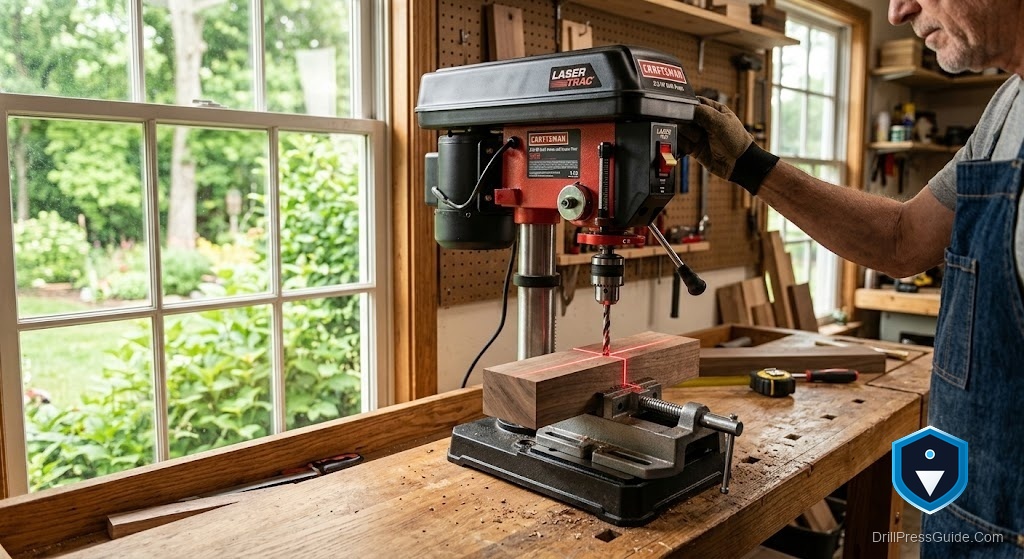
You spot a Craftsman 2/3 HP drill press with Laser Trac on a used listing, the seller swears the crosshair still lands dead center, and you want to know whether this laser-guided machine earns bench space before you commit to hauling it home. I have run the model No. 229250 against the questions that actually decide a purchase, checked its numbers against the Fine Woodworking bench test, and lined it up beside a current laser-equipped press so you can choose with your eyes open.
The Craftsman No. 229250 is a 15-inch Craftsman drill press with a two-line laser guide (branded Laser Trac) that projects crossing lines onto the workpiece to mark where the bit will enter. It ran on a 120V, 8-amp motor rated 2/3 HP maximum developed, changed speed by moving a belt across stepped pulleys, and used a 5/8-inch keyed chuck. It has been out of production for years, so every unit you find is used.
Should you buy it? If one turns up in clean condition and you mostly drill wood, yes, it is a serviceable machine that holds tolerances well for its class. If you want a current machine with a warranty, dial-in speed changes, and guaranteed parts, buy new instead. Here is the reasoning.
What do you actually get with the No. 229250?
You get a competent mid-size press with a genuinely useful sighting aid. Fine Woodworking measured runout at 0.004 inch on this model, against an average of 0.005 inch across nine 15-inch to 17-inch presses they tested, so the spindle runs true enough for clean holes in wood and light metal. The rack-and-pinion table lift moved smoothly on soft molded handles, the quill lock and depth stops held, and the feed handles reposition to the left side for left-handed users. Belt changing was easy and gave 12 speeds from 250 rpm up to 3,100 rpm. The table bevels 45 degrees, swivels a full circle, and carries a telescoping extension for longer stock.
The Laser Trac itself is the selling point. Two projected lines cross at the bit centerline, so you drop the bit onto a punch mark by eye rather than sighting down the quill. For repeat holes and production marking, that saves real time.
How well does the laser guide hold up over years of use?
The laser is only as good as its last alignment, and that is this machine’s honest weak spot. The two emitters are set into the head, and knocks, vibration, and time pull them off true, so the crosshair can drift away from the true bit center. You realign it with the adjustment screws, and you should test it against a drilled hole rather than trusting the projected lines on faith. Treat the laser as a fast approximation you confirm, not a substitute for a center punch on precise work.
The second real flaw is support. Because the No. 229250 is discontinued, you cannot walk into a store and buy a replacement part off the shelf. You lean on Sears PartsDirect for diagrams, belts, switches, and chucks, and on a used unit you may need one of those sooner than you would like.
Craftsman No. 229250 versus a current laser press: which makes sense?
The fair modern comparison is the WEN 4214T, a 12-inch variable-speed press with a laser and an LED work light that is a live listing on Amazon (WEN 4214T). Here is how they line up.
| Feature | Craftsman No. 229250 Laser Trac | WEN 4214T |
|---|---|---|
| Swing | 15 in. | 12 in. |
| Motor | 2/3 HP max developed, 120V, 8-amp | 5-amp induction |
| Speed changes | 12 speeds, belt moved by hand (250 to 3,100 rpm) | mechanical variable speed with digital readout (580 to 3,200 rpm) |
| Chuck | 5/8 in. keyed | 5/8 in. keyed |
| Sighting aid | Laser Trac two-line guide | single laser plus LED work light |
| Availability | discontinued (parts via Sears PartsDirect) | current, two-year warranty |
The Craftsman wins on swing and on that extra rack-and-pinion smoothness owners tend to like. The WEN wins on the two things you feel every session: you turn a dial to change speed instead of opening the guard and repositioning a belt, and a readout tells you the exact rpm. The WEN also comes with a warranty and parts you can order today.
One caution that applies to the Craftsman motor: Fine Woodworking noted that with a 2-inch Forstner bit, the tester had to slow the feed to keep the 8-amp motor from stalling. That is normal for a 2/3 HP developed rating, but it tells you this is a wood and light-metal press, not a machine for heavy boring.
Who should skip this drill press?
Skip the No. 229250 if you need a current machine with a warranty and dependable parts, if you change speeds constantly and do not want to open a belt guard each time, or if you drill large-diameter holes in metal where the modest motor and hand-set belt speeds will frustrate you. Those users are better served by the WEN 4214T or another current variable-speed press. Whatever you run, follow the OSHA and CCOHS guidance on clamping work, removing the chuck key before starting, and keeping guards closed.
Buy the Craftsman when a clean used unit appears and your work is mostly wood: you get true-running holes, a big table, and a laser that earns its keep once you confirm its alignment.
Verdict and takeaways
The Craftsman 2/3 HP Laser Trac (No. 229250) is a good used machine held back by its era, not a machine to chase at any condition. My call: buy a clean one for a wood shop, pass on a rough one, and buy the WEN 4214T new if you want current support.
- The spindle runs true (0.004 inch runout measured by Fine Woodworking), so hole quality is not the concern.
- The laser needs periodic realignment and a test hole to trust, especially on a used unit.
- Discontinued status means Sears PartsDirect is your lifeline for belts, switches, and chucks.
- For turn-a-dial speed changes, a warranty, and stocked parts, the WEN 4214T is the smarter buy today.
FAQ
Is the Craftsman No. 229250 still made? No. It has been discontinued for years, so every unit on the market is used. You can still get diagrams and common replacement parts through Sears PartsDirect by searching the model number.
How accurate is the Laser Trac guide? It is accurate when aligned and unreliable when it is not. The two projected lines cross at the bit center, but the emitters drift over time, so test the crosshair against a drilled hole and adjust it before trusting it on precise layout.
What size chuck and speeds does it have? It uses a 5/8-inch keyed chuck and offers 12 belt-driven speeds ranging from 250 rpm to 3,100 rpm, changed by moving the belt across stepped pulleys.
Can it drill metal? Yes, for light work. The 2/3 HP developed motor handles smaller bits in steel, but large-diameter bits will make it labor, so slow your feed and use cutting fluid.
How does it compare to the WEN 4214T? The Craftsman has more swing (15 inch versus 12 inch); the WEN offers mechanical variable speed with a digital readout, an LED light, a warranty, and parts you can order now. For daily convenience, the WEN edges ahead.
Where do I get replacement parts? Use Sears PartsDirect. Match parts to the exact model number stamped on the machine, since Craftsman sold several similar presses that do not share every part.
Is the runout good enough for woodworking? Yes. At 0.004 inch measured, it beat the average of a nine-press test group, which is well within what woodworking and light metalwork need.
References
- Fine Woodworking, Laser-Guided Drill Press No. 229250 review: https://www.finewoodworking.com/2005/10/25/laser-guided-drill-press-no-229250-review
- Sears PartsDirect (parts and diagrams): https://www.searspartsdirect.com
- WEN 4214T product page: https://wenproducts.com/products/wen-4214t-12-in-variable-speed-drill-press
- OSHA Woodworking eTool, drill press: https://www.osha.gov/etools/woodworking/production/machines-tools/drill-press
- CCOHS, drill presses safety: https://www.ccohs.ca/oshanswers/safety_haz/metalworking/drillpresses.html


