A Practical Guide to the Craftsman Tabletop Drill Press Lineup
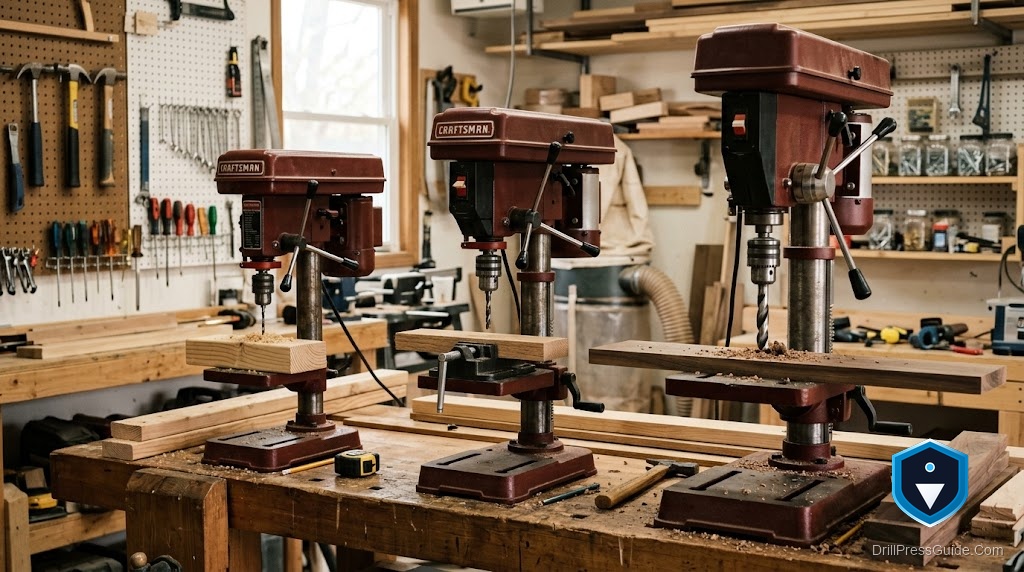
Craftsman tabletop drill presses have sat on home-shop benches for generations, and used ones remain some of the most common machines you will find secondhand. “Tabletop” (or benchtop) just means it bolts to a bench rather than standing on the floor, and Craftsman built the format in several swings and speed counts. This guide breaks down the lineup, from the little 8-inch up through the 10-inch and beyond, so you can pick the right one or identify the one you already have.
What a Craftsman tabletop drill press is
A Craftsman tabletop drill press is a compact bench machine built on the classic layout: an induction motor driving stepped pulleys for multiple spindle speeds, a quill carrying the spindle through its travel, a torsion return spring under a spring cap, a tilting table, a locking switch, and a keyed chuck. Most carry a 113-prefix model number (like 113.213850), which is the key to manuals and parts. The differences across the lineup come down to swing, the number of speeds, and motor size.
The short answer to “which Craftsman tabletop?” is this: pick the swing that covers your work (8, 9, or 10-inch for most bench needs), favor more speeds if you drill mixed materials, and confirm the 113-prefix model number so parts are findable. The tabletop format is ideal when space is limited and the work is small-to-medium.
The lineup by size
- 8-inch (3-speed and up). The compact end: pilot holes, dowels, small brackets, light metal. The 8-inch 3-speed is a classic starter. Least reach and travel.
- 9-inch. A slightly larger swing with a bit more capability, a common vintage Craftsman size.
- 10-inch. The most flexible tabletop size: more reach, a more usable table, and usually more speeds. This is where most bench users should land if the bench allows.
- Larger benchtop (up to the 15/17-inch class). Some Craftsman machines blur the line toward floor size; if your searches pull up a 17-inch, confirm whether it is truly a benchtop or a floor model before buying.
Speeds and motor
Craftsman tabletop presses set speed by moving the belt across stepped pulleys, with counts from three on the small units up to more on the larger ones. More speeds mean finer control over matching RPM to the job: slow for large bits and metal, fast for small bits in wood. Motor size (often a fractional-horsepower rating like 1/3 or 1/2 HP) rises with swing. Match both to your work: a 3-speed 8-inch is fine for light wood, while mixed materials benefit from more speeds and a bit more motor.
Buying used, and finding the model number
Craftsman tabletop presses are everywhere secondhand, and many are worth having. Check runout by spinning the chuck, feel the quill for slop, confirm the return spring retracts the quill smoothly, and make sure the switch and motor run cleanly. The single most useful step is reading the full 113-prefix model number off the plate, because that unlocks the parts diagram and manual through Sears PartsDirect. A tired but sound Craftsman tabletop comes back with a belt, a chuck, and a spring, all standard items.
The verdict
The Craftsman tabletop drill press lineup runs from the compact 8-inch 3-speed up through the flexible 10-inch and beyond, all built on the same serviceable layout. Pick the swing that covers your work (the 10-inch is the most flexible bench size), favor more speeds for mixed materials, and always read the 113-prefix model number so parts and manuals are findable. New or used, check runout, the quill, and the return spring, and keep the standard wear items on hand. Bought right, a Craftsman tabletop press serves a small shop for decades.
Takeaways:
- “Tabletop” means benchtop; the Craftsman lineup spans 8-inch, 9-inch, 10-inch, and larger.
- The 10-inch is the most flexible bench size; the 8-inch 3-speed is the classic starter.
- Speeds are belt-set (three and up); favor more speeds for mixed materials.
- The 113-prefix model number unlocks parts and manuals through Sears PartsDirect.
- Used Craftsman tabletop presses are common and often worth reviving; check runout, quill, and spring.
Tooling and replacement parts
Keep a Craftsman tabletop running with good tooling. Fit a quality keyed drill chuck with the matching arbor if the original wears, keep a fresh drill press V-belt on the shelf, and add a set of brad-point drill bits for clean holes in wood. A drill press vise makes work-holding safe, and a spare drill press chuck key saves a stalled job. Match parts to the 113-prefix model number before ordering.
FAQ
What sizes did Craftsman make tabletop drill presses in? Common swings are 8-inch, 9-inch, and 10-inch, with some larger benchtop models. The 10-inch is the most flexible bench size.
What does “tabletop” mean on a Craftsman drill press? It means benchtop: the machine bolts to a workbench rather than standing on the floor.
How many speeds does a Craftsman tabletop drill press have? Speeds are belt-set, from three on the small 8-inch units up to more on the larger machines.
How do I find parts for a Craftsman tabletop drill press? Read the full 113-prefix model number off the plate and pull the matching part diagram and manual from Sears PartsDirect.
Is a used Craftsman tabletop drill press worth it? Often, yes. Check runout, quill fit, and the return spring, confirm the model number, and match standard wear parts.
Which Craftsman tabletop size should I buy? Pick the swing that covers your work. The 8-inch suits small light jobs; the 10-inch is the most flexible bench choice.
References
- Sears PartsDirect, Craftsman drill press parts: https://www.searspartsdirect.com/
- Craftsman, support and manuals: https://www.craftsman.com/