
Shopping for a Craftsman Standing Drill Press? Start With Size, Speed, and Support
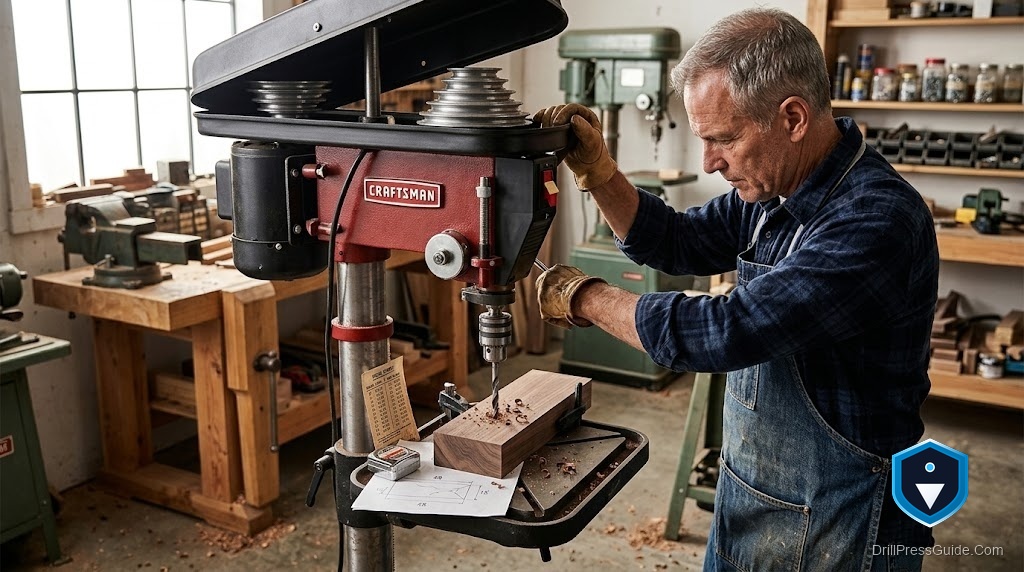
A Craftsman standing (floor) drill press is the machine that has anchored countless home shops, and used ones still turn up constantly. “Standing” just means floor-standing rather than benchtop, and Craftsman built these in several sizes and speed configurations over the decades. Whether you are buying new, buying used, or reviving one you already own, the smart approach is the same: size first, then speed, then support. Here is how, with an honest look at what these machines do well.
What a Craftsman standing drill press is
A Craftsman standing drill press stands on the floor on a cast base, with a tall column that gives you the height to drill long work upright and to raise or lower a generous table. The mechanicals are classic Craftsman: an induction motor driving stepped pulleys for multiple spindle speeds, a quill carrying the spindle through its travel, a torsion return spring under a spring cap, a keyed chuck, and a locking switch. Many carry a 113-prefix model number (like 113.213850), which is the key to everything downstream.
The short answer to “which Craftsman standing press?” is this: pick the swing and column height that fit your work and space, choose a speed count that matches your materials (a 15-speed heavy-duty model gives the widest range), and confirm the model number so parts are findable. The floor format shines when you drill tall or long work.
Start with size
On a standing press, two dimensions matter: swing and column height.
- Swing sets how wide a workpiece you can center (a 15-inch press reaches the center of a 15-inch board).
- Column height sets how tall a piece you can stand under the spindle, and how much table travel you have.
Craftsman standing presses were commonly sold in the 15-inch class, with smaller and larger variants around it. If you drill long stock upright or want lots of table adjustment, the floor format is exactly what you want; if your work is small and space is tight, a benchtop is the smarter pick.
Then speed
Craftsman standing presses set speed by moving the belt across stepped pulleys, and the heavy-duty models offer more positions (a 15-speed being the widest common range). More speeds mean finer control over matching RPM to the job: slow for large bits and metal, fast for small bits in wood. If you drill mixed materials, favor a model with more speeds; if you mostly do one kind of work, fewer speeds are fine.
Then support
This is where Craftsman earns its reputation. Because every machine carries a full model number, the parts diagrams, exploded views, and manuals are available through Sears PartsDirect, and the failure points are standard and documented: the V-belt, the chuck and chuck key, the torsion return spring and spring cap, ball bearings, the center pulley, the motor pulley and motor bracket, retaining rings, taper pins, the spindle assembly and spindle pulley, the head casting, the bed lock, and the locking switch. Read the complete number off the plate, pull the matching diagram, and you can identify and order nearly everything. That documentation is why a used Craftsman standing press is often worth reviving.
The verdict
The right Craftsman standing drill press is the one whose swing and column height fit your work and space, whose speed range suits your materials, and whose model number unlocks parts. The floor format is the pick when you drill tall or long work upright and want a generous, adjustable table; the 15-speed heavy-duty models give the widest control. Whether new or used, read the 113-prefix model number first, check runout, the quill, and the return spring, and keep the standard wear items on hand. Bought right, a Craftsman standing press runs accurately for decades.
Takeaways:
- “Standing” means floor-standing; judge it on swing and column height together.
- Craftsman standing presses were common in the 15-inch class, with heavy-duty 15-speed models offering the widest range.
- Speeds are belt-set; favor more speeds if you drill mixed materials.
- The 113-prefix model number unlocks part diagrams and manuals through Sears PartsDirect.
- Used Craftsman standing presses are often worth reviving; check runout, quill, and the return spring.
Tooling and replacement parts
Keep a Craftsman standing press running with good tooling. Fit a quality keyed drill chuck with the matching arbor if the original wears, keep a fresh drill press V-belt on the shelf, and add a drill press machine vise for safe work-holding. A drill press return spring assembly revives a tired quill, and a spare drill press chuck key saves a stalled job. Match parts to the 113-prefix model number before ordering.
FAQ
What does “standing” mean on a Craftsman drill press? It means floor-standing rather than benchtop: the machine stands on a cast base with a tall column, giving height for long work and a generous adjustable table.
What size is a common Craftsman standing drill press? Many were sold in the 15-inch swing class, with smaller and larger variants. Judge swing (how wide it reaches) and column height (how tall a piece fits) together.
How many speeds do Craftsman standing presses have? Speeds are belt-set; heavy-duty models offer up to fifteen for the widest range. More speeds help when drilling mixed materials.
How do I find parts for a Craftsman standing drill press? Read the full 113-prefix model number off the plate and pull the matching part diagram and manual from Sears PartsDirect.
Is a used Craftsman standing drill press worth buying? Often, yes, thanks to strong parts documentation. Check runout, quill fit, and the return spring, and confirm the model number.
Should I buy a standing or benchtop Craftsman? Choose standing for tall or long work and a generous adjustable table; choose benchtop for small work and tight space.
References
- Sears PartsDirect, Craftsman drill press parts: https://www.searspartsdirect.com/
- Craftsman, drill presses and manuals: https://www.craftsman.com/


