
Understanding the Craftsman Drill Press 1/2 HP: Setup, Limits, and Support
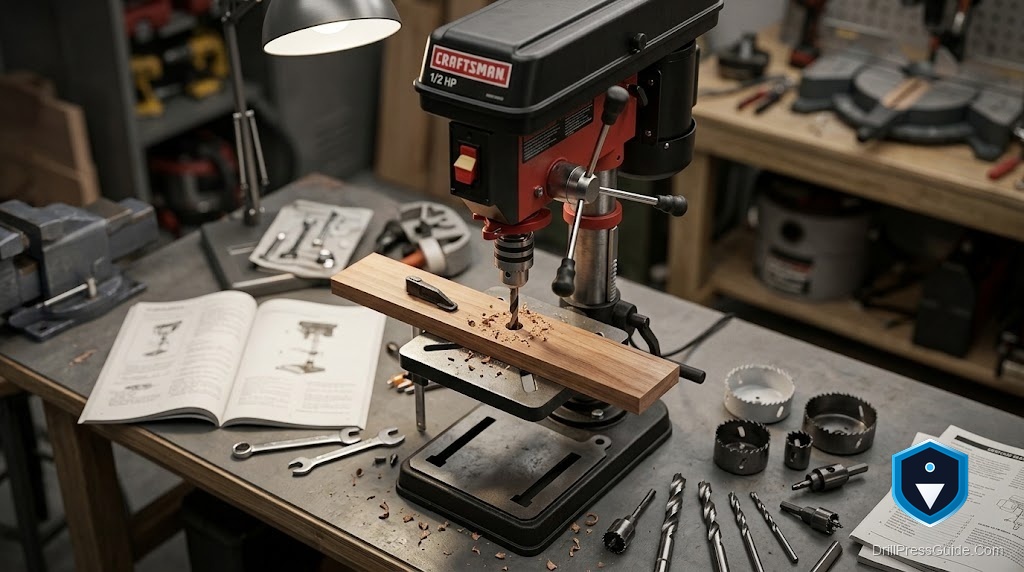
Somewhere between the tiny 1/3-horsepower hobby presses and the big 3/4-horsepower floor machines sits a whole class of Craftsman drill press 1/2 HP models, and they occupy a genuinely useful middle ground. Enough motor to drive real bits, small enough to live on a bench, common enough on the used market to be affordable. If you have one, or you are eyeing one, the practical questions are the same: how do you set it up right, what can it actually do, and can you still get parts when something wears out?
The Craftsman drill press 1/2 HP is a mid-power benchtop press (represented by models such as the 113-series) built for Sears by contractors like Emerson Electric, using a 1/2-horsepower motor, a stepped-pulley belt drive, and a keyed chuck. The half-horsepower rating places it above light 1/3-HP hobby machines and below 3/4-HP presses, giving it enough torque for general woodworking and light metal without the size of a floor model.
Short answer: a Craftsman 1/2 HP press is a capable general-purpose benchtop machine, well suited to woodworking and light metal, as long as you set the belt to the right speed for the job and accept that it is not built for heavy repeated large-diameter work. Setup is straightforward, the limits are predictable, and parts support through Sears PartsDirect is a real advantage. Here is what to know.
What 1/2 HP actually gets you
Horsepower on a drill press translates to how large a bit you can drive and how hard you can feed without bogging the motor. At 1/2 HP, you have comfortable capacity for the bits most shops use daily: twist bits, spade bits, and mid-size Forstner bits in wood, plus light metal drilling at low speed. You will feel the limit if you push a large Forstner or a big hole saw through hardwood, or drill large holes in thick steel, jobs that want a 3/4-HP machine. For the everyday range, though, 1/2 HP is a sweet spot: more capable than a 1/3-HP hobby press, and easier to place than a floor model.
Setup: getting it right
A correct setup is what separates clean holes from wander and chatter. Work through these steps:
Mount it solid. Bolt the base to a sturdy bench. A benchtop press is only as steady as what it sits on, and a wobbly bench shows up as vibration in the work.
Set the speed with the belt. Open the pulley cover and set the belt position for your bit and material using the speed chart, usually inside the cover. Slower for large bits and metal, faster for small bits in wood. This is the step most people skip, and it is the one that most affects results.
Tension the belt. After moving the belt, retension it by adjusting the motor bracket so the belt is snug but not overtight, then lock it. A loose belt slips; an overtight one wears bearings.
Set the depth stop. Use the depth-stop collar for repeatable hole depths, and check that the quill returns smoothly under its spring.
Square the table. Confirm the table sits square to the spindle with a small square before precise work.
The honest limits
Power ceiling. The clearest limit. Large-diameter bits in hardwood or thick steel will bog the motor. Work within the range and it performs well; push past it and it struggles.
Belt-change speeds. No variable dial. Changing speed means opening the cover and moving the belt, which discourages frequent changes.
Age. Most of these are older machines, so expect a chuck, belt, or switch to need replacing. All are serviceable.
Parts and support
This is where owning a Craftsman pays off. Sears PartsDirect maintains diagrams and parts listings for many 113-series machines, so V-belts, retaining rings, ball bearings, center and motor pulleys, the chuck key, torsion spring, spring cap, and switch are often orderable by model number. Generic belts and chucks cover the common wear items. Because parts fit varies by model, record your full model number before ordering; our Craftsman drill press parts guide walks through it.
Craftsman 1/2 HP versus the alternatives
Against a 1/3-HP hobby press, the 1/2 HP Craftsman drills larger bits and feeds harder, a clear step up for general work. Against a 3/4-HP floor machine, it gives up power and swing but wins on footprint and price. If you want the 1/2 HP class of capability with modern variable speed instead of belt changes, a current machine like the WEN 4214T offers dial-and-read speed and a 5/8-inch chuck in a 12-inch benchtop package. Buy the Craftsman for value and repairability; buy new for convenience and a warranty.
The verdict
The Craftsman drill press 1/2 HP is a well-judged middle-ground machine, capable enough for general woodworking and light metal, compact enough for a bench, and cheap enough used to be an easy recommendation. Set it up properly, bolt it down, set the belt speed for the job, tension the belt, and square the table, and it rewards you with clean, accurate holes. Respect its power ceiling on large bits and thick steel, and lean on Sears PartsDirect for the wear items it will eventually need. If you want variable speed and a warranty, buy new; if you want honest capability for little money, this class of Craftsman delivers.
Frequently asked questions
What can a 1/2 HP drill press do? It comfortably drives twist, spade, and mid-size Forstner bits in wood, plus light metal drilling at low speed. It will bog on large Forstner bits or big holes in hardwood or thick steel, which want a 3/4-HP machine.
Is 1/2 HP enough for a drill press? For general woodworking and light metal, yes. It sits above 1/3-HP hobby presses and handles the bit sizes most shops use daily. Heavy large-diameter work is where it reaches its limit.
How do I set the speed on a Craftsman 1/2 HP drill press? Open the pulley cover and move the belt to the position shown on the speed chart for your bit and material, slower for large bits and metal, faster for small bits in wood, then retension the belt and lock the motor bracket.
How do I set up a Craftsman drill press? Bolt it to a solid bench, set the belt speed for the job, tension the belt, set the depth-stop collar for repeatable depth, and square the table to the spindle before precise work.
Can you still get parts for a Craftsman 1/2 HP drill press? Often yes. Sears PartsDirect lists belts, bearings, pulleys, springs, chuck keys, and switches for many 113-series models, and generic belts and chucks cover wear items. Order by full model number.
What is the difference between 1/3, 1/2, and 3/4 HP Craftsman drill presses? More horsepower means larger bits and harder feed without bogging. The 1/3-HP models suit hobby work, 1/2 HP handles general woodworking and light metal, and 3/4-HP floor machines take on large holes and heavier metal.
Why does my drill press bog down? Usually the bit is too large for the motor, the speed is set too high for the bit, or the feed pressure is too heavy. Drop to a lower speed, ease the feed, and stay within the machine’s power range.
References
- Sears PartsDirect, Craftsman drill press parts and diagrams by model: https://www.searspartsdirect.com
- VintageMachinery.org, Craftsman and Emerson tool documentation: https://vintagemachinery.org
- Popular Woodworking, drill press setup and speed guidance


