
A Practical Guide to the Craftsman Drill Press Floor Model Lineup
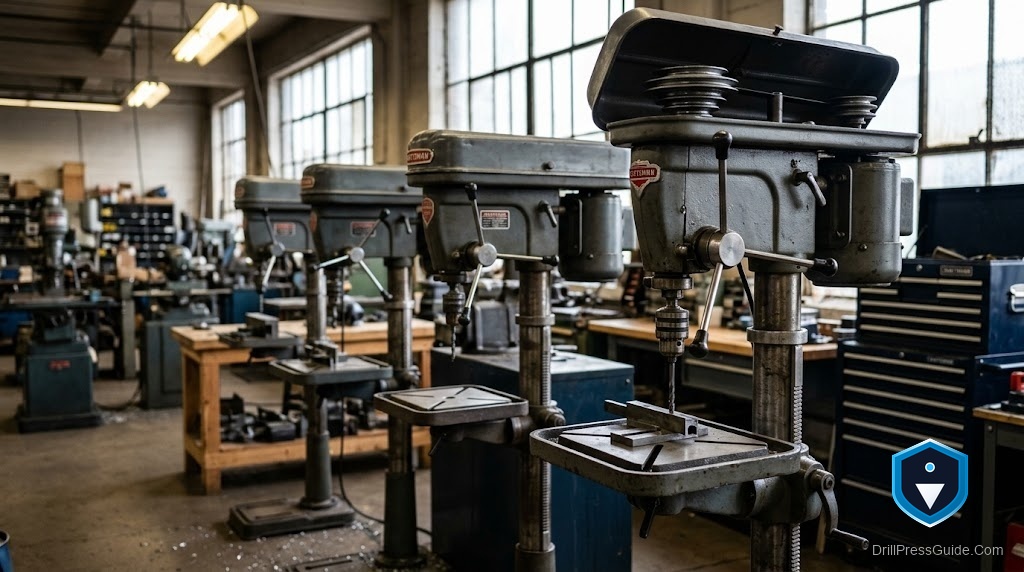
When a Craftsman owner decides to move up from a benchtop press, the floor model is the destination. These are the full-height, freestanding machines that reach the center of wide workpieces, carry stronger motors, and hold holes straighter thanks to their mass. Craftsman sold floor models across the years in sizes like 15-inch, 15-1/2-inch, and 17-inch, and plenty of them, including many from around 1990, are still working in home shops today. If you are considering a Craftsman floor drill press, here is how the lineup breaks down and how to keep one running.
What a Craftsman floor drill press is
A Craftsman floor model is a freestanding drill press built on the classic Craftsman layout, scaled up: a motor driving a stepped-pulley belt for multiple speeds, a spindle with a keyed chuck, a quill with a torsion return spring, and a cast table that raises, tilts, and locks on a tall column reaching to the floor. Compared with a benchtop press, the floor model brings more swing, more spindle travel, a stronger motor, and the rigidity that comes from height and mass. Like all Craftsman stationary tools, these carry Sears model numbers, and that number is the key to parts and manuals.
How the lineup breaks down
The Craftsman floor models sort mainly by swing:
- 15-inch models. The common mid-size floor press, with enough swing and power for general woodworking and light metal. A frequent choice, including many 1990-era machines.
- 15-1/2-inch models. Effectively the same class with a slightly larger stated swing, sharing most parts and characteristics.
- 17-inch models. The largest Craftsman floor presses, with the most swing and typically a stronger motor for the heaviest work this range handles.
Across all of them, judge the machine by swing, spindle travel, speed range, and motor rating. A 1990 floor model, for example, is a simple, durable machine whose value lies in heavy iron and documented parts rather than modern features.
Parts and the model number
Here is where Craftsman beats off-brands. Because these are Sears machines, parts diagrams and manuals are available by model number through Sears PartsDirect, and the failure points are standard: a V-belt, the chuck and key, a torsion return spring and spring cap, ball bearings, the spindle and center pulleys, the motor pulley and bracket, the locking switch, and the taper pin. Find the model number on the machine, pull the matching diagram, and you can order or match nearly everything, even on a decades-old floor press. That documented support is a big reason these machines stay useful.
Tooling and replacement parts
Keep a Craftsman floor press running with standard tooling. Fit a quality keyed drill chuck with the matching arbor if the original wears, keep a fresh drill press V-belt on the shelf, and fix a weak quill return with a drill press quill return spring. Add a heavy drill press machine vise to use the machine’s capacity and keep a spare drill press chuck key. Confirm the taper before ordering an arbor, and match springs, pulleys, and bearings by model number.
The verdict
The Craftsman floor drill press lineup is a smart move up from a benchtop machine for a home shop, offering more swing, travel, motor, and rigidity in a freestanding package. Choose a 15-inch or 15-1/2-inch model for general woodworking and light metal, or a 17-inch model for the most swing and power. These are simple, durable machines, and because they are documented Sears tools, keeping one running is easy: find the model number, pull the parts diagram, and the failure points are all standard components. Fit a good chuck, belt, and heavy vise, and a Craftsman floor press anchors a home shop for many years. For heavy industrial metalwork, a dedicated metalworking press is the next step.
Takeaways:
- Craftsman floor models are freestanding presses with more swing, travel, motor, and rigidity than benchtop machines.
- The lineup sorts mainly by swing: 15-inch, 15-1/2-inch, and 17-inch models, including many 1990-era machines.
- Judge each by swing, spindle travel, speed range, and motor rating.
- Parts and manuals are available by Sears model number; failure points are standard, documented components.
FAQ
What sizes do Craftsman floor drill presses come in? Commonly 15-inch, 15-1/2-inch, and 17-inch swings. The 15-inch class is the frequent mid-size choice; the 17-inch is the largest with typically a stronger motor.
Is a 1990 Craftsman floor drill press worth buying? Often yes. These are simple, durable machines, and parts and manuals remain available by Sears model number, so a clean example is a strong, serviceable press.
Floor model or benchtop, which should I choose? A floor model brings more swing, travel, motor, and rigidity for wider and heavier work; a benchtop press saves space for lighter tasks. Match to your work and space.
Where do I get parts for a Craftsman floor press? By Sears model number through Sears PartsDirect. Failure points (belt, chuck, key, return spring, pulleys, bearings, switch) are standard and documented.
How do I find the model number? It is on the machine’s ID plate and any manual, typically with a 113 prefix. That number unlocks the parts diagram and manual.
Why won’t the quill return on my floor model? Usually a tired torsion return spring under the spring cap. Match the correct spring by model number and adjust its tension.
What chuck and taper do they use? A keyed chuck on a standard taper. Confirm the taper by removing the chuck before ordering a replacement arbor.
References
- Sears PartsDirect, Craftsman floor drill press model lookup and parts diagrams: https://www.searspartsdirect.com/
- Craftsman drill press owner’s manuals (Sears model-number archive): https://www.searspartsdirect.com/model-lookup
- OWWM.org, Craftsman and Sears stationary tool identification forums: https://owwm.org/


