Old Craftsman Drill Press Parts: What to Measure Before You Order
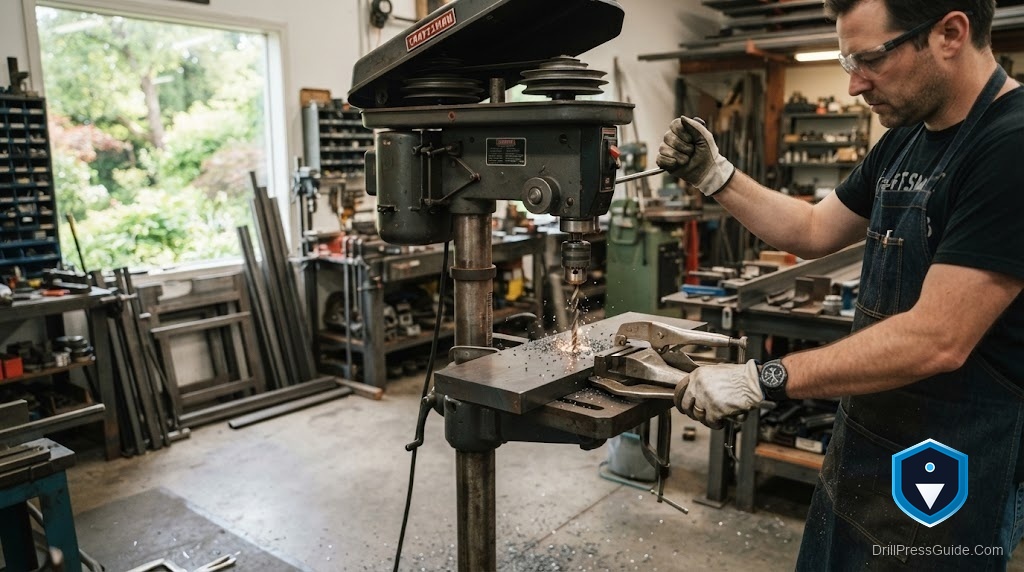
The fastest way to waste a parts order on an old Craftsman drill press is to click buy based on a photo and a hopeful guess. Parts that look right arrive and do not fit, because the belt was an inch too long, the bearing bore was a size off, or the chuck taper was wrong. Every one of those mistakes is avoidable with a tape measure and a set of calipers. The habit that separates a smooth restoration from a drawer full of wrong parts is simple: measure before you order.
Old Craftsman drill press parts come from machines built by King Seeley, with the 103 prefix from 1946 to 1964, and by Emerson, with the later 113 prefix. They split into standard consumables that fit by measurement across machines, and model-specific castings that fit only within a family. For the standard parts, which are most of what a restoration needs, the right measurement is the whole answer. This guide covers what to measure for each.
Measure the belt
The V-belt is the most commonly replaced part and the easiest to get wrong from a guess. Measure the old belt’s outside circumference with a tape, or if the old belt is missing, wrap a string around the pulley path at the position you will run and measure that length. Note the belt profile too, the cross-section width and depth, since Craftsman presses use a standard profile. With the length and profile in hand, any supplier can match a standard V-belt. There is no need for a branded belt.
Measure the bearings
Ball bearings are defined by three numbers: the inner diameter, the outer diameter, and the width. All three are usually stamped on the old bearing, but confirm them with calipers, since a worn stamp can mislead. Better still, most bearings carry a bearing number, and reading that number lets any bearing supplier cross-reference a modern equivalent exactly. Measure or read all your bearings before ordering, because a press has more than one and they are not always the same size.
Confirm the chuck taper
The chuck is defined by its arbor taper, not by the Craftsman name. Most old Craftsman presses use a JT33 arbor, but confirm before ordering, since some smaller machines use JT2. To check, remove the chuck and measure the arbor’s large and small diameters and its length, then compare against the JT33 dimensions, or read any taper marking. With the taper confirmed, a standard JT33 keyed drill chuck fits any JT33 arbor once the old chuck is driven off, and a larger replacement JT33 chuck mounts the same way if you want more capacity. A JT33 chuck will not seat on a JT2 arbor, which is exactly why you measure first. Check runout on a budget chuck before precision work.
Measure the return spring housing
The quill return spring is semi-standard, so if you are replacing a broken one with a generic part, measure the spring housing diameter and the spring width and thickness first. A generic return spring assembly fits many machines, but fit is not universal, so the measurements tell you whether it will seat in your spring cap. Where possible, keep and reuse the original cap and retaining pin.
Measure model-specific parts, and match the family
For pulleys, tables, brackets, and handles, measurement still matters, but you must also confirm the part comes from a compatible model. Measure a pulley’s bore and count its steps; measure a handle’s thread diameter and pitch, remembering that some late 1957 model 100 presses used larger 1/2-13 handle threads instead of 3/8-16. Match these against a same-family donor or a parts diagram for your exact model, since Craftsman 10-inch and 15-inch parts do not interchange despite the shared badge.
Conclusion
Ordering old Craftsman drill press parts is reliable the moment you measure instead of guess. Take the belt’s length and profile, the bearings’ three dimensions or their numbers, the chuck’s arbor taper, and the spring housing’s dimensions, and standard consumables will fit every time. For model-specific pulleys, tables, and handles, measure and also confirm the part matches your model family. A tape and calipers up front save a drawer full of wrong parts later.
Three takeaways: measure the belt length and profile, read the bearing numbers, and confirm the chuck arbor taper before ordering anything.
Frequently Asked Questions
What should I measure before ordering an old Craftsman drill press belt? The outside circumference of the old belt, or the pulley path with a string if the belt is gone, plus the belt profile. With length and profile, any supplier matches a standard V-belt.
How do I find the right bearings for an old Craftsman press? Read the bearing number stamped on each old bearing, or measure the inner diameter, outer diameter, and width with calipers. Any bearing supplier cross-references the number to a modern equivalent.
How do I confirm the chuck taper on an old Craftsman drill press? Remove the chuck, measure the arbor’s large and small diameters and length, and compare against JT33 dimensions, or read any taper marking. Most use JT33, but some small machines use JT2.
Can I use a generic quill return spring? Often, but measure the spring housing diameter and the spring width and thickness first, since fit is not universal. Keep the original cap and retaining pin where possible.
Why measure model-specific parts if I know the model? Because Craftsman changed some parts within a model run, like the 1957 handle thread change, and sizes vary between the 10-inch and 15-inch machines. Measuring confirms the exact fit.
Do Craftsman drill press parts interchange between models? Standard consumables fit by measurement across models. Model-specific castings, pulleys, and handles only cross over within a compatible family, so confirm before ordering.
References
- Sears PartsDirect, Craftsman drill press parts and diagrams. https://www.searspartsdirect.com
- The Garage Journal, Craftsman drill press information, 1946 to 1984. https://www.garagejournal.com
- Jacobs Chuck Manufacturing, Mounting and Removing Chucks. http://www.jacobschuck.com/uploads/ueditor/file/20200604/1591240204146153.pdf