
Using the Old Craftsman Drill Press Manual: Setup and Reference Guide
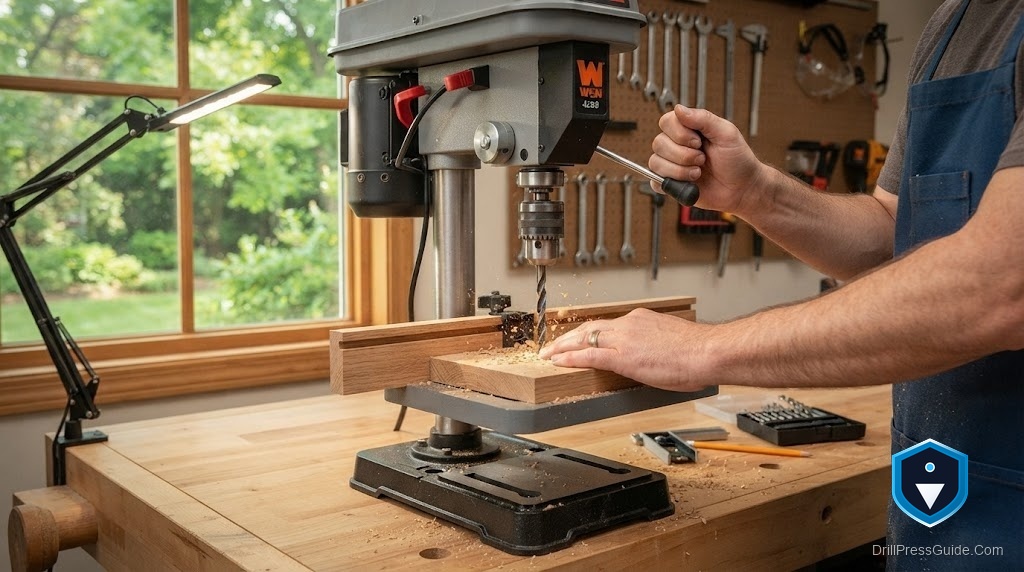
Finding the manual for an old Craftsman drill press is only half the job. The other half, the half that actually makes the machine drill straight and run right, is knowing how to use it. A manual is not bedtime reading; it is a working reference with a parts diagram, a speed chart, and a set of adjustment procedures that together turn a running machine into an accurate one. Owners who treat it that way get a press that drills square and lasts; owners who file it away keep guessing at speeds and fighting a table that will not align.
An old Craftsman drill press manual is the owner and parts documentation Sears published for a specific model, identified by the model number and its 103 or 113 prefix. Once you have the correct manual for your machine, it becomes the reference for four things that matter every time you use the press: setting speed, adjusting the quill and depth, aligning the table, and ordering parts.
This guide walks through how to put each part of the manual to work.
Read the specifications first
Before anything else, read the specifications page so you know what the machine is. It lists the motor requirement, the chuck capacity, the quill travel, the number of speeds, and the spindle taper. These numbers set your expectations and keep you from asking the machine to do work it was never built for, like running a large bit meant for a floor press. The spindle taper, usually JT33 on these machines, also tells you which chuck fits if you ever replace it.
Set the speed from the belt chart
The single most-used page is the belt and speed chart. On an old Craftsman, you change speed by moving the V-belt across the pulley steps, and the chart shows which step combination gives which spindle speed. The working rule the chart supports: lower speeds for larger bits and for metal, higher speeds for small bits and for wood. Running a large bit too fast burns the bit and the work, while running a small bit too slow is merely inefficient. Set the belt for the job using the chart before you drill, and re-tension it so it deflects slightly under thumb pressure.
Adjust the quill, spring, and depth stop
The manual’s adjustment section is where accuracy lives. Use it to set the quill return spring tension so the quill returns smartly without slamming, following the documented procedure for the spring cap and preload. Use it to set the depth stop for repeatable hole depths. And use it to check the quill for excessive play, with the manual’s tolerance as your guide. These adjustments are what make the difference between a press that feeds smoothly and one that chatters or wanders.
Align the table using the documented method
A table that is not square to the spindle drills angled holes, and the manual gives the procedure to align it. Follow it: set the table at right angles to the spindle using the documented reference, and confirm with a square or a bent-rod check between the chuck and the table. The manual also covers the table clamp, the raising mechanism, and the alignment pin, so you can lock the table solidly once it is square.
Keep the parts diagram for repairs
The exploded parts diagram is the reference you return to for every repair. It names each component with its part number, so ordering a replacement becomes a matter of reading a number rather than measuring and guessing. When the chuck wears out, the diagram confirms the arbor taper so you can fit a correct replacement; most of these machines take a JT33 arbor, so a standard JT33 keyed chuck fits once the old one is driven off. The diagram also identifies the belt, bearings, and spring so you can match standard consumables by size.
Conclusion
Using an old Craftsman drill press manual well means treating it as a working reference, not an archive. Read the specifications to know the machine, set speed from the belt chart to match the bit and material, adjust the quill spring and depth stop for smooth accurate feed, align the table with the documented procedure so holes come out square, and keep the parts diagram for every repair. Do that, and the manual turns a vintage press from a guess into a precise, dependable tool.
Three takeaways: the belt chart sets the right speed for the bit and material, the adjustment section is where accuracy lives, and the parts diagram makes ordering replacements a matter of reading a number.
Frequently Asked Questions
What is the most useful part of an old Craftsman drill press manual? For daily use, the belt and speed chart; for repairs, the exploded parts diagram. Together they cover setting the machine up correctly and ordering the right parts.
How do I set the speed on an old Craftsman drill press? Use the belt chart to find the pulley-step combination for your target speed, then move the V-belt accordingly. Use lower speeds for large bits and metal, higher speeds for small bits and wood.
How do I align the drill press table using the manual? Follow the manual’s procedure to set the table square to the spindle, confirm with a square or bent-rod check between chuck and table, then lock the table with its clamp.
How do I adjust the quill return spring? Use the manual’s adjustment section, which covers the spring cap and preload, to set the tension so the quill returns smartly without slamming.
How do I use the parts diagram to order parts? Find the component on the exploded diagram, read its part number, and order by that number. For consumables like belts and bearings, match the size the diagram specifies.
What chuck does the manual say fits my machine? The specifications and parts diagram give the spindle taper, usually JT33 on these presses, so a standard JT33 keyed chuck fits once the old chuck is driven off.
References
- Sears PartsDirect, Craftsman drill press parts and diagrams. https://www.searspartsdirect.com
- VintageMachinery.org, publication reprints and manufacturer archive. http://vintagemachinery.org


