Which Vintage Craftsman Drill Press Parts Fit? A Compatibility-First Guide
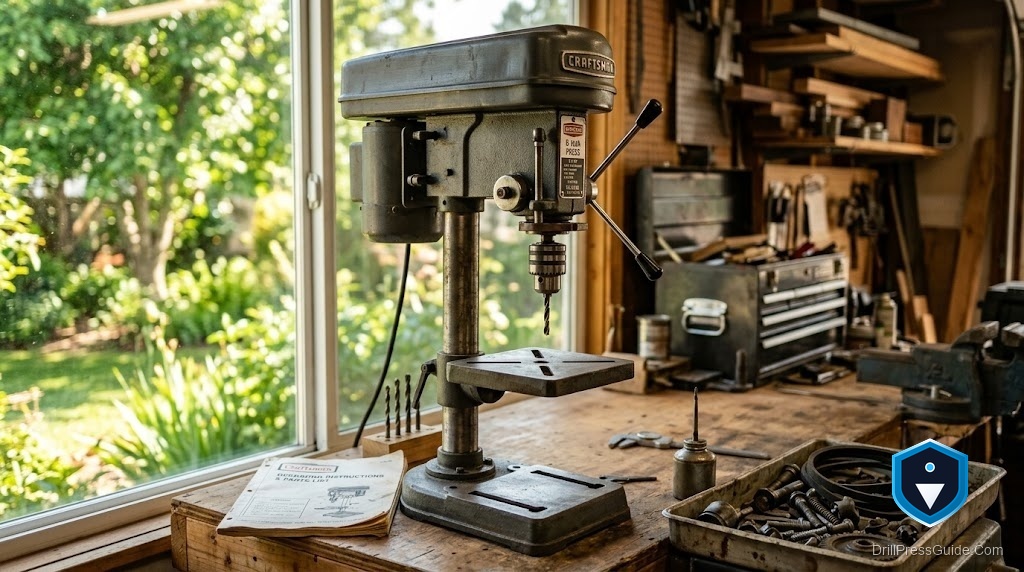
The fastest way to waste money on a vintage Craftsman drill press is to order a part that looks right in a photo. A pulley that is a quarter inch off, a chuck with the wrong taper, a belt an inch too long, and you are out the money and no closer to a running machine. The parts almost always exist. The problem is compatibility, and compatibility on these presses is decided by measurements and model numbers, not by how similar two parts appear on a screen.
Vintage Craftsman drill press parts fall into two groups, and the split is the whole game. One group is universal: belts, bearings, chucks, and springs that are defined by a size or a taper, so any part of the right dimension fits regardless of what machine it came off. The other group is model-specific: pulleys, the head casting, the motor bracket, the table, and the bed lock, which were made for one design and interchange only across closely related models.
So the honest answer to which vintage Craftsman drill press parts fit is: the universal ones fit by measurement, and the model-specific ones fit only within a family you have to confirm. Sort every part you need into those two buckets before you spend a dollar.
Confirm the machine before the part
Compatibility starts with the model number, not the part. A 103 prefix means King Seeley, built between 1946 and 1964; a number like 103.33140 pins down a specific machine, and later 113 numbers are Emerson. This matters because King Seeley changed details mid-run. A well-known example from the owner community: some late 1957 model 100 presses shipped with model 150 parts, including larger feed handle threads that jumped from 3/8-16 to 1/2-13 and a different motor mount. Two machines with almost the same badge can take different handles.
So write down the full model number and, where you can, the approximate year. Then you are matching parts to a known machine instead of guessing from a picture.
The universal parts, and how to size them
These are the parts that make vintage Craftsman presses easy to keep alive.
V-belt. Defined by profile and length. Measure the outside circumference of the old belt, or wrap a string around the pulley path, and match a standard belt. No branded belt is needed.
Ball bearings. Defined by inner diameter, outer diameter, and width, all stamped on the old bearing or measurable with calipers. Any bearing supplier cross-references the number. Replace, do not clean, a bearing that feels gritty.
Chuck and arbor. Defined by taper. Most of these use a JT33 taper, so a standard JT33 keyed chuck fits once the old chuck and arbor are driven off. If you want a fresh larger-capacity unit, a replacement JT33 taper chuck drops on the same way. The one caution is runout; budget chucks can run a few thousandths out, so if your work is precise, check it against a dial indicator before trusting it. Confirm your arbor is JT33 and not a smaller JT2 before ordering, because a mismatched taper simply will not seat.
Quill return spring. The old flat torsion springs lasted decades under constant tension, and many still do. If yours is broken, a generic drill press return spring assembly can substitute, though fit is not guaranteed across every model, so measure the housing and the spring width first. Its weakness is that the modern flat clockspring design is not as durable as the original, so keep the old cap and pin.
Small rubber parts. The quill bumper and spindle washers on the 100 and 150 series are reproduced by hobby sellers and are cheap insurance during a rebuild.
The model-specific parts, and how to match them
These are where the compatibility-first mindset earns its keep.
Pulleys. Cast for a specific spindle and motor shaft diameter and a specific number of steps. Measure the bore, the step count, and the outer diameters. A four-pulley step block from one model rarely fits another. Match by model family, and when in doubt, source from a donor of the same number.
Head casting, motor bracket, table, and bed lock. These are the true model-specific parts. Interchange is limited to closely related models, and the only safe way to buy is to confirm the donor machine shares your model family. Craftsman 10-inch and Craftsman 15-inch drill press parts are generally not interchangeable, despite the shared badge.
Feed handles and lock handles. As the 1957 example shows, thread sizes changed. Measure the thread before ordering a handle.
A simple buying order
Work from universal to specific. Fit the belt, bearings, chuck, and spring first, because those get the machine running and they fit by measurement. Only then chase pulleys and castings, and only after confirming the donor shares your model family. This order keeps you from spending on rare castings for a machine you have not yet proven will run.
Conclusion
Which vintage Craftsman drill press parts fit comes down to a single habit: sort every part into universal or model-specific before you buy. Belts, bearings, chucks by taper, and springs fit by measurement across machines. Pulleys, castings, brackets, and handles fit only within a confirmed model family. Match by numbers and calipers, not by photos, and the parts you need will almost always turn out to exist.
Three takeaways: the full model number and year come first, universal parts fit by dimension, and model-specific castings need a confirmed donor family.
Frequently Asked Questions
Are Craftsman 10-inch and 15-inch drill press parts interchangeable? Generally no. The shared Craftsman badge hides different designs. Castings, pulleys, and tables are sized to each machine, so confirm the model family before assuming a part crosses over.
What taper does a vintage Craftsman drill press chuck use? Most use a JT33 arbor taper, though some smaller presses use JT2. Measure or confirm the taper before buying a chuck, because a mismatched taper will not seat.
How do I find the right belt for a vintage Craftsman press? Measure the old belt’s outside circumference or the pulley path, then match a standard V-belt profile. Branded belts are not required.
Can I use a modern return spring on an old Craftsman press? Sometimes. Measure the spring housing and width first. Modern flat clocksprings can fit but are less durable than the originals, so keep the original cap and pin.
Where do model-specific Craftsman parts come from? Sears PartsDirect diagrams, donor machines of the same model family, and the vintage tool community. Confirm the donor shares your model before buying castings or pulleys.
Did Craftsman change parts within the same model? Yes. Some late 1957 model 100 presses shipped with model 150 parts, including larger handle threads and different motor mounts, so year matters as much as model.
References
- The Garage Journal, Craftsman drill press information and interchange notes, 1946 to 1984. https://www.garagejournal.com
- Sears PartsDirect, Craftsman drill press parts and diagrams. https://www.searspartsdirect.com
- Jacobs Chuck Manufacturing, Mounting and Removing Chucks. http://www.jacobschuck.com/uploads/ueditor/file/20200604/1591240204146153.pdf