
Which Drill Press for Jewelry Making Fits Your Work, Space, and Budget?
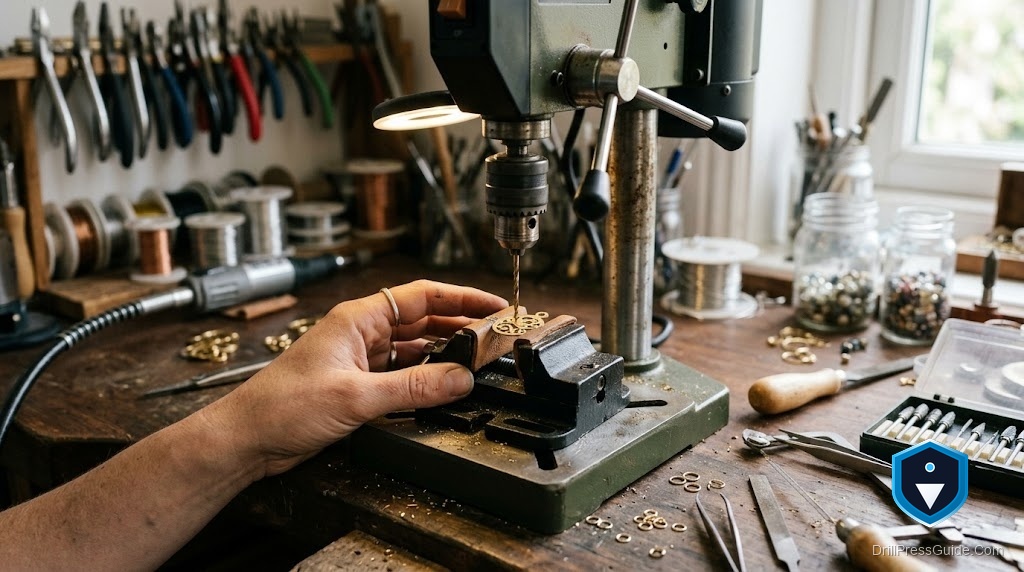
Jewelry work asks a drill press for finesse, not force: tiny bits, delicate materials, and holes placed precisely on small parts. That makes choosing one different from picking a general shop machine, because the features that matter for a big woodworking press barely register here, while a few specific qualities decide whether fine bits drill clean holes or wander and snap. This guide walks through what actually matters for jewelry, so you can match a press to your work, your space, and what you want to spend, without paying for capability you will never use.
A drill press for jewelry making is a machine used to drill small, precise holes in metal blanks, findings, beads, and similar pieces with fine bits, chosen for control and precision rather than power or capacity. The qualities that matter are low runout, a suitable speed range, a chuck that holds tiny bits, a stable and precise table, and a size that fits your space.
Short answer: for jewelry, prioritize low runout so fine bits do not wander, a speed range that suits small bits and delicate materials, a chuck or collet that grips tiny bit shanks, and a stable table, in a footprint that fits your bench or studio. Power and large capacity barely matter here, so match the press to fine, precise work rather than to raw drilling ability.
Runout and the chuck matter most
With the fine bits jewelry uses, runout, how much the chuck and bit wobble as they spin, is the single most important quality, because a tiny bit exaggerates any wobble and wanders off the mark or breaks. So look first for a machine known for low runout and a chuck that runs true. Just as important is whether the chuck can actually grip the tiny shanks jewelry bits use; a large general chuck may not close down enough or hold small bits concentrically, so a chuck suited to small bits, or the ability to fit a collet-style holder, is worth prioritizing. Runout and a chuck that holds fine bits true are where jewelry accuracy begins, so weigh these above everything else.
Speed range for small bits and delicate materials
Small bits generally need higher speeds to cut cleanly, so a press whose speed range reaches suitably high suits jewelry better than one geared for large bits at low RPM. Variable speed is a real convenience, letting you dial the right speed for different bit sizes and materials, softer metals, harder alloys, or brittle stone and glass beads, without swapping belts. For hard or brittle materials you may want lower speeds with water cooling, so a wide, easily adjusted range is genuinely useful. When weighing options, a machine that reaches the higher speeds fine bits want, and adjusts easily, serves jewelry work better than one built around brute low-speed torque.
Table, stability, and holding small parts
Jewelry pieces are small, so the table and how you hold work matter more than sheer size. Look for a stable, flat table that adjusts precisely and locks solidly, and think about how you will hold tiny parts, since they must be clamped in a small vise or fixture, never fingers, because a fine bit can grab and spin them. A press with a table that accepts a small vise or a jeweler’s fixture, and that sits steady without vibration, supports precise, safe drilling. A benchtop machine is almost always right for jewelry; a big floor model offers capacity you will not use. Prioritize a precise, stable, steady table over a large one.
Matching to your space and what you spend
Because jewelry work does not need power or capacity, you can choose based on space and value rather than size. A compact benchtop press fits a bench or small studio and is usually the sensible choice, leaving room for the tools and materials jewelry actually needs. Put your money toward the qualities that matter, low runout, a chuck that holds fine bits, and a useful speed range, rather than toward horsepower or a large table you will not use. Thinking about your actual pieces, the smallest bits you use, the hardest materials you drill, and the space you have, points you to a press that fits your work rather than one that is simply big or powerful.
Conclusion
Choosing a drill press for jewelry making is about finesse, not force. Prioritize low runout and a chuck or collet that grips tiny bits true, since fine bits punish any wobble; favor a speed range that reaches high for small bits, ideally variable; and look for a stable, precise table that takes a small vise or fixture, in a compact footprint that fits your space. Skip the power and capacity a big machine sells, because jewelry never uses them. Match the press to your smallest bits, your hardest materials, and your studio, and you get clean, precisely placed holes in delicate work, which is the whole reason to choose carefully rather than by size.
Frequently asked questions
What matters most in a drill press for jewelry? Low runout and a chuck or collet that holds tiny bits true, because fine bits exaggerate any wobble and wander or snap. Precision and control matter far more than power or capacity.
Do I need a big or powerful drill press for jewelry? No. Jewelry work uses tiny bits and small parts, so power and large capacity barely matter. A compact benchtop machine chosen for precision is almost always the right choice.
Is variable speed worth it for jewelry? Yes. Small bits need higher speeds, and different materials, soft metals, hard alloys, brittle stone or glass, want different speeds, so an easily adjusted range is genuinely useful.
Why does the chuck matter for jewelry bits? Because a large general chuck may not close down enough or hold tiny bit shanks concentrically. A chuck suited to small bits, or a collet-style holder, grips fine bits true for accurate holes.
How should I hold small jewelry pieces? In a small vise or fixture clamped to the table, never in your fingers, because a fine bit can grab and spin a tiny piece. Look for a table that accepts a small vise or jeweler’s fixture.
Benchtop or floor model for jewelry? Benchtop, almost always. A floor model offers capacity and power jewelry never uses, while a compact benchtop press fits a bench or studio and leaves room for other tools.
References
- OSHA, Machine Guarding eTool: Drill Presses, osha.gov
- Vintage Machinery, machine tool references, vintagemachinery.org


