Small Drill Press for Jewelry Making: A Setup Focused on Accuracy
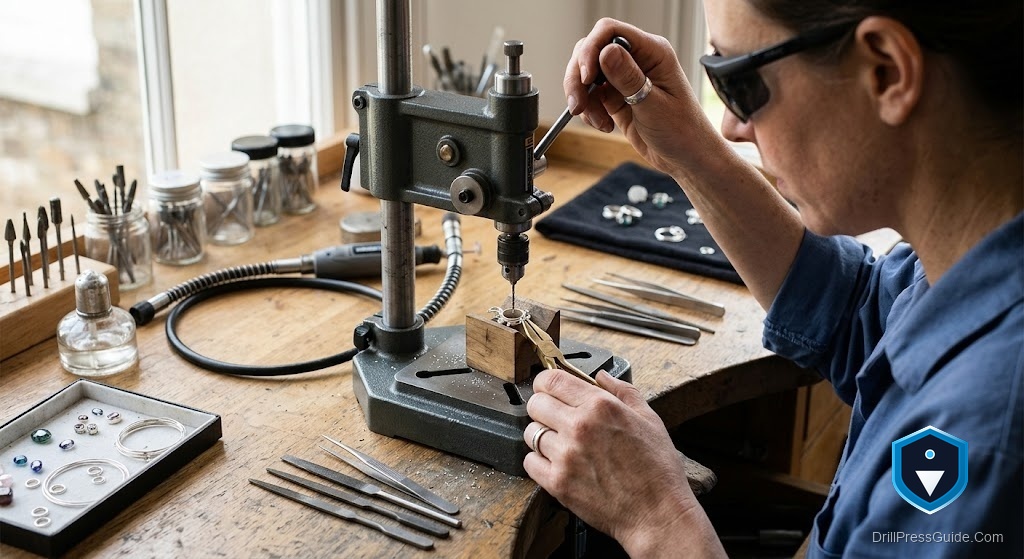
Jewelry work asks a drill press for the opposite of brute force: tiny bits, delicate materials, and holes placed precisely on small parts that a big machine would overwhelm. A small drill press set up thoughtfully for this work drills clean, accurately placed holes in metal, stone beads, and findings without wandering or grabbing. The accuracy comes less from the machine’s size than from how it is set up and used, so this guide focuses on the setup choices that make a small press genuinely precise for jewelry.
Using a small drill press for jewelry making means drilling small, precise holes in metal blanks, findings, beads, and similar pieces with fine bits, relying on a machine set up for control rather than power. An accuracy-focused setup means minimal runout, an appropriate speed, secure holding of tiny parts, and support and lubrication suited to the material.
Short answer: set up a small press for jewelry by minimizing runout so fine bits do not wander, matching speed to the tiny bit and the material, holding small parts securely in a vise or fixture rather than by hand, and supporting and cooling or lubricating the work as the material needs. For jewelry, accuracy and control matter far more than power, so the setup should aim at steadiness and precision.
Runout and secure bit holding come first
With the fine bits jewelry uses, the machine’s runout, how much the chuck and bit wobble as they spin, matters enormously, because a tiny bit exaggerates any wobble and wanders or snaps. So the first setup priority is a chuck that holds small bits true and concentric, and bits seated properly and tightened. A chuck suited to very small bit shanks, or a collet-style holder, grips fine bits better than a large general chuck. Getting the bit to spin true, with minimal runout, is what lets it start exactly on your mark and drill a clean, placed hole, so this is where accuracy for jewelry begins.
Match speed to the tiny bit and material
Small bits generally need higher spindle speeds to cut cleanly, and the right speed also depends on the material, softer metals, harder alloys, stone, or glass beads each behave differently. Set the speed appropriate to the bit size and material rather than leaving it at a generic setting, since too slow can make a fine bit grab and too fast can burn or overheat delicate work. For very hard or brittle materials like stone or glass, slower speeds with water cooling are often needed. Matching speed to both the small bit and the specific material is a key setup choice, because it is what keeps the bit cutting cleanly instead of wandering, grabbing, or overheating.
Hold small parts securely, never by hand
The most important safety and accuracy rule in jewelry drilling is to hold small parts securely, never in your fingers, because a fine bit can grab a tiny piece and spin it instantly. Use a small vise, a pin vise fixture, clamps, or a purpose-made holding jig to grip the piece firmly on the table, keeping your fingers well clear of the bit. For very small or awkward parts, a fixture that locates and holds them repeatably also improves accuracy. Secure holding is both what protects your hands and what keeps the part from shifting mid-hole, so treat a reliable way to clamp tiny work as an essential part of the setup, not an option.
Support, cool, and place the hole
Support the work under the drilling point with a backing so the bit exits cleanly without tearing or cracking the piece, and so it does not drill into the table. For metals, a little cutting lubricant helps the bit cut and stay cool; for stone or glass beads, water cooling is usually needed to prevent cracking and burning. Place the hole precisely by marking or center-punching where the material allows, and using the press’s controlled plunge to start exactly on the mark. Feed gently, letting the bit cut rather than forcing it, since fine bits break under pressure. Supporting, cooling, and carefully placing the hole are what turn a steady setup into clean, accurately located jewelry holes.
Conclusion
A small drill press does excellent jewelry work when set up for accuracy and control rather than power. Start with minimal runout and a chuck that holds fine bits true, match the speed to the tiny bit and the specific material, hold small parts securely in a vise or fixture instead of by hand, and support, cool, and carefully place each hole. Feed gently so fine bits do not break. Set up this way, a small press drills clean, precisely located holes in metal, findings, and beads while keeping your fingers safe, which is exactly what jewelry making needs, and it shows that for this work how you set the machine up matters far more than how big it is.
Frequently asked questions
What matters most in a drill press for jewelry making? Accuracy and control rather than power: minimal runout so fine bits do not wander, an appropriate speed, secure holding of tiny parts, and support and cooling suited to the material.
Why does runout matter so much for jewelry? Because jewelry uses very fine bits, and any wobble in the chuck and bit is exaggerated by a tiny bit, making it wander off the mark or snap. A chuck that holds small bits true is essential.
What speed should I use? Generally higher speeds for small bits, adjusted to the material. Softer metals, hard alloys, stone, and glass each differ, and brittle materials like stone or glass often need slower speeds with water cooling.
How do I hold tiny parts safely? Always in a small vise, clamps, or a holding fixture, never in your fingers, because a fine bit can grab and spin a tiny piece instantly. Keep your hands well clear of the bit.
How do I stop the piece cracking or tearing? Support it under the drilling point with a backing so the bit exits cleanly, cool metals with a little cutting lubricant and stone or glass with water, and feed gently rather than forcing the bit.
How do I place the hole accurately? Mark or center-punch where the material allows, get the bit spinning true with minimal runout, and use the press’s controlled plunge to start exactly on the mark, feeding gently.
References
- OSHA, Machine Guarding eTool: Drill Presses, osha.gov
- Vintage Machinery, machine tool references, vintagemachinery.org