
Mini Drill Press Bench: What It Is, Where It Fits, and What to Check
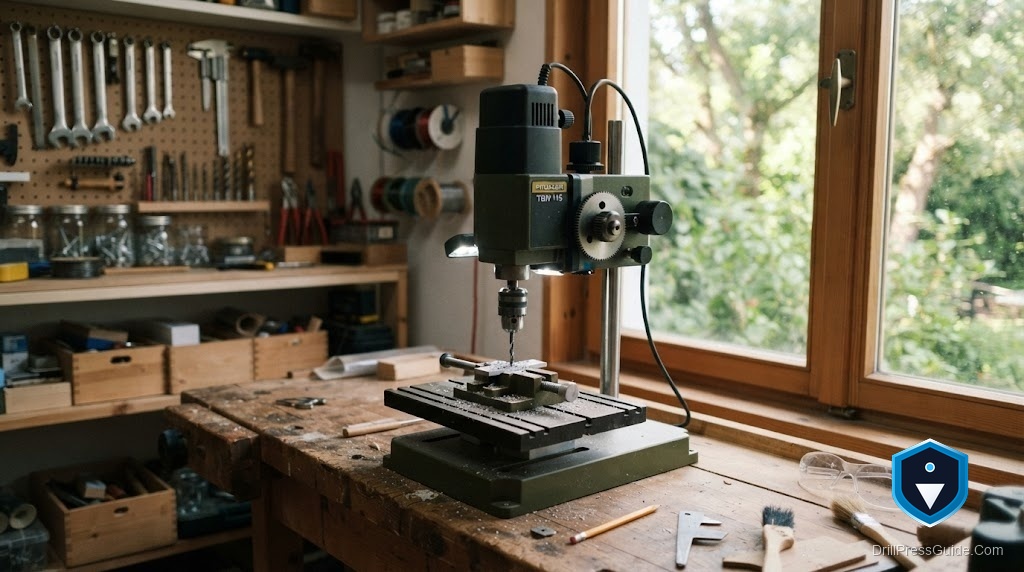
A mini drill press bench is exactly what it sounds like: a small drilling machine that sits on a workbench, desk, or table and handles precision work that a full-size drill press is too large and too powerful to do well. If you have ever tried to drill a 1/32-inch hole in a circuit board with a 12-inch benchtop press, you know the problem. The bit snaps, the board burns, and the hole wanders off center. A mini drill press bench solves this by scaling down the machine to match the work.
A mini drill press bench is a compact, bench-mounted drilling machine designed for accuracy on small parts. These machines typically have a swing of 6 to 8 inches, a small collet or chuck system, and a high-speed motor suited for jewelry, electronics, model building, and light metalwork. They are not smaller versions of standard benchtop presses. They are a different category of tool built for a different scale of work.
The question is whether a mini drill press bench is the right tool for your workshop, or whether a standard benchtop press will handle everything you need. The answer depends on what you actually drill. If your work involves standard hardware holes in wood and metal, a standard 8-inch or 10-inch benchtop press is the better choice. If you build models, repair jewelry, or prototype electronics, a mini drill press bench is essential.
What Makes a Mini Drill Press Bench Different
The most important difference is the chuck system. Standard benchtop presses use a Jacobs chuck with three jaws that grip the bit. This works fine for 1/8-inch bits and larger, but the runout increases as the bits get smaller. A mini drill press bench often uses collets, which grip the bit around its entire circumference. This reduces runout and provides better grip for tiny bits. Some machines use both systems, with a chuck for standard bits and a collet adapter for precision work.
Speed is the second major difference. Standard benchtop presses run from 500 to 3,000 RPM. A mini drill press bench runs from 2,000 to 10,000 RPM or higher. Small bits need high speed to cut properly. A 1/32-inch bit at 500 RPM will grab and break. The same bit at 5,000 RPM cuts cleanly through brass, plastic, or circuit board material.
Size and weight are also different. A standard 8-inch benchtop press weighs 30 pounds and has a footprint of roughly 12 by 18 inches. A mini drill press bench like the PROXXON TBM 115 weighs 11 pounds and has a footprint closer to 8 by 12 inches. The Dremel 220-01 workstation weighs 5 pounds and folds for storage. These machines fit on a desk, a kitchen table, or a small workbench in an apartment.
Our Top Picks for Mini Drill Press Benches
PROXXON 38128 TBM 115 Precision Bench Drill Press
The PROXXON TBM 115 is the gold standard for mini drill press benches. It is a German-made machine with a cast iron base, a steel column, and a machined aluminum head. The three-step pulley system gives you speeds of 2,800, 5,500, and 8,500 RPM. The chuck is a 3/8-inch keyed type, and the included collet set lets you hold bits down to 1/64 inch.
What makes the TBM 115 exceptional is the runout. Owners consistently report near-zero runout, which is critical for micro-drilling. The bearings are quality, the spindle is ground true, and the belt drive provides smooth power transmission without the vibration of a direct-drive motor. For jewelry, watchmaking, electronics, and model building, this is the machine most professionals reach for.
The quill travel is about 1-1/2 inches, which is small but sufficient for the scale of work this machine handles. The depth stop is a simple collar with a scale, and it works well for repeatable holes in thin material. The table is small but adjustable, and the overall footprint is minimal.
The flaw is the price. The TBM 115 costs more than some full-size benchtop drill presses. You are paying for precision machining, not capacity. For a hobbyist who drills the occasional model part, the price is hard to justify. For a jeweler or electronics builder who drills precision holes daily, the accuracy pays for itself in broken bits and ruined workpieces.
Who should skip it: woodworkers and general DIYers who need to drill holes larger than 1/4 inch in thick material. The PROXXON is too small and too slow for that work. It is also overkill if you only need a drill press once a month.
Check out the PROXXON 38128 TBM 115 on Amazon
Dremel 220-01 Workstation
The Dremel 220-01 is not a standalone drill press, but it is the most common mini drill press bench setup for hobbyists and makers. It is a workstation that converts a Dremel rotary tool into a bench-mounted drill press with 2 inches of drilling depth. The head tilts in 15-degree increments for angled holes, and the base includes tool storage and a flex shaft holder.
What makes the 220-01 genuinely useful is the ecosystem. If you already own a Dremel 3000, 4000, or 4300, you are halfway there. The workstation accepts the same collets and bits you already use, and the onboard tool storage keeps your accessories organized. For model builders, jewelry makers, and hobbyists who already live in the Dremel world, this is a natural extension.
The speed range goes up to 35,000 RPM, which is far higher than any traditional drill press. For tiny holes in circuit boards, jewelry, or models, this is a genuine advantage. The collet system is precise, with minimal runout when the collet is properly tightened.
The flaw is the plastic construction. The base is metal, but the head and telescoping column are plastic. It flexes under pressure, and if you push too hard, the bit drifts. This is not a machine for heavy-duty drilling. It is for light, precise work where the rotary tool does the cutting, not the pressure of your hand.
Who should skip it: anyone who needs to drill metal thicker than sheet stock or wood thicker than 1/2 inch. The Dremel workstation is a precision tool, not a production machine. If you need repeatable depth stops or a rigid quill, look at a true mini bench press instead.
Check out the Dremel 220-01 Workstation on Amazon
LAKIX Mini Drill Press Machine
The LAKIX mini drill press is a standalone machine designed for small-scale precision work. It features a compact benchtop footprint, a high-speed motor, and a precision chuck system suited for jewelry, electronics, and model making. The machine is smaller and lighter than a standard 8-inch benchtop press, and it is designed for accuracy rather than capacity.
What makes the LAKIX relevant is the price. It is significantly less expensive than the PROXXON and the Dremel workstation-plus-tool combination, which makes it accessible for beginners who are not sure how deep they will get into precision work. The machine is also genuinely compact, fitting on a small bench or even a desk.
The flaw is the build quality and the support. The LAKIX is an import machine with limited documentation and a smaller user community than Dremel or PROXXON. If something breaks, finding replacement parts may be difficult. The runout is also higher than the PROXXON, though acceptable for most hobby work.
Who should skip it: professionals who need guaranteed precision and long-term support. The LAKIX is a hobby machine. For daily production work, the PROXXON TBM 115 is the safer investment.
Check out the LAKIX Mini Drill Press on Amazon
Comparison: Mini Drill Press Benches at a Glance
| Feature | PROXXON 38128 | Dremel 220-01 | LAKIX Mini |
|---|---|---|---|
| Type | Standalone precision | Rotary tool station | Mini benchtop |
| Speed range | 2,800 to 8,500 RPM | Up to 35,000 RPM | High speed variable |
| Chuck/collet | 3/8-in chuck + collets | Dremel collets | Precision collets |
| Spindle travel | ~1.5 in | 2 in | ~1.5 in |
| Weight | ~11 lb | ~5 lb | ~8 lb |
| Best for | Jewelry, watchmaking | Electronics, models | Hobby precision |
The PROXXON is the choice for professionals who need the lowest runout and the most rigid setup. The Dremel 220-01 is the choice for hobbyists who already own a Dremel and need a flexible, multi-purpose workstation. The LAKIX is the budget entry point for standalone precision work. For most buyers, the decision comes down to the scale of your work and your budget.
Setup Tips for Mini Drill Press Benches
Mount the machine on a solid, vibration-free surface. Precision work is ruined by vibration, so avoid mounting the press on a wobbly bench or a table shared with a running bench grinder. A dedicated plywood base plate bolted to a solid workbench is ideal.
Use the right collet for the bit. A loose collet causes runout, which snaps small bits and ruins precision holes. Match the collet to the bit diameter exactly. Do not use a 3/32-inch bit in a 1/8-inch collet. The wobble will destroy the bit and the hole.
Use a backer board for thin materials. When drilling through circuit boards, brass sheet, or thin plastic, place a scrap piece of soft material underneath. This prevents the bit from grabbing as it exits and produces a clean hole on both sides.
FAQ
Q: What is the smallest hole a mini drill press bench can make?
A: With the right collet and a quality bit, the PROXXON can drill holes as small as 0.5 millimeters. The Dremel workstation, using Dremel collets, can go even smaller. The limit is usually the bit, not the machine.
Q: Can I use a mini drill press bench for woodworking?
A: Yes, for small woodworking projects like pen blanks, inlays, or small dowel holes. For large Forstner bits or long auger bits, a full-size benchtop press is necessary. Mini drill press benches lack the spindle travel and motor torque for big bits.
Q: Are the collets on mini drill press benches standard size?
A: Not always. PROXXON uses metric collets, Dremel uses its own collet system, and other machines may use ER or Jacobs chucks. Check the compatibility before you buy specialty bits. Adapters exist, but they add runout.
Q: Do mini drill press benches need special maintenance?
A: Keep the spindle and collets clean of debris. A small chip in the collet can cause runout that ruins a precision hole. Lubricate the quill lightly with machine oil. Do not over-lubricate, as excess oil attracts dust and chips.
Q: What is runout, and why does it matter?
A: Runout is the wobble of the spindle as it rotates. For large bits in wood, a few thousandths of an inch of runout is not noticeable. For a 1/32-inch bit in brass, the same runout causes the bit to snap or wander off center. Precision work requires near-zero runout.
Q: Can I use a mini drill press bench for production work?
A: The PROXXON TBM 115 is designed for light production in jewelry and electronics shops. The Dremel 220-01 is not built for production. For high-volume production, an industrial precision press from a machinist supply house is the better choice.
References
- PROXXON. TBM 115 Precision Bench Drill Manual. https://www.proxxon.com/
- Dremel. 220-01 Workstation Product Specifications. https://www.dremel.com/
SEO Metadata:


