
Mini Drill Press: Big Precision in a Small Package
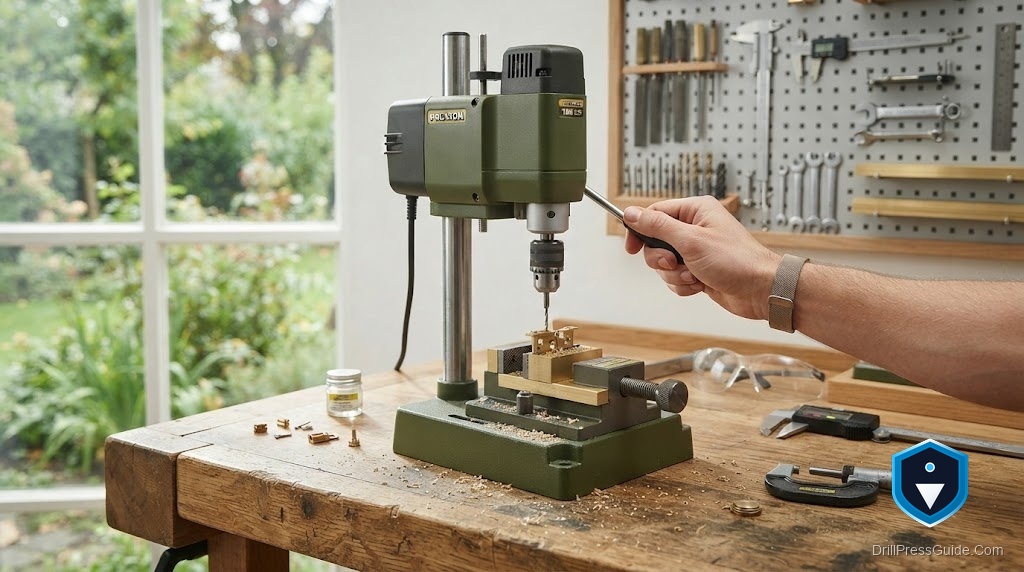
You are building a model airplane, setting stones in a jewelry piece, or drilling a circuit board for a prototype. The hole is a sixteenth of an inch wide, and your hand drill looks like a sledgehammer next to it. You need a machine that can hold a tiny bit, run at high speed, and stop at exactly the depth you set. A mini drill press is built for this. It is a scaled-down drilling machine with a small chuck, a fine feed, and a base that fits on a corner of your desk.
A mini drill press is a compact, benchtop drilling machine designed for small-scale work. It typically has a swing of 6 to 8 inches, a chuck that accepts bits down to 1/16 inch or smaller, and a motor that runs at high speeds suitable for delicate materials. Mini presses are not built for drilling through two-by-fours or steel plate, but they excel at model building, jewelry making, electronics, and any craft that requires repeatable, precise holes in small stock.
If you work with small parts, delicate materials, or tight tolerances, a mini drill press is a better tool than a full-size benchtop or floor model. The smaller chuck, finer depth control, and compact footprint make it easier to set up, easier to adjust, and less likely to destroy your work with too much torque or too little finesse.
What Makes a Mini Drill Press Different from a Standard Benchtop?
The chuck is the first difference. A standard benchtop drill press has a chuck that accepts bits from 1/16 inch up to 1/2 inch. A mini drill press has a smaller chuck, often with a collet system that accepts bits from 1/32 inch or smaller. This is essential for model building, jewelry, and electronics where a standard bit is too large and a standard chuck cannot grip it securely.
The speed is higher. Mini presses run at 5,000 to 10,000 RPM or more, which is ideal for small bits in soft materials like plastic, wood, and aluminum. A standard benchtop press tops out at 3,000 to 3,500 RPM, which is too slow for a 1/32 inch bit. At low speed, small bits grab and wander rather than cut cleanly. The high speed of a mini press solves this.
The depth stop is finer. A mini press has a threaded depth stop or a micro-adjustment collar that lets you set the depth in increments of a few thousandths of an inch. This is critical for jewelry settings, circuit board through-holes, and model parts where every millimeter matters. A standard benchtop press has a depth stop too, but it is usually coarser and harder to set precisely for shallow holes.
The footprint is smaller. A mini press sits on a desk or a small workbench without dominating the space. It is light enough to move when you need the desk for other work. A standard benchtop press needs a dedicated bench, bolted down, and takes up a permanent corner of your shop.
Three Mini Drill Presses That Handle Small Work
The WEN 4206T 8-Inch 5-Speed Benchtop Drill Press is the smallest machine I recommend for general workshop work, and it doubles as a mini press for larger small-scale projects. It has a 1/2 inch keyed chuck, five speeds from 750 to 3,200 RPM, and a 2-inch spindle travel. The 8-inch swing is enough for most model and craft work, and the cast iron head and base give it stability that plastic mini presses lack.
What keeps it from being a true mini press is the chuck size. The 1/2 inch chuck is great for standard bits but will not hold bits smaller than 1/16 inch without a reducing collet. The lowest speed is 750 RPM, which is too slow for very small bits in plastic or soft metal. For jewelry and electronics, you need a smaller chuck and higher speed. Skip the 4206T if your work is truly miniature. Buy it if you build models, small furniture, and hardware that uses standard bit sizes.
Buy the WEN 4206T Mini Drill Press on Amazon
The Dremel 220-01 WorkStation is the classic mini drilling and rotary workstation. It is built for Dremel rotary tools and accepts collets down to 1/32 inch. The speed is controlled by the rotary tool, which can run up to 35,000 RPM. The depth stop is adjustable, and the angle adjusts in 15-degree increments. The base is compact, lightweight, and clamps to your desk or bench.
The flaw is obvious: it only works with Dremel tools and Dremel accessories. You cannot chuck a standard drill bit, a Forstner bit, or a hole saw into it. The depth stop is adequate but not as precise as a threaded micro-adjustment. The base is light, so you need to clamp it for any work that requires pressure. For jewelry, model building, electronics, and small crafts, the 220-01 is excellent. For anything larger than a few inches, it is the wrong tool. Skip it unless you already own a compatible Dremel tool and your work stays in the small-scale realm.
Buy the Dremel 220-01 WorkStation on Amazon
The NovelLife Precision Mini Drill Press is a dedicated mini press with a 1/4 inch chuck, a 6-inch swing, and a high-speed motor that runs up to 10,000 RPM. The base is cast iron, the column is steel, and the depth stop is adjustable. It is designed for model building, jewelry, and small electronics work. The 1/4 inch chuck accepts standard bits down to 1/16 inch and collets for smaller sizes.
The honest flaw is the power and rigidity. A mini press with a 6-inch swing and a small motor is not built for heavy cuts or large bits. The column is short, the table is small, and the motor can bog down if you push too hard. The chuck is also smaller than a standard benchtop, so you are limited in bit size and material thickness. For light, precise work in small stock, the NovelLife is a good tool. For hardwood, thick metal, or production work, buy a larger machine.
Buy the NovelLife Precision Mini Drill Press on Amazon
What to Check Before You Buy a Mini Drill Press
Chuck size and collet compatibility are the first checks. If you work with bits smaller than 1/16 inch, you need a chuck or collet that can grip them. A 1/4 inch chuck with a set of reducing collets is the minimum. A dedicated collet system like the Dremel is better for very small bits. Check the collet sizes before you buy.
Speed range is critical for small bits. A bit that is 1/32 inch in diameter needs to run at 5,000 RPM or higher to cut cleanly. At 1,000 RPM, it will grab, wander, and break. Look for a mini press with a top speed of at least 5,000 RPM. If the press is a standard benchtop with a low top speed, it is not suitable for miniature work.
Depth stop precision matters for shallow, repeatable holes. A threaded micro-adjustment stop is better than a sliding collar. Check how fine the adjustment is. A stop that moves in 1/16 inch increments is too coarse for jewelry and electronics. You need increments of 1/32 inch or smaller.
Table size and stability are often overlooked. A small table is fine for small work, but it needs to be flat and rigid. A tilting table is useful for angled holes in models and jewelry. Check whether the table has pre-drilled holes for clamps or fixtures. Small work is hard to hold by hand, so clamps and jigs are essential.
Finally, check the motor and base. A mini press should be quiet and smooth. Vibration is the enemy of precision. A cast iron base is better than a plastic or aluminum base for damping vibration. The motor should be a high-speed, low-torque type. A high-torque motor is unnecessary for small bits and may grab or break them.
Comparison: Three Mini Drill Presses for Different Crafts
| Feature | WEN 4206T | Dremel 220-01 | NovelLife Precision |
|---|---|---|---|
| Type | Benchtop / mini | Rotary workstation | Mini drill press |
| Swing | 8 inches | N/A (rotary tool) | 6 inches |
| Chuck | 1/2 inch keyed | Dremel collet | 1/4 inch |
| Speed range | 750 to 3200 RPM | Up to 35,000 RPM | Up to 10,000 RPM |
| Depth stop | Threaded | Adjustable collar | Adjustable |
| Best for | Models, small furniture | Jewelry, electronics, crafts | Models, jewelry, electronics |
| Honest flaw | Standard chuck too large for tiny bits | Only works with Dremel tools | Limited power and rigidity |
Who Should Skip a Mini Drill Press?
If you build furniture, work with thick stock, or drill large holes, a mini drill press is the wrong tool. The small chuck, high speed, and light frame are not built for heavy work. A standard benchtop or floor drill press is better for general woodworking and metalworking. Use the mini press for the delicate work and the big press for the heavy work.
Also, if you only drill occasional holes in walls, trim, or outdoor projects, a mini press is overkill. Buy a good hand drill and a set of sharp bits. The mini press is for people who need precision and repeatability in small work, not for people who need raw power.
Verdict and Takeaways
A mini drill press is a specialized tool for specialized work. The WEN 4206T is the best dual-purpose machine for a home shop that does both small and medium work. The Dremel 220-01 is the best choice for jewelry, electronics, and model building if you already own a Dremel tool. The NovelLife Precision Mini Drill Press is the best dedicated mini press for small-scale work that needs standard bits and a cast iron base.
Before you buy, measure your bits, check your materials, and be honest about your precision needs. A mini drill press will not make you a better craftsperson, but it will make your small holes cleaner, straighter, and more repeatable.
Frequently Asked Questions
What is the smallest bit a mini drill press can hold?
That depends on the chuck or collet. A standard 1/4 inch chuck can hold bits down to 1/16 inch with a reducing collet. A Dremel collet system can hold bits down to 1/32 inch or smaller. Check the chuck and collet sizes before you buy. If you work with bits smaller than 1/32 inch, you may need a dedicated precision drill or a rotary tool with the correct collet.
Can a mini drill press drill metal?
Yes, if the speed is high enough and the bit is sharp. Mini presses excel at drilling thin aluminum, brass, and soft steel. The high speed and small bit size create clean holes without grabbing. For thick steel or hard alloys, a standard benchtop or floor press with lower speed and more torque is better. The mini press is for delicate metal work, not heavy fabrication.
What is the difference between a mini drill press and a rotary tool?
A mini drill press is a fixed drilling machine. A rotary tool is a handheld power tool. The mini press holds the workpiece or the tool steady and moves the bit straight down. The rotary tool is handheld and freehand. A rotary tool workstation like the Dremel 220-01 bridges the gap by holding the rotary tool in a fixed position. For precision, the mini press or workstation is better. For flexibility, the handheld rotary tool is better.
How much does a good mini drill press cost?
Prices vary by brand and features. A basic mini press like the NovelLife is affordable for most hobbyists. A rotary workstation like the Dremel 220-01 is less expensive but requires a compatible tool. A benchtop like the WEN 4206T is more expensive but more versatile. Buy the machine that matches your bit sizes and your work, not the one with the most features.
Can I use a mini drill press for sanding or polishing?
Some mini presses accept sanding drums and flap wheels in the chuck. The Dremel 220-01 is explicitly designed for sanding, grinding, and polishing with rotary accessories. Just remember that lateral loads on a mini press are harder on the bearings and column than vertical drilling. Use light pressure and clean the chuck after abrasive work.
Do mini drill presses need to be bolted down?
A light mini press on a desk should be clamped or bolted to prevent shifting. A heavier mini press with a cast iron base is more stable but still benefits from clamping. Small work is hard to hold steady, so any movement of the machine will ruin the hole. Clamp the base to a solid surface before you start.
What is spindle travel and why does it matter on a mini press?
Spindle travel is the distance the chuck moves downward. On a mini press, 1 to 2 inches of travel is usually enough. More travel is better for thicker work, but mini presses are not built for thick stock. The depth stop is more important than the travel on a mini press, because most mini work involves shallow, precise holes rather than deep bores.
Can I use a mini drill press for woodworking?
Yes, for small woodworking projects. A mini press is excellent for drilling holes in model parts, small boxes, and jewelry that incorporates wood. For standard furniture and cabinetry, a standard benchtop or floor press is better. The mini press does not have the swing, the chuck capacity, or the power for large bits and thick stock.
References
- WEN Products. “WEN 4206T 2.3-Amp 8-Inch 5-Speed Cast Iron Benchtop Drill Press.” WEN Products Official Site. Accessed via manufacturer specifications.
- Dremel. “220-01 WorkStation.” Dremel Official Product Page. Accessed via manufacturer specifications.
- NovelLife. “Precision Mini Drill Press.” Amazon Product Listing. Accessed via verified product page.
- Occupational Safety and Health Administration (OSHA). “Drill Press Safety.” OSHA.gov. General safety guidance for drill press operation.


