PCB Drill Press: Match the Bit, Speed, and Support to the Job
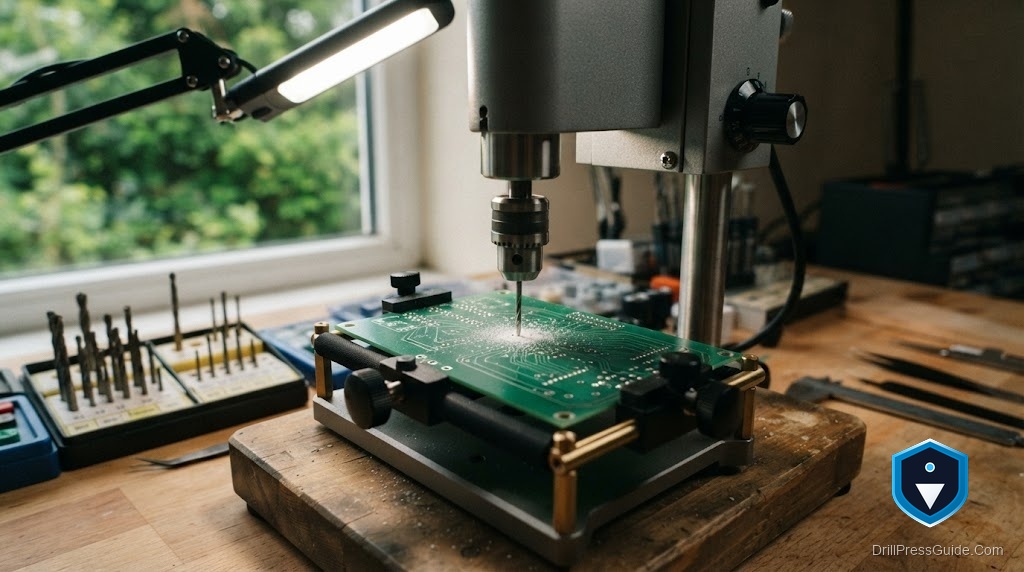
Drilling a printed circuit board looks trivial next to drilling steel, until you realize the holes are often smaller than a pencil lead, the bits are brittle tungsten carbide that snap if the board flexes a hair, and there can be hundreds of them on one board. A PCB drill press is a precision, high-speed, small-scale job, and the whole challenge is control: tiny bits, high RPM, and a board held dead flat so nothing wanders or breaks.
A PCB drill press is a small press used to drill the fine holes in printed circuit boards for component leads and vias, using tiny carbide bits at high speed with the board held flat and steady. Precision and rigidity at small scale matter far more than power.
The short answer: use a small press with a high top speed and minimal spindle runout, tiny tungsten-carbide PCB bits, and hold the board flat with backing underneath. Fragile carbide bits snap from flex and side load, so control, not force, is the goal.
Why PCB drilling is its own discipline
PCB holes are tiny, commonly a fraction of a millimeter to around one millimeter, and the fiberglass board is abrasive, which dulls ordinary bits fast. The work calls for carbide micro bits that stay sharp in fiberglass, and a press that runs fast and true, since runout or flex snaps a bit instantly.
That rules out a big, heavy, low-speed machine tuned for metal. A compact press with a high top speed, a small precise chuck or collet, and minimal spindle runout is what this work wants, essentially the opposite of a metalworking press.
Bits: tiny carbide, treated as consumable
PCB drilling uses tungsten carbide micro bits because fiberglass board abrades steel bits quickly, and carbide holds an edge. A set of tungsten carbide PCB micro drill bits covers the small sizes a board needs, and buying a set matters because these bits are brittle and break, so spares are not optional.
The honest reality is breakage. Even with good technique, carbide micro bits snap from the smallest side load or flex, so treat them as consumables and keep a range of sizes. That is the nature of the work, not a fault in the tooling.
Speed and a flat, backed board
Run fast. Small-diameter holes need high RPM to cut cleanly, so use the press’s top speed, and let the sharp carbide do the work with a light, straight plunge. Feed straight down with no side movement, since the least sideways nudge breaks a micro bit.
Support is everything. Back the PCB with a flat sacrificial board so the bit exits into material rather than air, and clamp or hold the board flat so it cannot flex or lift as the bit retracts. A board that flexes even slightly snaps the bit and can tear the copper pad. Flatness and backing are the two habits that save both bits and boards.
Workholding, dust, and safety
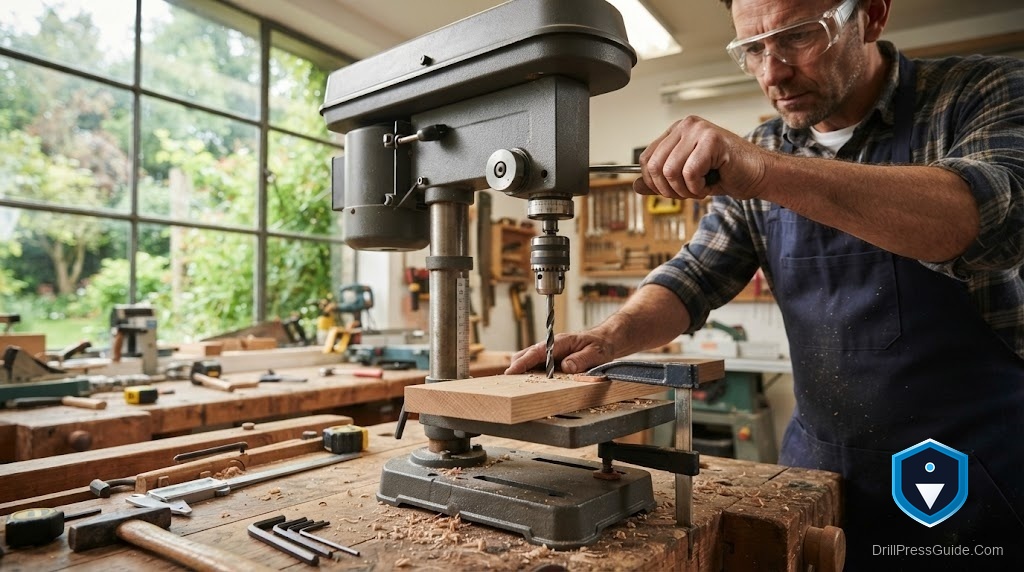
Hold the board flat against the table on its backer with clamps or a simple fixture, and keep the plunge purely vertical. Fiberglass dust is an irritant, so wear eye protection and a dust mask, and avoid breathing the dust. Keep fingers well clear of the fast-spinning bit, and let the spindle stop before clearing dust or repositioning the board.
A small vacuum or a damp wipe keeps the abrasive dust down, which is kinder to both your lungs and the machine.
The verdict
A PCB drill press is a precision, high-speed instrument for tiny holes, defined by fine carbide bits, high RPM, minimal runout, and a board held flat and backed. Power and mass are irrelevant; control and rigidity at small scale are everything. Use a compact high-speed press, treat carbide micro bits as consumables, back the board, and plunge straight, and clean PCB holes follow. The habit that saves the most bits is keeping the board dead flat, because flex and side load are what snap carbide every time.
Keep these in mind:
- PCB work needs a high-speed, low-runout small press, not a heavy metal machine.
- Use tungsten carbide micro bits and keep spares; they break easily.
- Run fast and plunge straight down with no side movement.
- Back the board and hold it flat; flex snaps bits and tears pads.
Frequently asked questions
Can I drill PCBs on a drill press? Yes, a small high-speed press with low runout drills PCBs well using tungsten carbide micro bits. Hold the board flat and backed, and plunge straight down.
What bits do I use for PCB drilling? Tungsten carbide micro bits, because fiberglass board quickly dulls steel. Buy a set with spares, since these brittle bits break easily.
What speed should I drill PCBs at? High. Small-diameter holes need high RPM to cut cleanly, so use the press’s top speed with a light, straight plunge.
Why do my PCB bits keep breaking? Usually board flex or side movement during the plunge. Back the board with scrap, clamp it flat, and feed straight down with no sideways force.
Do I need a special press for PCBs? Not a special one, but a compact press with high speed and minimal spindle runout works far better than a heavy, low-speed metal machine.
Is PCB dust dangerous? Fiberglass dust is an irritant to lungs, eyes, and skin. Wear eye protection and a dust mask, and keep the dust down with a vacuum or damp wipe.
References
- IPC, printed board design and fabrication standards: https://www.ipc.org/
- Occupational Safety and Health Administration, machine guarding: https://www.osha.gov/machine-guarding